You already ran the free scan. It gave you a score out of 100, a list of images to compress and something about render-blocking JavaScript. You fixed four of them. Nothing happened.
So what is a website audit, if it isn't that list? The short answer is that the list was never the audit. It was the part a machine can do.
A crawler is very good at the questions it can ask. It can't ask the one that usually matters, which after 100+ sites worked on over 12+ years is nearly always the same question.
Worth being precise about the difference before we go further: a scan is automated and tests the site against known technical rules. An audit is a person reading your site against your business. One returns a list and the other returns an order. Audits also come in scopes. A technical audit, an SEO audit, a UX audit and an accessibility audit are all real things. Each one is narrower than what follows. What I'm describing is the whole-business version. That's the one worth paying for when you don't yet know which layer the problem is in.
The Short Answer
A website audit is a read of your whole site as a system, in a fixed order. The site itself including the backend, then strategy, then the systems behind it. A free scan checks whether the pages work. An audit asks whether there was ever a plan behind them.
If You're Reading This Because It's Your Site
Reading more isn't the hard part. La Jugada is $47 and it tells you which layer this is actually sitting in.
Get it, $47What Is the Free Scan Actually Checking?
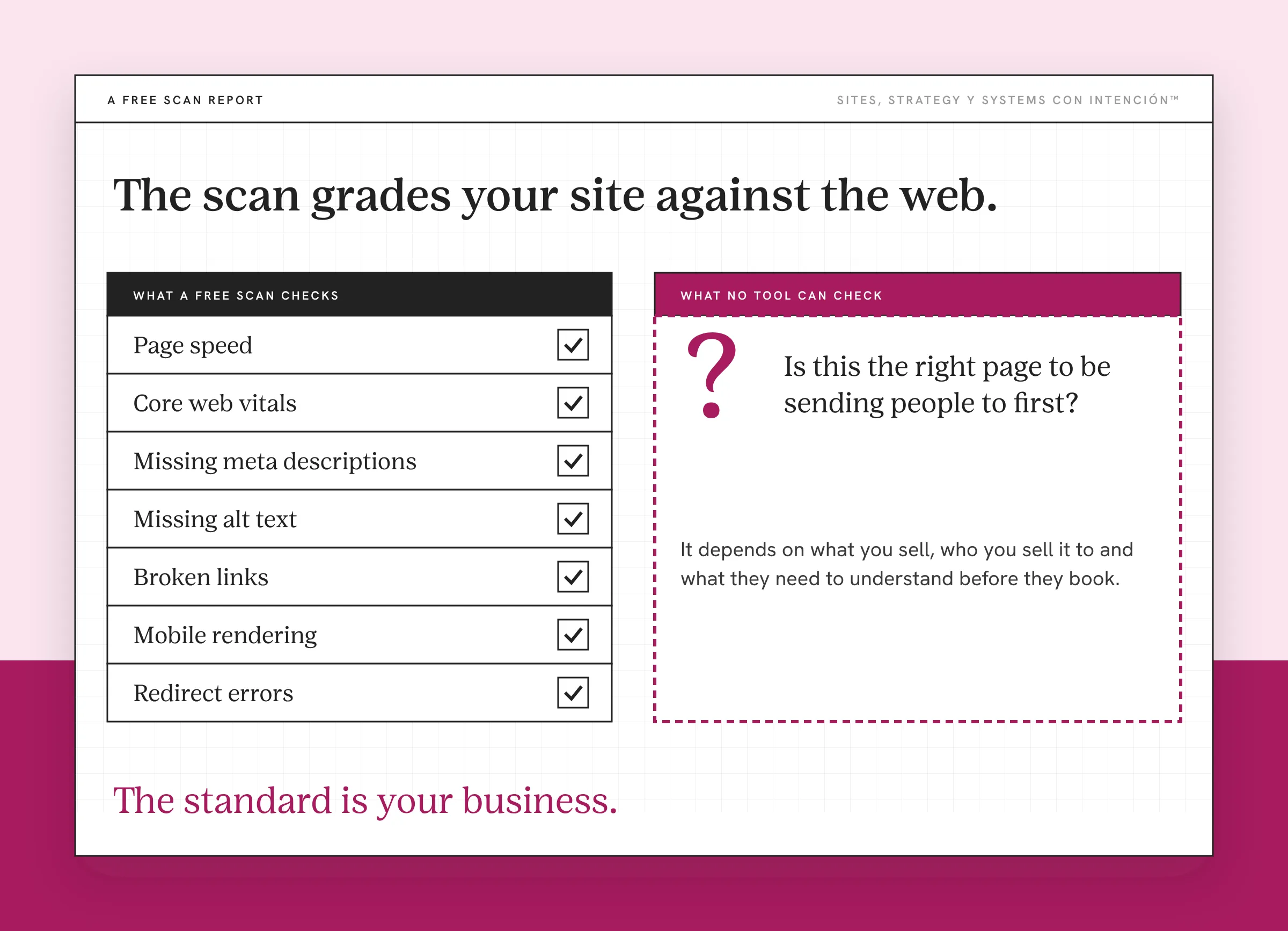
Run any of the free tools and you get roughly the same report. Page speed, core web vitals, missing meta descriptions and alt text. Broken links, mobile rendering, a handful of redirect errors.
All of that's real. Slow pages lose people. Broken links send people and crawlers to dead ends. Missing meta descriptions mean search engines build your preview from whatever's on the page with no summary from you to pick from. None of this is fake work.
It's just that every item on that list is a question with a known right answer. Is the page under three seconds, does the image have alt text, does the link resolve. A machine can check all of those because the standard exists independently of your business.
Now try to write the check for is this the right page to be sending people to first. There's no rule to test it against. The answer depends on what you sell, who you sell it to and what they need to understand before they'll book anything. Ninguna herramienta can run that check, because the standard is your business and the tool has never met it.
That's the whole gap. The scan grades your site against the web. An audit grades your site against your business.
What Is a Website Audit: The Three Layers, in the Order I Run Them
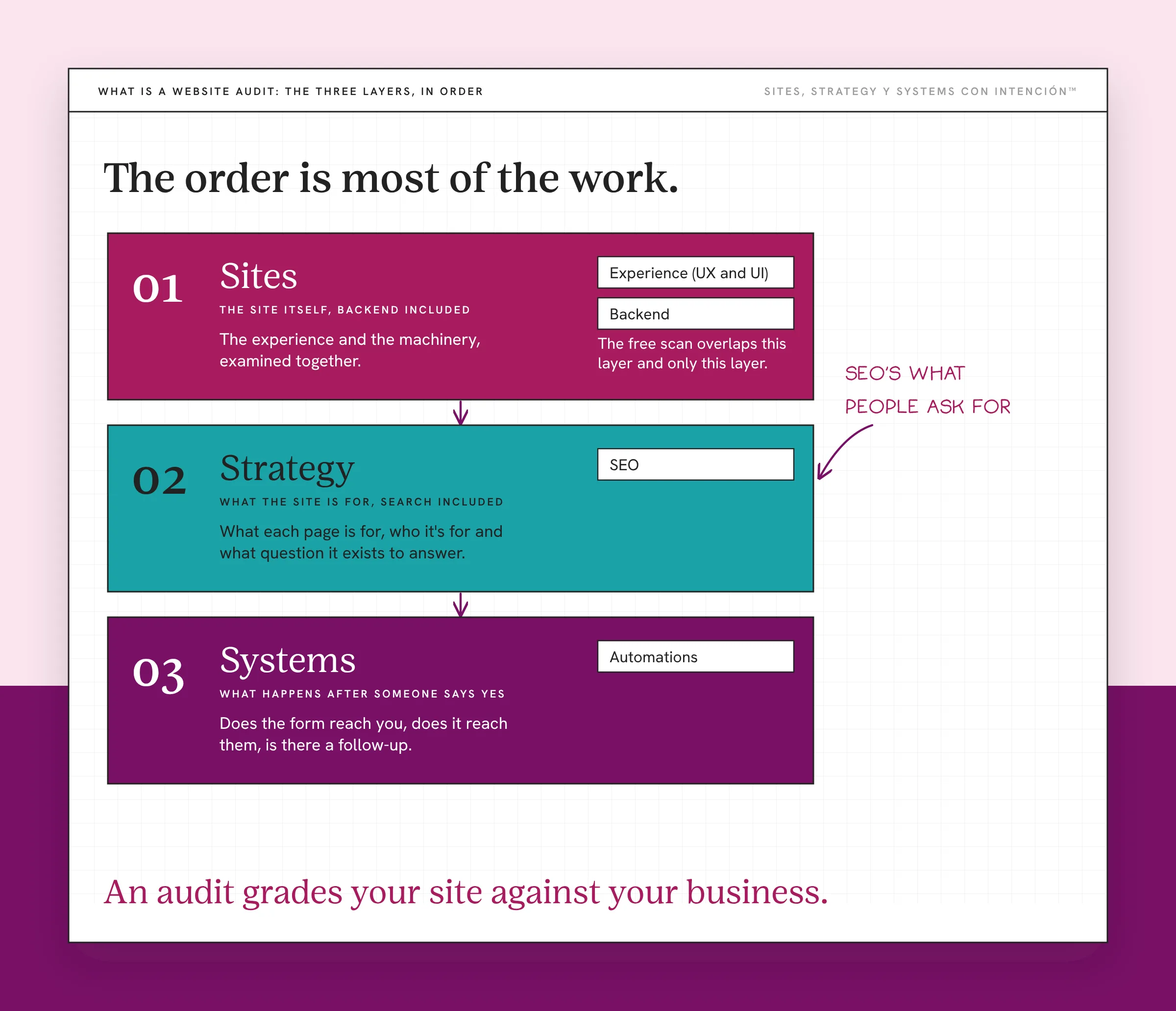
I usually look at the website first, UX and UI along with the backend. Then strategy, which is the SEO layer. Then automations, which is the systems layer.
Nobody turns on a burner before the mise en place is done. Everything prepped, in order, within reach, so the cooking part is the easy part. Skip it and you're dicing onions with a pan already smoking. Things burn while you're looking somewhere else.
An audit runs the same way and the order is most of the work. It's also not the order a lot of audits use. Plenty start with SEO because SEO's what people ask for. Starting there means you optimize the traffic flowing into a structure nobody has checked yet.
1. Sites: The Site Itself, Backend Included
This is the experience and the machinery, examined together rather than as two jobs.
The experience half: what a stranger meets, in what order, where they stall. Can someone tell within a few seconds what you do and who you do it for? Does the navigation match how they think about their problem? Or how you think about your services? Is trust asked for before it has been earned? Does the site still reflect your brand?
The backend half: how the site is really built. Page structure, how content is stored, what happens when you need to change something, whether the platform is fighting you. Speed and technical health live here too, which is why the free scan overlaps this layer and only this layer.
Treating these as one pass matters, because more experience problems have a backend constraint underneath them than founders expect. A page nobody can fix stays broken. An outdated website built around a version of the business you've outgrown usually can't be edited into the current one. That's a structural finding.
2. Strategy: What the Site Is For, Search Included
Only now does SEO come in. It arrives as the largest part of this layer rather than the whole of it. By this point the site's structure is known, so the read has something to attach to.
Strategy here means what each page is for, who it's for and what question it exists to answer. SEO is the part of that with a name. So this is keyword targeting. Whether the pages a search engine can see are the pages you'd want someone to land on. What Google Search Console says is getting impressions, against what is invisible. It's also whether the site says anything specific enough to rank at all, which is a positioning question before it's a search one.
3. Systems: What Happens After Someone Says Yes
The layer almost every audit skips. It's also the one founders are most surprised to see on the list.
Someone fills in your form. What happens next? Does it reach you reliably, does it reach them, is there a follow-up or does it depend on you remembering. Is the booking link the same link in four places. When you land a client, does the intake run itself or run through you?
A site can be beautiful and well-ranked and still leak at the handoff. Auditing the site without the systems behind it tells you why people aren't inquiring, never why the inquiries you do get go cold.
What Can a Scan Structurally Never See?
One finding I see over and over is one no crawler will ever report: there's no content strategy underneath the site.
The pages exist and they load and they pass every technical check. Nothing about the set of them was ever decided. Pages got added when they were needed, each one reasonable on its own. The result is a site that answers a slightly different question on every page and no question completely.
It usually shows up in the blog first, because the blog's where a missing plan is easiest to see. Sometimes it's twenty posts with no thread between them, each one fine alone. Sometimes it's a burst of posts that stopped a year ago. Sometimes the posts are good and there's still no route from any of them to anything you sell. Sometimes there's no blog at all, which tells you everything you know is living on calls instead of on the site. Different shapes, same finding. The sentence I end up saying outloud is siempre the same one: nobody decided what this was for.
A scan can't flag the absence of a plan, because absence has no error code. Everything present is fine. The problem is a thing that was never there. A tool that checks what exists will report a clean bill of health on a site with no spine. Créeme, this is the one that reframes the project. It's also why the audit comes before the redesign. Rebuild a site with no content strategy and you get a faster site with no content strategy. That spine is the part of website strategy no scan can check.
Why SEO and Messaging Turn Out to Be the Same Problem
Most founders arrive with two separate to-do lists, one marked SEO and one marked website messaging. Not all of it overlaps. Crawling, indexing and site speed are their own problems. But the content half of those two lists is usually one list. Both break for the same reason: the page isn't specific about what it answers, who it's for and why it deserves to exist.
Search engines read your site roughly the way a visitor does. Both are trying to work out what this page is about, who it's for and whether it answers the question that brought them. When the positioning hedges, when the copy speaks to four audiences at once, when nothing commits, a visitor can't place you. Neither can a crawler. Low visibility is often a messaging problem wearing an SEO costume.
Search Engine Journal's analysis of the content signals Google's quality rankings may rely on leans the same way. It argues for planning content around the reader's experience instead of exact-match keywords, though it admits keywords still matter. I'd put clear, human, jargon-free writing ahead of keyword-shaped writing. On the content layer, the quality that makes copy land is doing a lot of the work that makes a page rank.
Which is why fixing the website structure and the specificity of what each page is about moves discoverability and conversion at the same time. One fix, two problems. That combination is usually the cheapest line item in the whole report.
Why Founders Avoid the Audit They Already Know They Need
With the founders I talk to, time and money are rarely the whole reason. They have been suspecting something for months, usually because the signs they needed a redesign had already started showing up in how they behave around the site.
What stops a lot of founders is simpler. Ay bendito, once you know precisely what's wrong you can't unknow it. If the audit comes back saying the site is actively working against the business, that's a bigger conversation than a page refresh. Es esa incomodidad, the one that shows up every time you're embarrassed to send someone your link.
This isn't a character flaw and it's well documented. Harvard Business Review's write-up on information avoidance puts a number on it. People turned down useful information about a third of the time. That included feedback on their own performance and on their finances. The reason was mostly self-image. A website's a very public piece of self-image.
An audit hands you a map, hermana. It turns a vague dread into a list with an order on it, which is a much easier thing to carry around. And no, tranquila, you won't have to fix everything on it.

There's a second reason, less emotional and just as common: you're too close to it. You know what every section is supposed to mean, so you can't see the user experience a stranger gets. The distance between those two is usually the most valuable thing in the report.
What Do Founders Never Expect to Find?
One of the patterns I see most often is that the problem isn't where they thought it was.
They come in certain it's the copy or the SEO. What the audit surfaces is that the entry point is wrong. Or the order is. Or the services page is organized around what you deliver instead of what the client is deciding between. The information was all there. It was arranged for the wrong reader, the kind of problem a website restructure fixes. Aquí es donde se cae the original plan, usually in a good way, because the fix is smaller than a rebuild and it sits somewhere nobody had looked.
That's the difference between a list of fixes and a read of why a site that looks fine still isn't converting.
What Should a Website Audit Cost?
It depends on what's being audited and by whom. The honest range runs from free automated scans to a full strategic investigation across the site, the strategy and the systems. Narrow technical reviews sit in between. The number tracks the scope rather than the quality. Website redesign cost works the same way, which is why it's worth knowing the scope before anyone prices the fix.
The more useful question is what you're buying. Cheap doesn't mean bad. A narrow audit done well is worth its price. What isn't worth paying for, at any price, is a report that returns the same list the free tool already gave you, which is a classic website audit mistake. What you're paying for is the judgment. The order, the reasoning, someone saying which three things to do and which nine to leave alone.
Mine starts with a Strategic Cafecito from $350. Full audits are available and get quoted first. Details are below. Whoever you hire to do it, ask what the deliverable is before you book. If the answer is a report, ask what is in it besides the scan.
Key Takeaways
- A website audit is a read of your site as a system: the site and backend together, then strategy, then the systems behind it. A scan checks whether the pages work.
- The order matters. Starting with SEO optimizes traffic into a structure nobody has checked.
- The most common finding is the absence of a content strategy, which no crawler can report because absence has no error code.
- On the content layer, SEO problems and messaging problems are usually one problem, so the fix counts twice.
- Some founders put off an audit because once you know what's wrong, you can't unknow it.
I'd rather talk through what an audit would find on my site.
Bring your site, your numbers and the thing you already suspect to one private session on your real question. Notes are included. Sessions start at $350. Full audits are available and get quoted first.
Frequently Asked Questions
What is a website audit?
A review of your site as a system rather than as a list of pages. A complete one covers three layers. The site itself, including UX and the backend. The strategy layer where SEO and messaging sit. Then the systems layer that handles what happens after someone inquires. Automated scans cover part of the first layer only. The rest needs a person who knows your business.
What is the difference between a website audit and a free website scan?
A scan tests your site against known technical standards: speed, alt text, broken links, mobile rendering. Those standards exist independently of your business, which is why software can check them. An audit tests your site against your business. Do the pages, the order and the positioning fit what you sell and who you sell it to? No tool can run that check.
How much does a website audit cost?
Anywhere from free to several thousand dollars. Automated scans cost nothing. A narrow technical review costs less than a full strategic investigation across the site, the strategy and the systems. With me, it starts with a Strategic Cafecito from $350. Full audits are available and get quoted first. Ask what the deliverable is before you book, because price tells you much less than scope does.
What is a website audit checklist?
The technical items a scan covers. Page speed and core web vitals, title tags and meta descriptions, heading structure and internal links. Broken links, redirects, mobile responsiveness. A checklist is a useful inventory of technical gaps. It can't tell you whether the site's structure supports the decision you need a visitor to make.
How often should I audit my website?
Any time the business changes meaningfully: new offers, refined positioning, a shift in who you serve, a change in pricing. Outside of that, once a year is the baseline I would recommend. Sooner if conversion or traffic moves in a way you can't explain.
Do I need an audit before a redesign?
Before a significant one, I would. Not before every visual refresh. The audit tells you what is structurally wrong, which is what the redesign needs to fix. Redesigning first is how people end up with a new-looking site carrying the same conversion problem and no idea why the numbers didn't move.
What happens after a website audit? Do I have to fix everything?
No. A good audit tells you not to. The output should be ordered by what is costing you now: which problems can wait, which are fine as they are. If the report is a flat list with no priority on it, you've been given homework rather than a diagnosis.
About the Author