
You have a number for what fixing the website would cost. You don't have one for what leaving it costs, which is how it keeps winning the argument every quarter.
It also doesn't feel like it's costing anything. Clients still come and referrals still land. Nothing has visibly broken, so the site moves to next quarter. Then the one after that.
Most advice about an outdated website starts with a list of signs that yours is one. Signs are the easy part, eso lo sabemos. I've worked on 100+ service business websites over 12+ years and spotting an old site has never been the difficult thing. The difficult thing is that the real costs never arrive as a bill. They arrive distributed, across your calendar and your inbox and inside the pause a referral partner takes before sharing your link.
Picture The Challenge on MTV rolling an intro full of people who stopped competing years ago. Nobody whose job it is noticed, so it rolls every season anyway. Nothing about it is broken. It just isn't true anymore.
Outdated here means behind your business, not behind design trends. A site can look completely current and still be describing work you stopped taking two years ago. The trigger is the gap, which is why how often you should redesign has no number for an answer.
The Short Answer
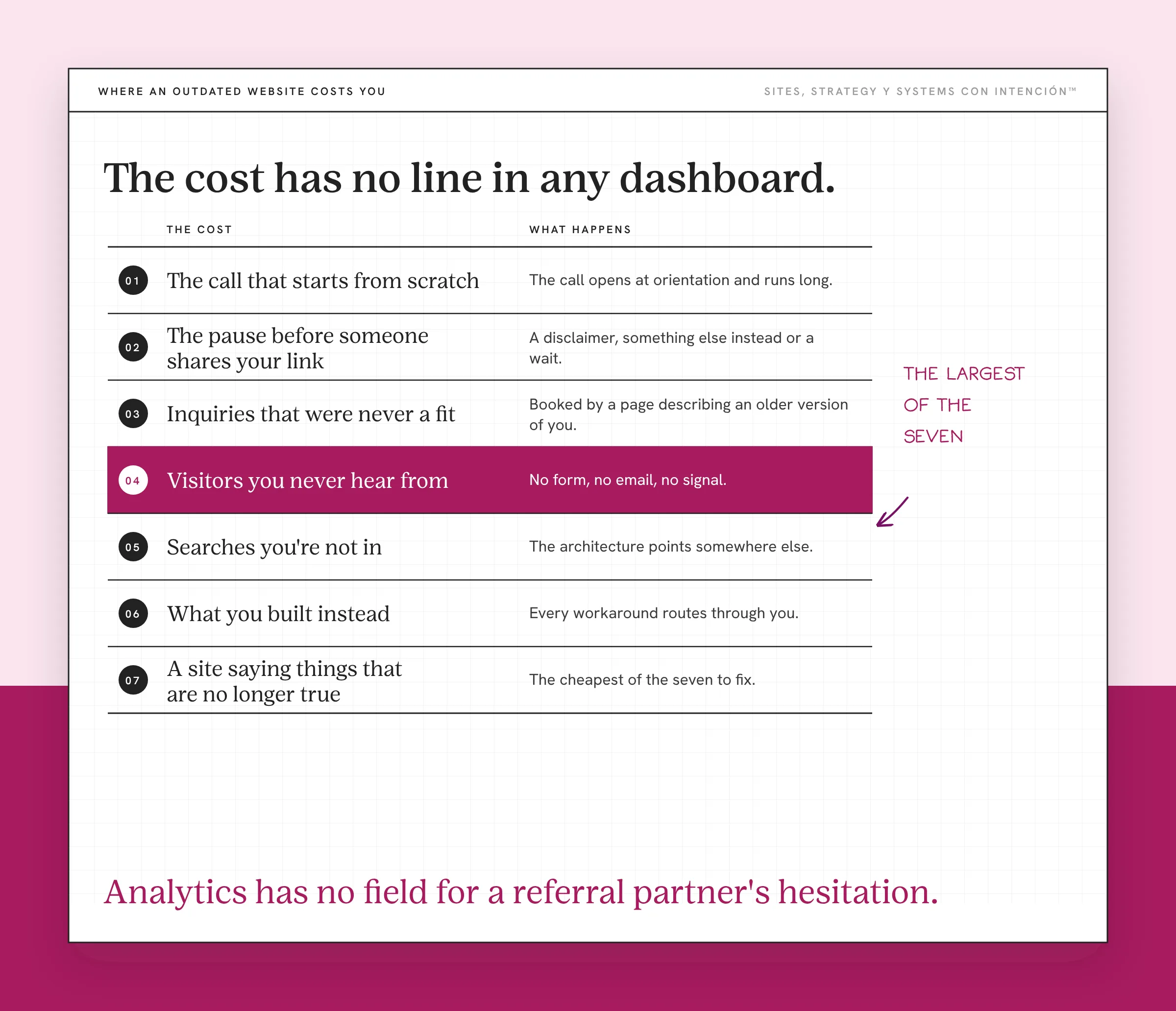
An outdated website can cost you in seven places. None of them show up in a report: longer discovery calls, referral partners who hesitate, inquiries that were never a fit, visitors you never learn about, searches you aren't in, the workarounds you built instead and a site telling people things that are no longer true.
If You're Reading This Because It's Your Site
Reading more isn't the hard part. La Jugada is $47 and it tells you which layer this is actually sitting in.
Get it, $47Why Does None of This Show Up in a Report?
Every cost below has the same property. It's real, it's recurring and there's no line in any dashboard where it appears.
Analytics can tell you how many people arrived. It can't tell you how many of them would have inquired if the services page had made sense. It has no field for a referral partner's hesitation. It doesn't log the twenty minutes you spent on a call explaining something a page should have explained. Nothing in your reporting knows what a warm lead thought before they closed the tab.
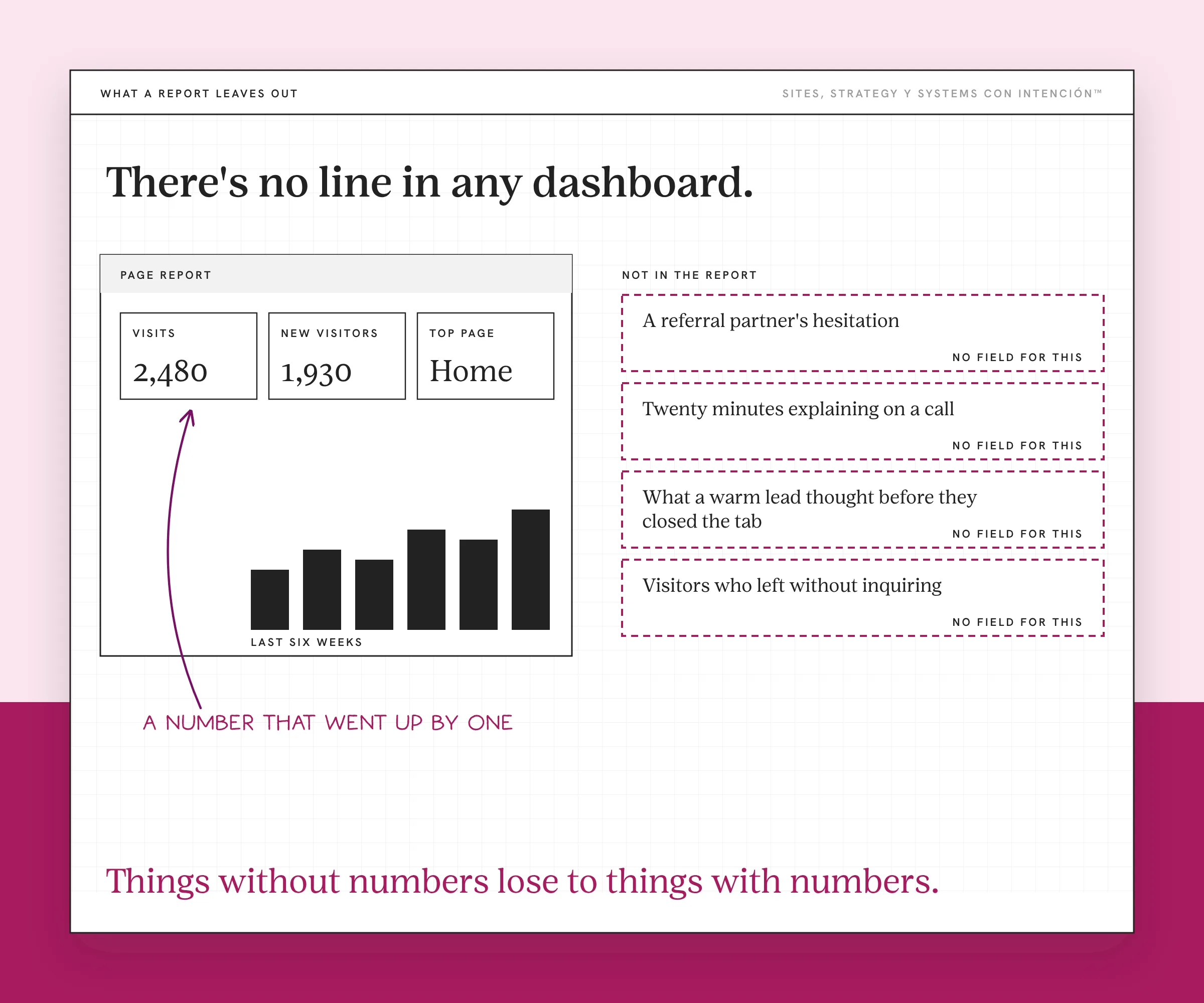
So the site sits in the category of things that aren't urgent, next to everything else you're carrying. It stays there. Not because you decided it didn't matter. Because there was never a number attached to it. Things without numbers lose to things with numbers every single time.
That invisibility is the mechanism. It's also why this compounds instead of resolving: a cost you can't measure never gets prioritized, so it runs for years at whatever rate it happens to be running at. If you've ever wondered why a site that looks fine still isn't converting, this is usually where the answer starts. Vamos por partes. Seven places, starting with the one that hides best.
What Does the Call That Starts From Scratch Cost?
When a website has done its job, the person who books has already read the positioning, understood the offer structure and decided they trust you enough to spend the time. The call opens at the real question.
When the site hasn't done that work, the call opens at orientation. What you do, who it's for, what the process looks like, what happens after they say yes.
It can vary. But when someone arrives with a pile of questions your site should have already answered, that call runs long. Time how far over your own calls run and multiply it by how many you take a month, because the figure it produces is usually the moment this stops being abstract.
There's a quality cost sitting underneath the time cost. By the time you reach the part that matters, their situation and whether this is the right fit, you've both spent your good attention on context-setting. And some of those calls end in a no that a clear services page would have produced in ninety seconds without either of you booking anything.
The Pause Before Someone Shares Your Link
Before anyone refers you, they run a fast and mostly unconscious calculation: is this going to reflect well on me?
A referral is a credibility transfer. In Nielsen's 2015 Global Trust in Advertising report, recommendations from friends and family topped the list, with 83% of global respondents trusting them completely or somewhat. The person sending a referral is staking their own standing on what happens when their contact lands on your site. Referred leads close faster and with less convincing than any other source I've seen, which is exactly why this one is expensive.
In the pause before they share, one of three things happens. They send it with a disclaimer, which is "their site is a little outdated but they're incredible." They send something else instead. Or they decide to wait until they think of someone who is a better fit, which is the version you'll never hear about. Aquí entre tú y yo, that last one is the real cost. You don't lose a client. You lose a referral partner's confidence that sending someone your way produces a good experience. That isn't a thing you can watch leave.
The Inquiries That Were Never Going to Be a Fit
A site that's behind the business attracts people who wanted the business you used to be.
Every one of those inquiries costs a real response. You read it, you write back, maybe you take a call. Somewhere in there you work out that they wanted a different scope or a different budget or a service you stopped offering. Nothing about that exchange was anybody's fault. It was booked by a page describing an older version of you.
In what I've seen, a smaller number of well-aligned inquiries outperforms a higher volume of misaligned ones on close rate and on time-to-close. La cosa es que an inquiry volume you feel decent about can be a cost rather than a result.
What Does an Outdated Website Cost in Visitors You Never Hear From?
This is the one where nothing measurable happens at all. That's the entire problem.
They found you and they landed. They read enough to form an impression, then left without inquiring. You never learn they were there. No form, no email, no signal. They're one number inside a traffic count that went up by one this month.
There's no version of this you can investigate after the fact. You can't follow up with them, because you don't know they exist. You can't A/B test your way to them, because they're already gone. Everything you might learn about what makes a high-converting page has to be worked out before they arrive rather than after. No te voy a endulzar esto: this may well be the largest of the seven and it's the one you have the least direct evidence for. That combination is what makes an outdated site feel survivable for years.
Which Searches Are You Not In?
An old site doesn't only underperform with the people who reach it. It also limits how many reach it.
Structure is usually the culprit. A site built around how the business was organized three years ago no longer matches how people search for what you now do. The pages exist, the service is real and the architecture points somewhere else.
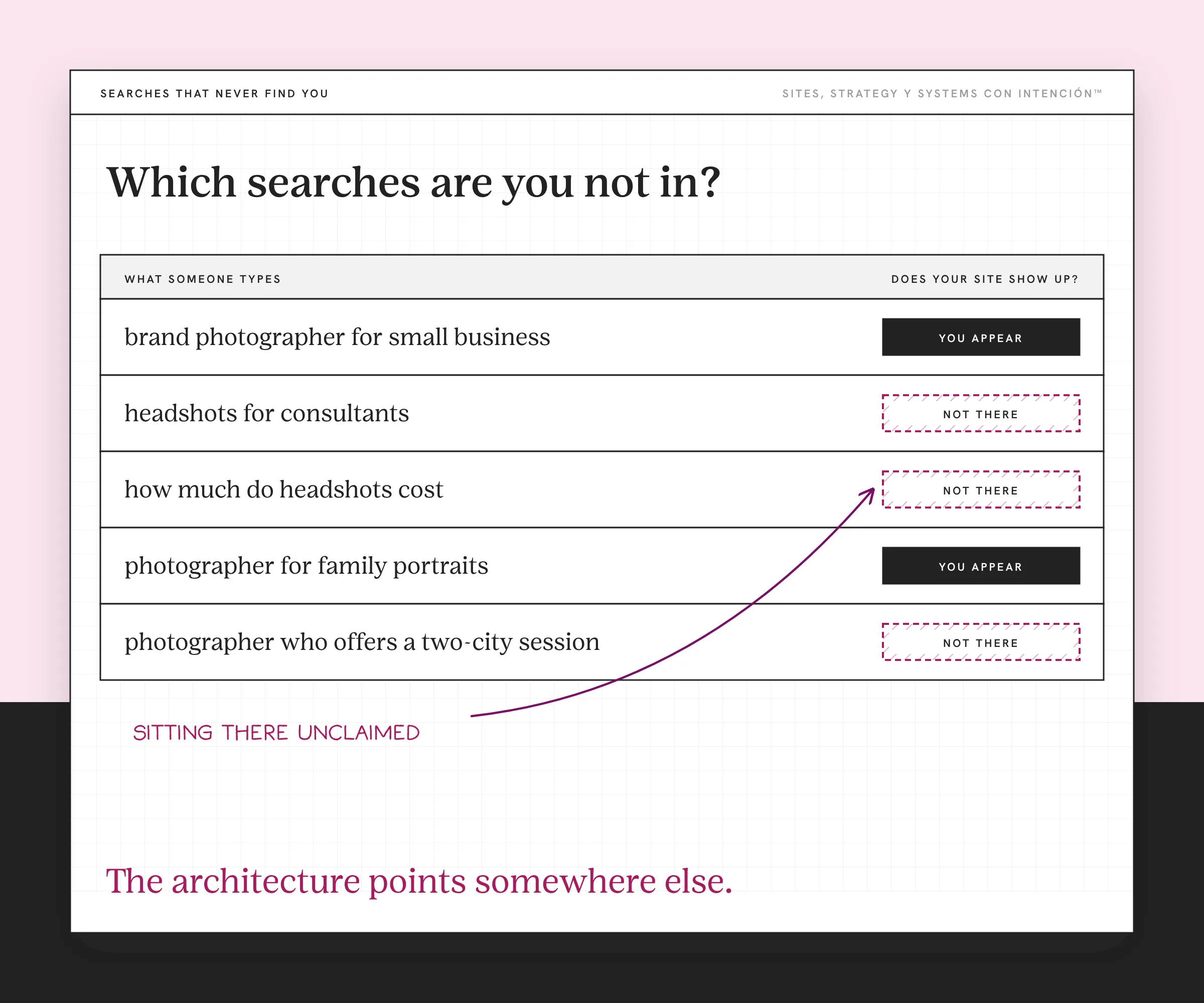
The photographer SEO case study is the cleanest version of this I can point to publicly: a photographer serving two markets with a site whose structure had stopped matching how people were searching. Comparing the three months before the structural work with the three months after, organic sessions from Google went from 63 to 258, a 310% increase. Her target keyword moved from position 20 to 8.2.
Read that in reverse and you have the cost. Everything that arrived after the fix was available before it, sitting there unclaimed.
What Did You Build Instead?
This is the cost founders feel most and count least. It shows up as behavior rather than as a feeling.
You send the Instagram instead of the link to a website you're embarrassed by. You over-explain on calls to cover what the page didn't say. You leave the URL out of a bio or a pitch. You stop pitching at the level you're working at, because the site doesn't back up the claim. You quote lower than you should. You stop asking for referrals as often, without ever deciding to.
Every one of those is a workaround. Every workaround routes through you. That's the actual expense. When you're the thing compensating for the website, the business hasn't gained the capacity you thought you were buying when you built it. It's the same pattern as business owner burnout, where you run out of room while everything still depends on you. A site you'd rather replace with a social media profile is doing the opposite of holding weight.
If the site also doesn't reflect your brand and introduces a version of you that has expired, the workarounds stop being optional. They become the only way the business sounds like itself.
When the Site Is Saying Something That Is No Longer True
Separate from anything looking dated: plenty of sites are stating things that are factually no longer the case.
Testimonials from work you no longer do. A case study at a price point you've doubled since, a blog that stops in 2023, services listed that you retired, a phone number nobody answers. And a copyright year that tells every visitor when someone last cared.
One caution on that last one, since every list on this topic tells you to update the year. A new year in the footer doesn't make old content current. Google's own guidance on helpful content makes a related point about page dates: it asks whether you're changing the date of pages to make them seem fresh when the content hasn't substantially changed. So update the content. The year follows.
I've reviewed sites where the structure was completely solid and the content still described the business from two years ago. Está fuerte, because this is the cheapest of the seven to fix and one of the most expensive to leave. Nobody needs a redesign to update a testimonial. What it costs in the meantime is that your best current work is invisible and your weakest old work is on display.
Where to Start If This Is Your Site
Do the cheap things first, because several of these are an afternoon. Update the credibility points. Fix the contact details. Remove the services you no longer sell. Answer the three questions your discovery calls keep opening with, directly on the services page. None of that needs a redesign quote.
Then stop before the expensive part. Most of these costs run for years because you can't see which of them are happening on your site. That makes the obvious move, a full website rebuild, a guess with a large price tag attached. Seeing the costs first is the step website strategy adds before anyone quotes you a rebuild.
Some of the seven above are running on your site right now. Some aren't. Some of what looks like your website hurting your business will turn out to be an offer or a positioning problem the site is only reporting. Working out which is which is a different job from redesigning. It's worth doing in that order. If you want the shape of what that examination covers, here's what a real website audit looks at.
Key Takeaways
- The cost of an outdated website is invisible by design, which is why it runs for years.
- None of the seven costs appear in any report you run, so the site loses every prioritization argument to problems that have numbers.
- When someone arrives with questions your site should have answered, the call runs long. Time your own calls and multiply by your call volume.
- The largest cost may be the one with zero evidence: the visitor who read enough to decide, then left without inquiring.
- Outdated means behind your business. A current-looking site can still be describing work you stopped taking.
I'd rather talk it through before I pay for a rebuild.
Bring your site, your numbers and whatever's bugging you to one private session on your real question. It starts at $350 and includes notes. Full audits are available and get quoted first.
Frequently Asked Questions
Can an outdated website hurt my SEO?
Yes, usually through structure rather than age. Nothing penalizes a site for looking old. What limits you is architecture built around how the business was organized years ago, which no longer matches how people search for what you do now. Mobile compounds it, since Google's mobile-first indexing guidance states it uses the mobile version of a site's content for indexing and ranking. Your pages can all exist and still point the wrong way.
How often should a website be updated?
The content should be updated whenever the business changes, which is more often than it sounds and cheaper than it sounds. Structural work is a different rhythm and depends on whether your offers, audience or positioning have moved rather than on how many months have passed. A three-year-old site describing current work is fine. A one-year-old site describing last year's offers isn't.
How do I know if my website is too outdated to keep using?
Ask what it's costing. If your calls open with questions the site should have answered, if referral partners hesitate, if the inquiries arriving are the wrong fit, the site is already charging you. Age on its own isn't the test. Whether the site still matches the business is.
What is the difference between a redesign and a rebuild?
A redesign changes what the site looks like and says. A rebuild changes how it's built and structured underneath. They solve different problems and cost very different amounts. Picking the wrong one is one of the more expensive mistakes available here. The full comparison of website redesign vs rebuild is its own conversation.
Do I need a full rebuild to fix this?
Not necessarily. Assuming you do is how people pay for a full rebuild to solve a problem three targeted fixes would have handled. Several of the seven costs are content updates. Others are structural but narrow. A rebuild is the right call when the underlying architecture can't support the business, which is less often than the sales pitch for a rebuild suggests.
Why doesn't any of this show up in my analytics?
Because analytics measures arrivals and events. All seven of these costs happen in places it can't reach: a call that ran long, a referral that was never made, an inquiry that was the wrong fit, a visitor who left without a trace. You'd need the counterfactual, which no tool provides. That gap is exactly why the cost persists.
About the Author