

By Kristine Gonzalez, website strategist, 12+ years and 100+ sites worked on across sites, strategy y systems
There's a sentence you say right before you send someone your site. You've probably never noticed that you say it.
"Don't look at it."
"I need to update that."
"It's a little outdated, I'm working on it."
"Just ignore the homepage, the services page is better."
I've watched that happen to clients, to friends and to myself, which is the only reason I know what the sentence is doing. If you've ever thought I'm embarrassed by my website, one of those came out of your mouth in the last month. In a DM or outloud in a room while you were still typing the URL.
A friend gave me the bluntest version of it. She couldn't send anyone to her site right now.
Nothing was on fire and nobody was calling her out. The business was running and clients were arriving through referrals and warm intros and people who already knew her work. She just had a site she wouldn't point at.
The Short Answer
The caveat you attach to your own link is a diagnosis you already made. It points at a page. Sometimes it names the problem and sometimes it only gestures at it. Either way it's the most specific site feedback you'll ever get for free. Writing it down turns months of vague embarrassment into a list you can finish.
If You're Reading This Because It's Your Site
Reading more isn't the hard part. La Jugada is $47 and it tells you which layer this is actually sitting in.
Get it, $47What Is the Caveat Actually Doing?
Look at who receives it.
You're handing your link to the one person you most wanted to impress, at the exact moment they decided to look you up. The first thing you give them is a warning about the thing you paid to build. The disclaimer arrives before the site does.
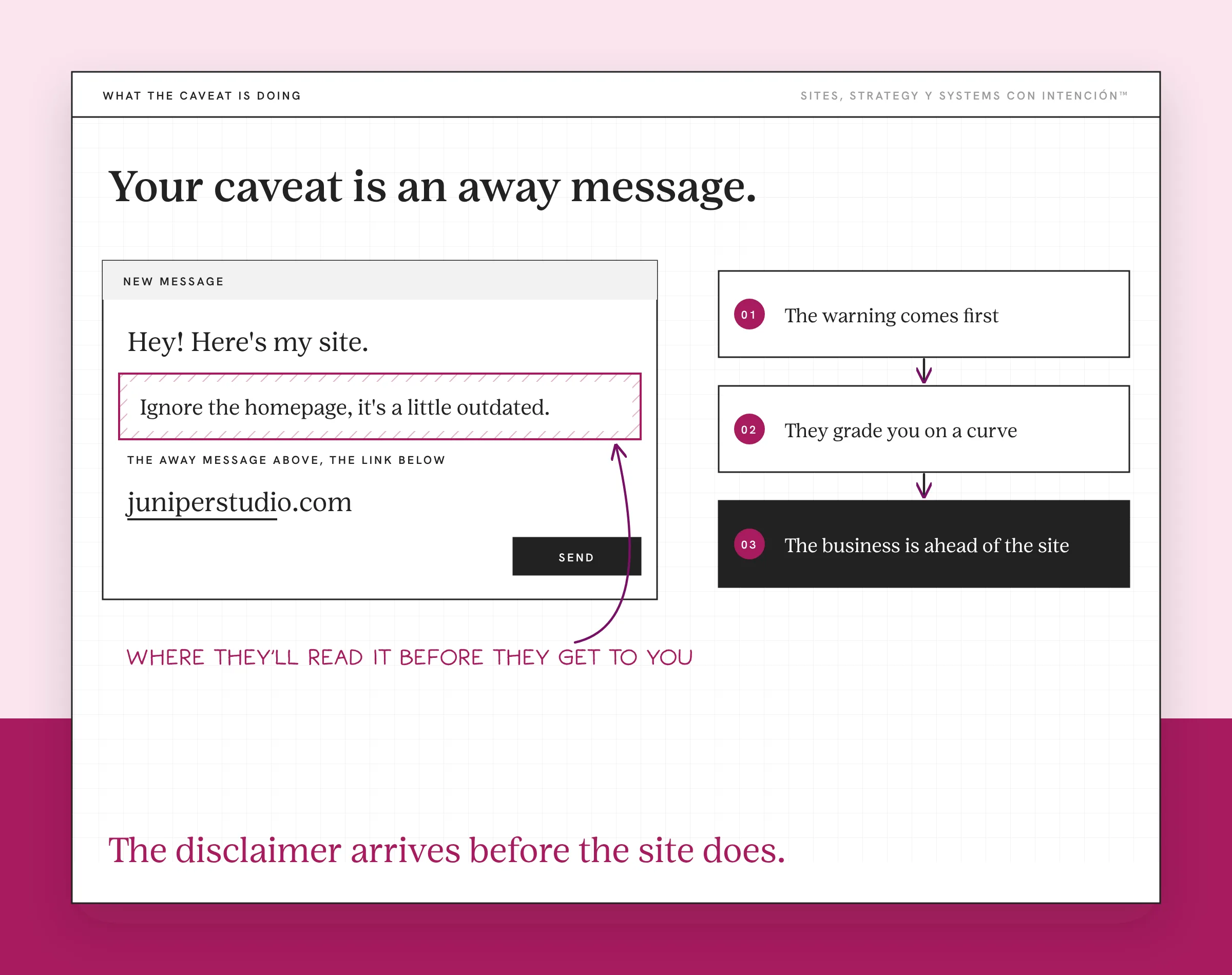
It's an away message. You're posting the excuse where they'll read it before they get to you, so they'll grade you on a curve.
And ay bendito, it works. That's the part that keeps it going. Saying "ignore the homepage" tries to buy you a softer read. They may nod, click anyway and read it a little more generously than they would have cold. You bought yourself a little grace and it cost you almost nothing.
Almost. The caveat also tells them, accurately, that the business is ahead of the thing representing it. You've introduced doubt before they had a chance to form their own impression.
This isn't only about vanity. You might well care how it looks and looking credible is a commercial concern, the subject of Stanford's web credibility guidelines. But listen to what you're apologizing for. You'll often find it's what the site says or what it never got around to saying. The font is rarely the thing. What the site says is a harder problem to fix with a new template.
Why Has Nothing Forced You to Fix It Yet?
Maybe something eventually will. Waiting for it isn't a strategy.
There's a story we tell about this, that the hiding works until something breaks it. A podcast host asks for your URL. A speaking gig Googles you. You raise your prices and suddenly the site has to carry weight it never carried before and you start asking whether your website is hurting your business.
It sounds right. In my experience that mostly isn't what happens.
I rebuilt my own site this year and no forcing event showed up. What happened was slower and less flattering than that. I got tired of the caveat. I got tired of it not reflecting my brand or the business I was running. I got tired of it not ranking the way I wanted, which I could see in Search Console every time I opened it. And I got tired of not putting in for my own site the due diligence I put in for every client who pays me.
That last one stung, punto. It's also why I can tell you what the sentence means.
Nobody's scheduled to make you take the away message down. There's no deadline on this, which is exactly why it sits untouched while every other part of the business moves. Same shape as a backend that hasn't kept up: never urgent enough to interrupt the week, never resolved enough to stop costing you.
So the honest read is that you shouldn't count on it. You can decide to be tired now instead of in eighteen months.
What Does It Cost to Keep Apologizing?
The obvious cost is the impression and that one's small. The cost that matters is quieter and it takes a while to see.
You stop sending the link. Not as a decision, more as a drift. You lean harder on referrals, on warm intros, on DMs. Any route where someone vouches for you before the site gets involved. Those routes work. They work so well that the site never gets tested, which means it never gets fixed, which means you lean harder on the routes that work.

And every one of those routes needs you in the room, which is how burnout as a business owner starts.
So you've started routing around the asset that was built to represent the business. The stall that isn't personal often looks like this from the inside: a site that could have carried some of that and never got the chance to.
How Do I Stop Apologizing for My Own Link?
Write the caveat down.
That's the whole move and it takes ten minutes. Next time you're about to send your site, catch the sentence before it leaves your mouth. Write it in a note, in the exact words you would've used outloud.
Now read your own away message back and treat it as a work order.
"It's a little outdated" is a mood and it gives you nothing. Push on it until it turns specific:
- Which page were you apologizing for? Look at the sentences at the top of this post. Almost all of them point at a page. "Ignore the homepage" is a homepage problem. That distinction is worth about three weeks of avoidance.
- What's out of date on it? An offer you stopped selling. A price that moved. A description of who you work with that stopped being true two client types ago.
- Would a stranger notice this at all? Some of it is only visible to you because you built it, which is why it's hard to review your own website objectively. That goes to the bottom of the list unless you can connect it to something a visitor would hit.
What comes out is a list instead of a feeling. Where the list is about things that aren't true anymore, the fix is removal. That's the good news nobody tells you. Taking down what's no longer true is faster than making something new and it fixes more of what your site's messaging should have already said than a redesign would.
If more than one thing comes out, start with whatever is both visible to a stranger and commercially wrong. An old photo of you is probably lower priority than a service you're still selling wrong, de verdad. That one costs you the wrong inquiries and the calls that come with them.
That list is your audit, nena. You've been carrying it around in your mouth for a year.
What If the Caveat Is Right and the Site Really Is Bad?
Sometimes it is. Other times you haven't looked in months and you're arguing with a memory of your own homepage.
You built it. You know every compromise in it, everything you meant to come back to, every section you shipped half-finished because launching mattered more that week. Nobody arriving from a search result carries any of that. They see a page, not a list of everything it isn't.
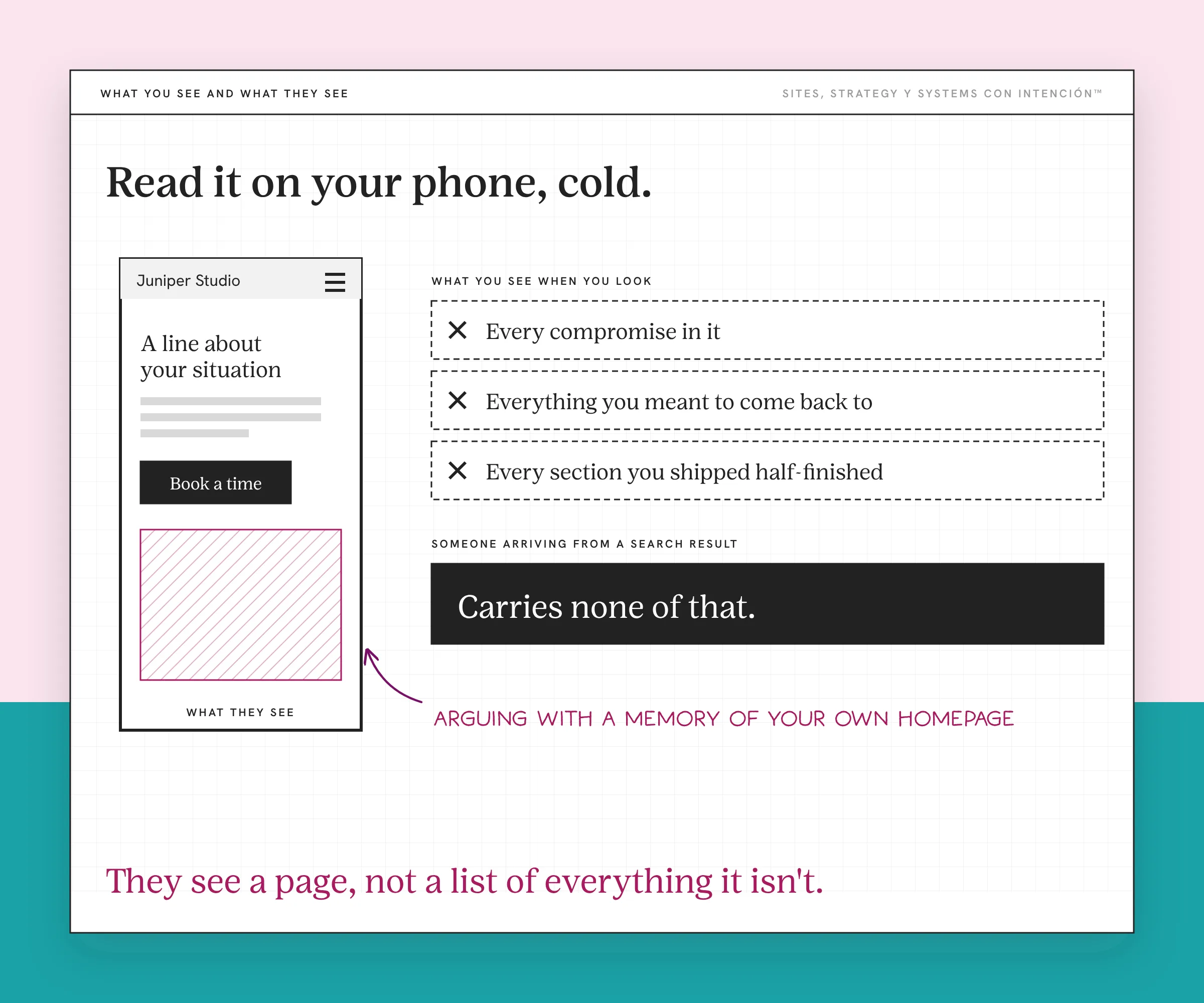
So before you price out a website redesign, go look. Read it on your phone, cold, the way someone else would. Pew Research's mobile fact sheet puts smartphone ownership at 91% of U.S. adults.
Then watch the reflex that follows, because the usual response to feeling bad about a site is to add más:
- More copy
- Another page
- New photos
- A different color on the button
If your caveat pointed at something structural, that's tweaking the surface while the foundation stays where it is. It's how founders who pick a redesign when they needed a rebuild end up with a prettier version of the same problem six months and several thousand dollars later. If it pointed at one outdated page, a copy update might be the whole job. Matching the fix to the actual problem is half of website strategy.
None of that is laziness. You're a founder who's done explaining yourself and doesn't have the bandwidth to fix the thing that should be doing the explaining for you. Which is fair, tranquila. It's also the loop and loops don't open on their own.
If the list you wrote down is short, do the list. If it's long and structural, a structural website audit will tell you which one you're looking at faster than another month of vague dread will.
Key Takeaways
- The sentence you attach to your own link is a diagnosis you already started and never wrote down.
- The caveat is a confession delivered to a qualified lead at the exact moment they decided to look you up.
- Don't count on a forcing event. Nothing external is scheduled to make you fix this, which is why founders sit in it for years.
- The cost that matters is that you stop sending the link, so you lean on routes that need you personally in the room.
- Write the caveat down and push it until it names a page and a specific thing. Much of what comes out is removal.
I apologize every time I share my link. Where do I start?
Before you rebuild anything, take La Digital Rueda. It's free and takes about two minutes. It asks a few questions about your site, your content and your backend. Then it shows you where the pressure is.
Want more like this in your inbox? Off the Clock is my week-ish newsletter about websites, systems and burnout-free business.
Frequently Asked Questions
Why do I hate looking at my own website?
One reason founders judge their own sites harshly is that they can see every compromise in it. You know what you meant to come back to and what you shipped half-finished to get it live. A stranger sees a page. You see a list of everything it isn't, which means you're evaluating it with context they don't have.
Is it normal to be embarrassed by your website?
Common enough that it has a name. Website shame gets discussed as a feeling, but the useful part is that it shows up attached to a specific sentence. The ones at the top of this post probably sounded familiar. What's worth noticing is how often the phrase is already specific. Plenty of founders say ignore the homepage or the services page is better, which means they already know where the problem is. Even a vague apology can often be pushed toward something that specific.
How do I know if my website is actually bad or if I'm being too hard on myself?
Go read it on your phone the way a stranger would, cold, without the context you carry. Then split what you find into two piles. Things only you can see because you built it. Things any first-time visitor would notice. The first pile is lower priority unless it maps to something a visitor would hit. The second pile is your list. It's whatever survives after you subtract what only you can see.
Should I stop sending my link until the site is fixed?
No. That instinct is the expensive part. Every month you route around the site is a month it doesn't get tested or improved. Worse, the routes you use instead all depend on you being personally available to vouch, so the site never gets to carry any of it. Send the link with the caveat if you have to. Then write the caveat down and fix what it names.
What if I can't explain exactly what's wrong with my website?
Then the caveat is doing you a favor by being vague, because vagueness is itself a clue. If you can't name a page, that's a clue the problem isn't living on one page. Try answering three questions instead: can a stranger tell what you sell, can they tell it's for them, can they tell what to do next. Wherever the no lands tells you which layer to investigate first. Any one of them could turn out to be copy or positioning or the offer itself. Knowing which layer to open beats redoing all three.
What do I fix first when the whole site feels wrong?
Start where your caveat points. If the sentence you say is "ignore the homepage," the homepage is the first place to look. If it's "the services page is better," that's a strong clue the rest of the journey needs attention before the services page does. Where two things come out, fix what's commercially wrong before what's merely dated. That sentence has been pointing somewhere for months. Start there, then escalate to a real read if the list turns structural.
About the Author