
You've tried the obvious things: posted more, adjusted the offer, redone the pricing, hired someone for the social side. Revenue moved a bit and then sat down again. None of it explains why.
Across 100+ sites worked on over 12+ years, one cause of a stall like that gets ruled out last. It's also the least intuitive one available: your website is hurting your business, without having changed at all.
One distinction before the rest. A ceiling isn't a leak. A leaking site's losing people at every volume. A ceiling only appears when you grow into it, which is why it can be invisible for years and then become the whole problem in one quarter.
The Short Answer
The site didn't get worse. The business scaled past what the site was built to hold. It was built when you were closing warm referrals on calls, where it only had to confirm you were real. Now people arrive cold, needing it to do the qualifying and trust-building you used to do yourself.
If You're Reading This Because It's Your Site
Reading more isn't the hard part. La Jugada is $47 and it tells you which layer this is actually sitting in.
Get it, $47What Changes Between $80K and $200K?
This is the clearest version of it I can describe. The numbers matter less than the shape of it.
You can host six people out of a normal kitchen. One oven, one good pan, everything timed in your head because you're standing right there. That's hosting energy doing the job a bigger kitchen would otherwise do. Host twenty in the same kitchen and nothing about the room got worse. It just stopped being able to hold what you're now trying to do. The first thing that goes is the part that depended on you being in two places.
At $80K, you're doing most of the relationship work personally. Referrals come in warm. Someone who already trusts the person who sent them lands on your site, which only has to confirm you exist and look legitimate, the basics of web credibility. Then you close them on a call. The site's almost a formality. It performs fine, because it's barely being asked anything at all.
At $200K, the volume is different and so is the mix. More people are finding you through search. Or through cold referrals where the relationship context isn't there. Those people are relying on the site to do the trust-building and the qualification that you used to do personally, on the phone, one at a time. Gartner's research on the B2B buying journey found B2B buyers spend only 17% of their buying time meeting with potential suppliers. The rest happens without you.
And the site was never built for that. It's built for people who already knew you and that's what outgrowing your website looks like.
So the ceiling shows up and so do the signs you need a website redesign. Leads that should convert don't, inquiries arrive misaligned, discovery calls do work the site should have done before anyone got on a call. Nothing about the site changed. What changed is who is arriving and what they need from it.
How Do You Find Out It Was the Site?
Usually last, after everything else has been tried, which is why this post exists.
The tell's in the split. Good leads come through referrals from people who know you well. Those convert fine. Cold leads, search leads, referrals from people without context, those fall off. Look at that for a second and the common denominator appears: the warm ones don't need the site and the cold ones do.
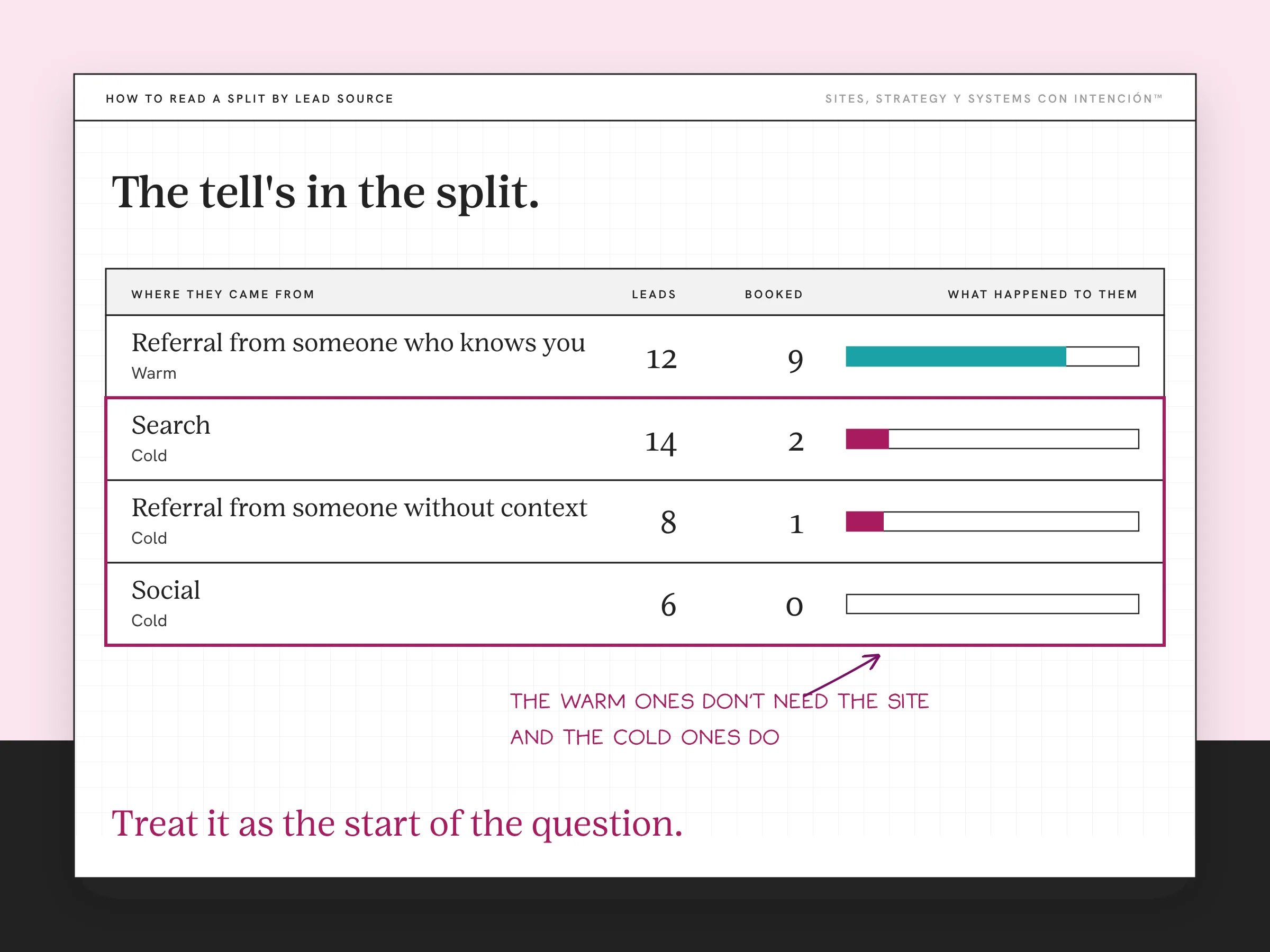
That's when the site becomes the thing worth investigating, hidden all along by the fact that your best leads never had to use it. Mira, you can check half of it in an afternoon: Google Search Console's performance report shows what search is sending you. If that number is healthy while those leads are the ones going nowhere, you have a strong reason to look at the site. What it can't tell you is why they left, so treat it as the start of the question.
Es un patrón que se repite: the founders who discover this are almost never the ones whose sites look bad. They have decent sites. The site is just answering a question nobody is asking any more, y ahí está el problema.
Why Is This the Same Problem as Burnout?
Worth naming, because they show up together and get treated as separate issues.
When the site isn't qualifying, trust-building or answering questions, those jobs don't disappear. They move to you. You absorb them, in calls, in DMs, in long emails explaining what the services page could have explained. Y eso cansa.

That's the same mechanism behind business owner burnout when the business is technically doing well. The growth ceiling is what it costs the business. Burnout is what it costs you. One cause, two bills. Plenty of founders are paying both while treating them as unrelated.
What Has to Change?
Not a redesign, necessarily. This is the part people get wrong when they finally act.
The site has to start doing the sorting that turns visitors into clients. Someone should be able to tell which service is theirs and whether they're a fit, without you. That's a positioning and structure job before it's a design one.
It has to answer what you currently answer on calls. Every question you find yourself repeating is a question your website copy should have handled. Process, timelines, what you need from them, roughly what it costs, what happens after they sign.
It has to give cold traffic a way in that's smaller than booking a call. People arrive at different levels of readiness, so turning website visitors into leads takes more than one way in. A warm referral is usually further along than someone who found you an hour ago. A site with one door loses everyone who isn't ready to walk through that particular one. Así de simple.
And the boring one that decides whether any of it holds: whatever the site starts doing, something behind it has to handle what comes next without you. A site that generates more inquiries into a manual intake process has moved the ceiling, not removed it.
What This Is Not
It isn't always the website. Sometimes the offer is the ceiling. Sometimes it's pricing. Sometimes capacity. A website audit reads the site against the business rather than guessing between them. The site will show you: if people reach the services page and leave, that can be scope or price rather than layout.

It isn't a rebuild by default. Whether this needs a redesign or a rebuild depends on whether the problems can be fixed separately. So does website redesign cost. When the problems can be fixed separately, a ceiling can come off with four or five structural changes. Knowing which one you're dealing with saves a lot of money in website strategy.
And it isn't the same as a site that was never built to convert at all. That one fails at every volume, which is its own reason a website isn't converting. This one worked, right up until it didn't.
Key Takeaways
- The site didn't get worse. The business scaled past what it was built to hold.
- At lower volume you do the trust-building personally and the site is a formality. At higher volume, cold traffic relies on the site to do what you used to do.
- The tell is the split: warm referrals still convert, cold and search leads fall off. The warm ones never needed the site.
- The growth ceiling and burnout are one mechanism. The ceiling is what it costs the business, burnout is what it costs you.
- Fixing it usually means sorting, answering the call questions, a smaller entry point, plus systems that can hold the result.
I'd rather talk through whether it's really my site holding me back.
Bring your site, your numbers and whatever's bugging you to one private session on your real question. It starts at $350 and notes are included. Full audits are available and get quoted first.
Frequently Asked Questions
Is my website hurting my business?
Look at where your leads come from and which ones convert. If warm referrals close fine and cold or search leads fall off, the common denominator is that warm leads never had to rely on the site. That split is one of the first things I'd investigate. It also shows up well before anything looks broken.
Why would a website that worked before stop working?
Because what it's being asked to do changed. A site built when most clients arrived pre-trusted only has to confirm you're real. Once people arrive cold, it has to qualify them and build trust without you present, which is a different job it was never designed for.
What are the most common business growth bottlenecks?
For service businesses: an offer that doesn't scale, capacity, pricing, the website. The website is the one that gets checked last, because it didn't change and because founders are too close to it to read it as a stranger would.
Is this a redesign problem or something deeper?
It depends on whether the problems can be fixed separately. If the site needs sorting, better answers and a smaller entry point, that's structural work inside what exists. If the platform and architecture can't hold those changes, you're looking at a rebuild.
Could it be my offer rather than my site?
Yes, though the site makes it visible. If people reach the services page and leave, that can be scope, price or fit rather than layout. Ruling this out first is cheaper than rebuilding pages that are describing the offer accurately.
Will fixing the website move revenue?
It can recover some of what is being lost between arriving and inquiring. It won't make cold traffic convert like a warm referral, because a referral arrives with trust already transferred and a website can't fully reproduce that. If the group falling off is small, the gain is small. If it's most of your incoming volume and almost none of your closed work, that gap is the one worth costing out.
About the Author