Most of the website copy I get sent is fine.
That's the part that makes this hard to fix. The grammar is clean, the offer is accurate, the tone matches the brand. Someone put real hours into it. And when the founder asks why nothing is happening, the honest answer is that nothing is wrong with the writing. The writing is doing a job nobody assigned it.
I've had this conversation enough times to know how it opens. The founder arrives with one question: why does a page that reads well produce silence.
The Short Answer
Website copy that converts earns its place by helping the right person decide. Copy that reads well and still brings in nothing is doing something else: describing an offer, showing personality or staying broad enough to include everybody. All three read well and none of them asks the reader to make a choice, which is why a page can be well written and still bring in nothing.
If You're Reading This Because It's Your Site
Reading more isn't the hard part. La Jugada is $47 and it tells you which layer this is actually sitting in.
Get it, $47What Is Website Copy For?
Website copy's job is decision support. That's the whole function.
Someone lands on a page carrying a question they haven't said outloud: is this for me. Every line either moves them toward an answer or delays it. A page full of accurate sentences that never resolves that question has failed at its job, however well it's written.
This is the part most advice skips. The standard guidance jumps to method: write like you talk, lead with benefits, keep it tight. All reasonable, all useless if nobody has decided what the page is supposed to accomplish. Method without purpose produces a page that's easier to read and no easier to act on.
The test is small. Read your page, mira, as a stranger who is scanning and has no context. The first rule of plain language is to write for your audience, which reads as obvious until you count how much page copy is written for the person who owns the business. At the end of it, can they say yes or no to working with you. If the honest answer is "they'd need to ask me a few things first," the copy is handing your reader homework.
The Three Jobs People Give Their Copy Instead
When a page reads well and does nothing, the three things I run into most are these. Sometimes all three at once.
1. It describes the offer. The page works as an accurate inventory of what is included, how it runs and what the process looks like. Every line of it is true. None of it asks the reader to place themselves inside it, which is what makes this website copy mistake hard to catch. Describing feels like the responsible thing to do, because clarity is supposed to be the whole point.
2. It sounds memorable. The page has real voice, sharp and specific enough that it could only belong to one person. This is the version people are proudest of, which is what makes it the hardest to revise. Personality is doing work on that page. The work it's doing happens to be a different one.
3. It covers every possible client. The page is written wide so nobody feels shut out. Every qualifier softened, every claim hedged, every service described in language broad enough to fit a dozen situations. The instinct behind this one is generous and the result is a page that speaks to nobody in particular.
Think about the difference between the horoscope in the paper and somebody reading your actual chart. Every Scorpio on earth gets the same paragraph on Tuesday and it's written so that all of them can nod at it. Nobody screenshots that one. The reading that makes you sit up is the one that needed your birth time down to the minute, because it could only be about you. A page written so that everyone can nod at it is the Tuesday horoscope. Y ya.
None of those sound like mistakes, y lo sé. That's the problem with them. Each one is a reasonable thing to want from a page. Each one also substitutes itself for the job that matters.
Why Do All Three Fail the Same Way?
Describing, performing and hedging look like three different problems. They're one problem wearing three outfits.

None of them puts a choice in front of the reader.
A description invites you to understand. A voice-forward page invites you to admire. A broad page invites you to see yourself somewhere in it if you squint. What none of them does is tell a specific person that this is for them while telling a different person that it isn't.
The thing nobody wants to hear is that your copy is doing a job you never assigned it. Ahí está: it's doing that job well, which is why nothing looks broken. You can't diagnose a page by reading it and asking whether it's good. You have to read it and ask what it's asking of you.
This is also why rewriting for voice alone rarely changes the numbers. A page that describes in your actual voice is still a page that describes. If your site doesn't sound like you, that's a real problem worth its own fix. It's also a different problem from this one.
What Changed on One Offer Page
One page, one offer and still getting nothing.
It wasn't a homepage, which matters. A homepage has an excuse: it has to cover everything. This page had one job. It was hedged wide anyway. The service was described in language broad enough to fit several kinds of client, with a few soft invitations near the bottom to reach out if it sounded like a fit.
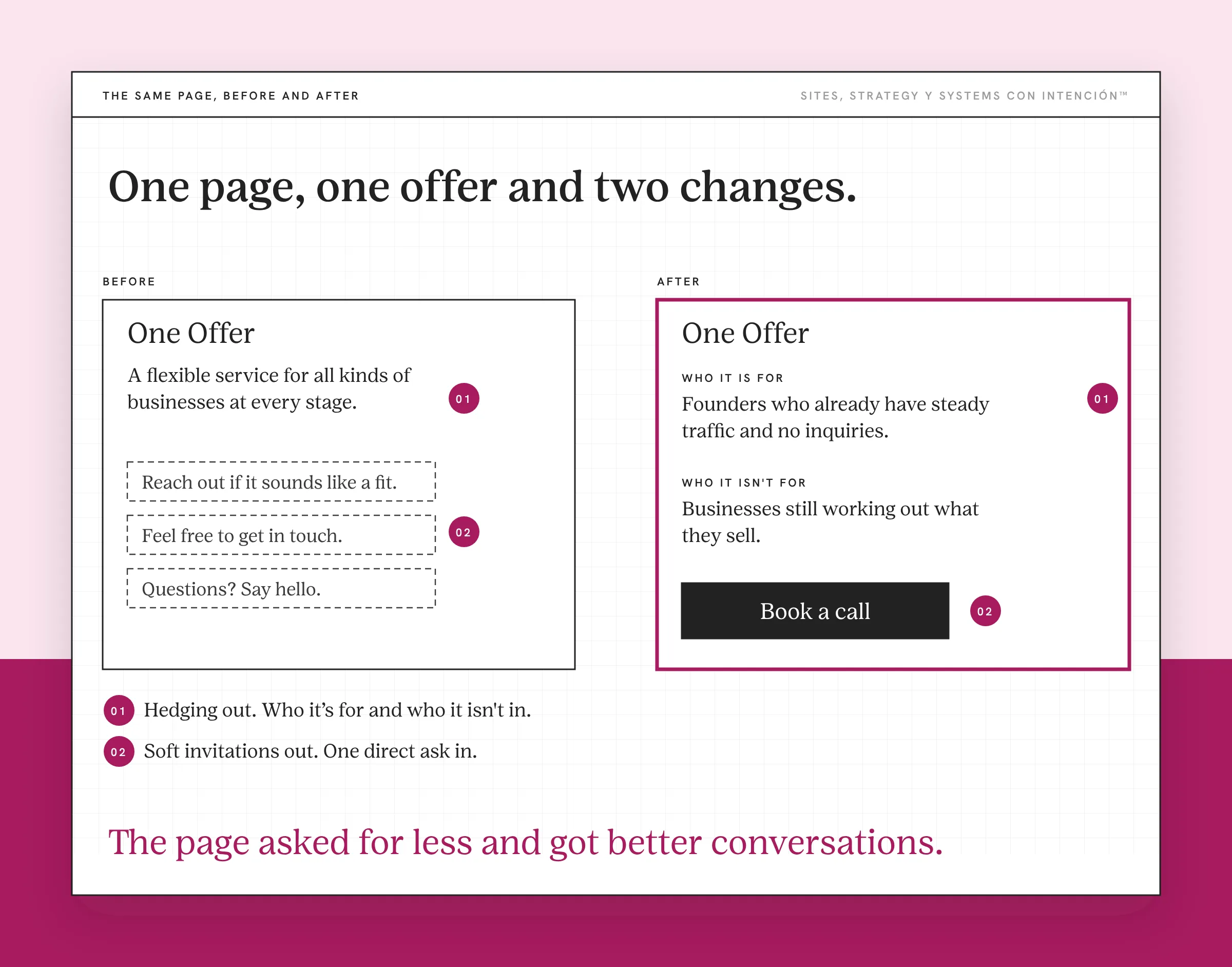
Two changes.
The hedging came out and was replaced with who the work is for and who it isn't. Explicit, on the page, in the reader's field of view.
The soft invitations came out and were replaced with one direct ask.
What happened after: inquiries got better fit, not more numerous. Roughly the same volume, sometimes fewer. The wrong-fit conversations stopped showing up. That's the outcome, tal cual, stated the way it happened. No percentage, because I didn't measure one.
I want to sit on that for a second, because it's the opposite of what this whole category promises. Every article about website copy sells you more. More traffic converted, more leads, more inquiries. The change that worked on that page didn't produce more of anything. It produced fewer conversations that were worth having. That was the win.
How to Write Copy That Helps Someone Decide
The method follows from the purpose. Once the page's job is to support a decision, the writing questions get easier to answer.
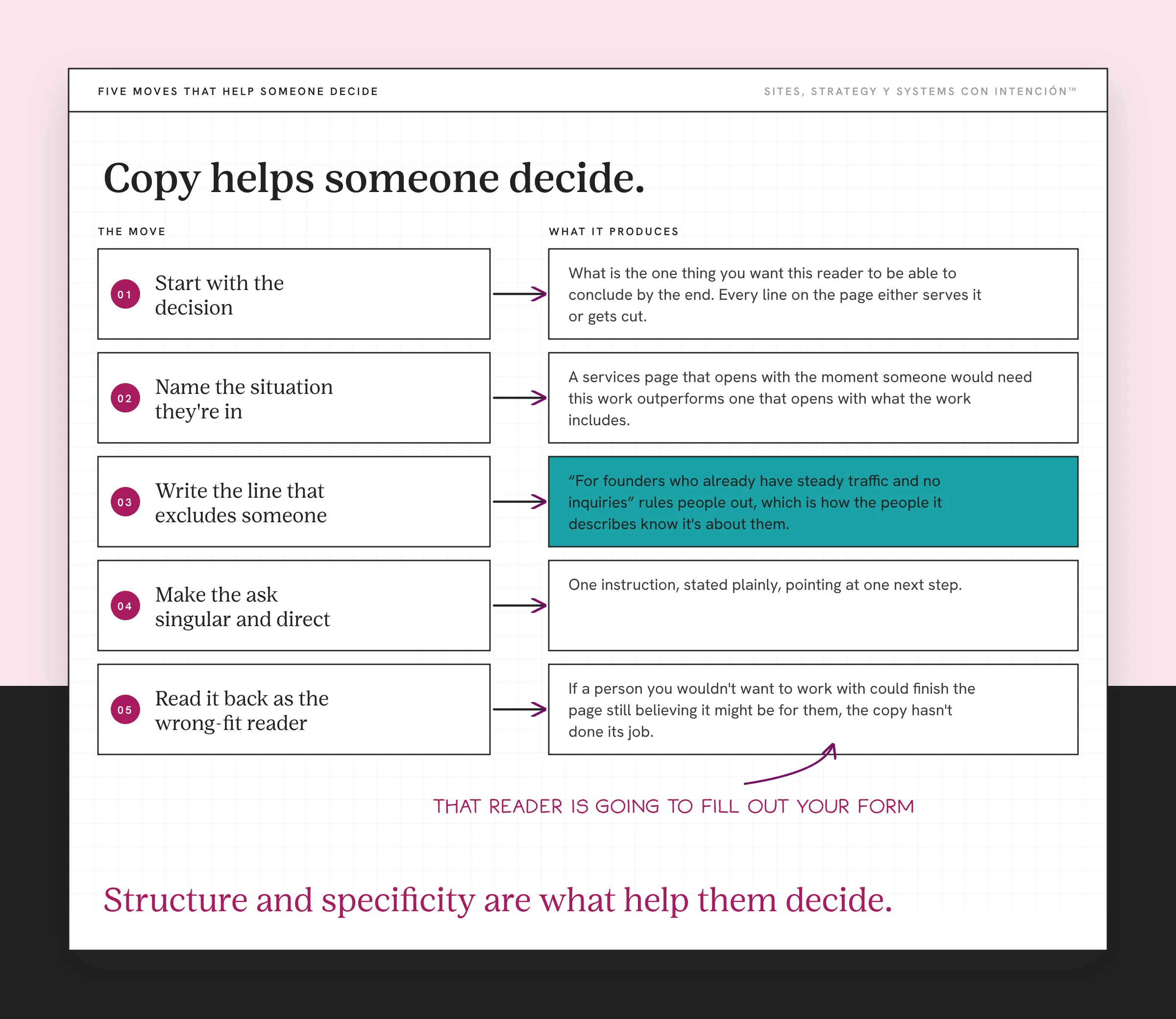
Start with the decision the page has to produce. What is the one thing you want this reader to be able to conclude by the end. Write that down before you write anything else. Every line on the page either serves it or gets cut.
Name the situation they're in. The reader recognizes themselves through circumstance. A list of your deliverables isn't a place anybody recognizes themselves. For a reader still working out whether this is for them, a services page that opens with the moment someone would need this work outperforms one that opens with what the work includes. The same instinct is what makes an about page land or fall flat. The same logic governs how you organize website content across the whole site.
Write the line that excludes someone. This is the hard one and it's covered below.
Make the ask singular and direct. One instruction, stated plainly, pointing at one next step. Several gentle nudges read as politeness and function as ambiguity. Where that ask sits on the page is its own question, separate from what it says.
Read it back as the wrong-fit reader. If a person you wouldn't want to work with could finish the page still believing it might be for them, the copy hasn't done its job. That reader is going to fill out your form. Then you spend forty minutes finding out what the page should have told them.
Something worth saying here: this isn't a voice exercise. The page can sound exactly like you and still fail every one of these. Voice is a big part of whether they trust you. Structure and specificity are what help them decide. The order these get done in is its own topic, covered in how to write website copy. Voice and structure working together is a big part of how I think about content strategy.
Who It Is For and Who It Is Not
The excluding half is the one people skip. Pues, it's also the one that does the work.
Almost everybody agrees with "speak to your ideal client." Almost nobody writes the second sentence. Naming who your work serves is comfortable. Naming who it doesn't serve feels like turning away money. On a page that's already producing silence, turning away anything feels insane.
What it does instead is sort. A reader who finds the line that rules them out leaves without filling out your form, which is the correct outcome for both of you. It's the same principle behind what NNGroup calls information scent: people follow the cues that tell them they're in the right place. They leave when those cues say otherwise. A reader who finds the line that rules them in has just had their decision made easier by the only person who could make it easier.
The line that loses you the wrong client is the same line that wins you the right one. It has to be specific enough to cost you something. "For service-based businesses" costs nothing and sorts nobody. "For founders who already have steady traffic and no inquiries" rules people out, which is how the people it describes know it's about them.
This is also the mechanism behind a page that reflects your brand. A page written to include everybody can't describe anybody, including you.
What Does This Not Fix?
Copy is one layer, nada más. A few things that look like copy problems aren't.
If the words are right and the page still doesn't move anybody, the order of the page is worth a look. Sequencing's a separate discipline from wording. Structuring a site for conversions is where that gets handled.
If the whole site reads like a different business than the one you run now, that's a messaging problem. It gets solved upstream in your website messaging.
If you're weighing whether the site or a separate funnel is the thing that moves people, that's a structural question. And if the site has no path through it at all, copy won't build one. That's a strategy question for a service business. No amount of rewriting substitutes for it.
And if the real issue is that you're the only thing holding the whole operation together, your bottleneck sits upstream of the page. That's a capacity problem with a website-shaped symptom.
Key Takeaways
- Website copy has one job and it's decision support. The reader should finish a page knowing whether this is for them.
- Three common jobs people assign their copy instead: describing the offer, sounding memorable, covering every possible client.
- Those three fail the same way. None of them puts a choice in front of the reader.
- Being specific about who the work isn't for is the move that makes the rest of the page work.
- The measure of good copy is fit. Fewer inquiries from better-matched people beats more inquiries from anyone.
Okay, which page of my copy do I fix first?
Share your link and answer five questions. About 10 minutes later you'll have a private page with a read on your site, your marketing and your backend plus the first move worth making. It's $47 and there's no call.
Want more like this in your inbox? Off the Clock is my week-ish newsletter about websites, systems and burnout-free business.
Frequently Asked Questions
What is website copy supposed to do?
Help the right person decide. Every line either moves the reader toward a yes or a no. Otherwise it delays them. A page that reads well and leaves the reader unsure whether the work is for them hasn't done its job.
Why isn't my website copy working when it reads fine?
Because reading well and working are different tests. Most copy that reads fine is describing the offer, showing personality or staying wide enough to include everybody. All three are reasonable. None of them asks the reader to make a choice.
How long should website copy be?
Long enough to get someone to a decision and no longer. Length's the wrong variable to optimize. A short page that only describes the offer fails exactly the way a long one does, with less material to work with. The useful question is whether a reader can reach a yes or a no by the end. If they can do that in two hundred words, write two hundred. If it takes a thousand, write a thousand.
Should website copy say who it's not for?
Yes. It should also be specific enough to cost you someone. A line that rules nobody out will fail to tell the right reader that the page is about them, because the two jobs are the same job. "For service-based businesses" excludes almost no one and sorts almost no one. A line naming the situation someone is in right now will send the wrong readers away before they reach your form, which saves you both the call.
Does better copy mean more inquiries?
Not always. Better fit is the more useful measure. On the offer page described above, inquiries stayed flat or dropped slightly while the wrong-fit conversations stopped arriving. That was the improvement, even though the raw count went the wrong direction. Volume's easy to measure and easy to grow with the wrong readers. Fit is what determines whether the inquiries are worth answering, so it's the number worth watching.
Do I need to fix my voice first?
Those are two different jobs and they fail differently. Voice determines whether a reader trusts you. Specificity y structure determine whether they can decide. A page written in your actual voice that only describes the offer is still a page that only describes the offer, so fixing the voice alone won't change what the page does. If your site sounds like someone else entirely, fix that too. Just don't expect it to move the numbers on its own.
About the Author