Jane the Virgin told you what happened, then who it happened to, then why it mattered. The narrator kept the order straight so you never had to hold four things at once. Mira, a site has the same obligation. This isn't the same job as deciding what pages you need.
That one is architecture. Which pages exist, how they sit relative to each other, what nests under what. Useful work and a different question from this one. Structuring for conversions is about the order a visitor meets things in. That's a sequence rather than a shape. A site can have flawless architecture running a broken sequence.
In the audits I run, the strategic layer is usually where the leverage is. Unless something's actually broken, technical fixes on their own rarely move conversion, which surprises people who were hoping the problem was the load time.
The Short Answer
To structure a website for conversions, work out the four things a stranger has to settle in order, then decide which page settles each one. They check whether the site is for them, then whether you solve their specific version of the problem, then whether they trust you enough to move, then what to do about it.
If You're Reading This Because It's Your Site
Reading more isn't the hard part. La Jugada is $47 and it tells you which layer this is actually sitting in.
Get it, $47What Are the Four Things a Visitor Settles?
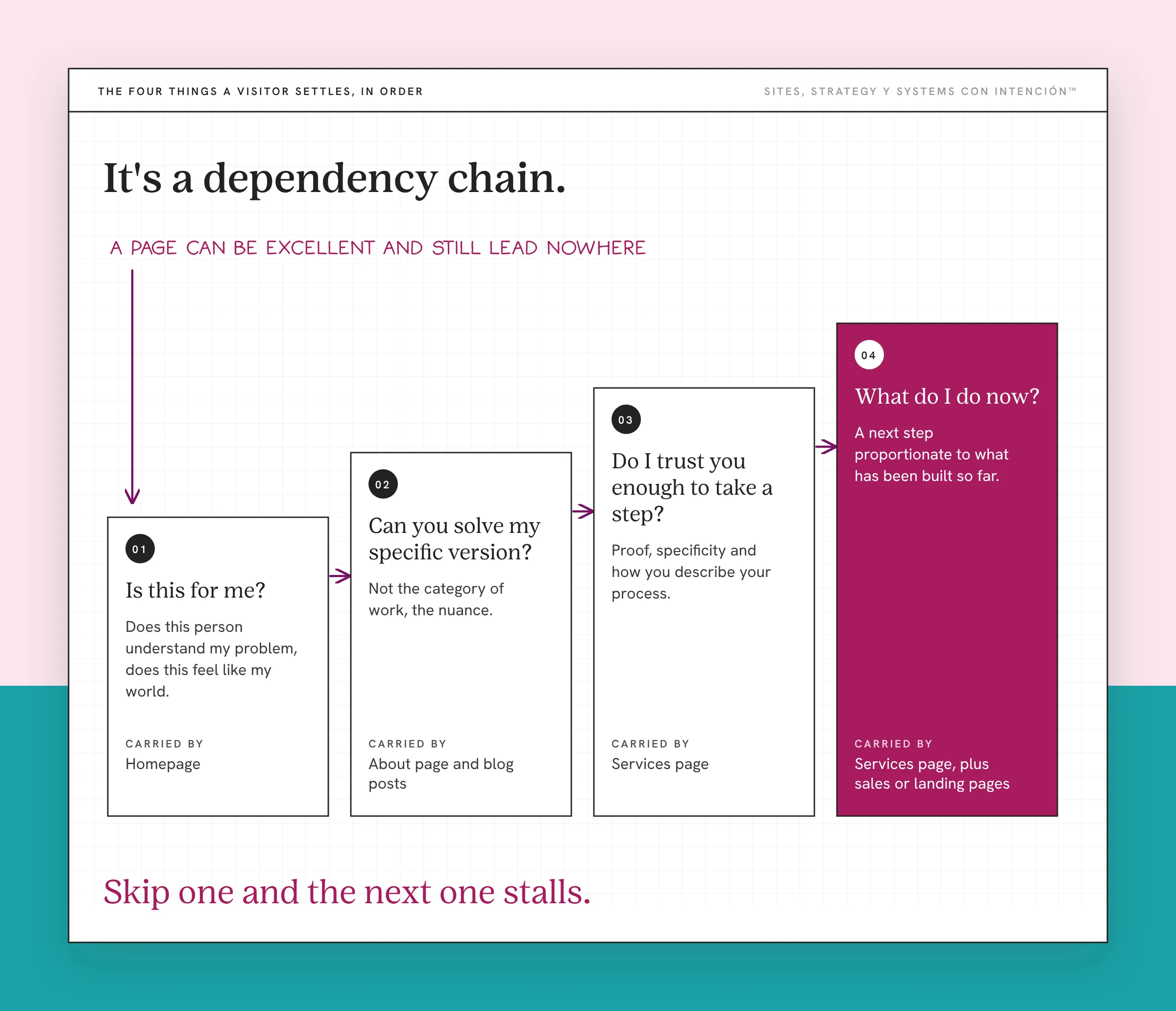
Every stranger who ends up as a client goes through the same four. None of it happens consciously and it happens anyway.
1. Is this for me. The landing check happens before they've consciously decided to pay attention to anything on the page. Nielsen Norman Group found 79% of test users always scanned a new page rather than reading it. Does this person understand my problem, does this feel like my world.
2. Can you solve my specific version of it. Not the category of work, the nuance. Plenty of people do what you do. They need to know you've met their situation before.
3. Do I trust you enough to take a step. Proof, specificity and how you describe your process either move them here or stall them.
4. What do I do now. A next step proportionate to what has been built so far, rather than the biggest ask you have.
For a stranger arriving cold, the order holds and it isn't a funnel diagram. It's a dependency chain. They can't evaluate whether you solve their problem until they believe the site is for them. They can't decide to act until the trust exists. Skip one and the next one stalls, which is why a page can be excellent and still lead nowhere.
Stage One: Is This for Me?
This is the recognition check and it happens in the first scroll.
Nothing else on the site gets read properly if this fails, which makes it the highest-leverage screen you own. For most first visits that's the homepage's job. Someone landing on a services page or a blog post meets it there instead. The failure mode is a page that introduces the business beautifully while never naming the visitor's situation.
What it needs is specificity. "For service-based businesses" costs nothing and sorts nobody. A sentence that names the thing they haven't said outloud to anybody does the whole job in one line.
Stage Two: Can You Solve My Specific Version?
This is where a service site goes quiet when nobody built for this stage on purpose.
They've accepted that you do this kind of work. What they don't know is whether you've met their particular version of it: their size, their constraint, the thing that makes their situation awkward. Category-level competence is assumed and nuance is what they're shopping for.
Two things carry this stage. The about page, when it's doing its real job, answers whether you understand their world. And a blog post that goes deep on one specific problem does it better than any services page can, because the depth itself is the evidence.
This is also why generic service descriptions underperform work that names a narrow situation. The narrow version reads as experience. The broad version reads as availability.
Stage Three: Do I Trust You Enough to Take a Step?
Trust at this stage gets built by how precisely you describe the problem and how plainly you describe what happens next. For most service businesses, credentials sit further down the list than people expect.
Proof supports it. Digital.gov's guide to testing for understanding makes a related point about clarity: you find out whether something lands by testing it with real people, then revising and testing again. Rereading it yourself won't tell you. A testimonial that names a situation like theirs does real work. A wall of logos on a page that hasn't yet recognized them does none, because there's nothing for the proof to confirm.
Process descriptions are the part people underrate. Someone deciding whether to spend real money wants to know what the first two weeks look like. Vagueness there reads as either inexperience or something being hidden. Neither helps.

The copy is what carries all of this, which is why what your website copy is doing matters more at this stage than anywhere else on the site.
Stage Four: What Do I Do Now?
The ask has to match what the page has earned.
A call that opens on logistics rather than convincing is what that looks like from the other side. Ahí se ve el trabajo. That's the whole point of getting stage four right: the conversation confirms a decision rather than starting one. A next step sized correctly does that work for you before anybody picks up a phone.
Sized incorrectly, it fails in two directions. Too big and they leave, because a thirty-minute call is a lot to ask of someone who has read one page. Too vague and they drift, because let's connect asks nothing they can say yes to. The middle is where sites tend to have nothing at all, y eso se nota, which is the missing next step.
Call to action placement, where the ask goes and how many of them there are, is its own decision. What belongs here is the principle: one ask per page, sized to the stage that page serves.
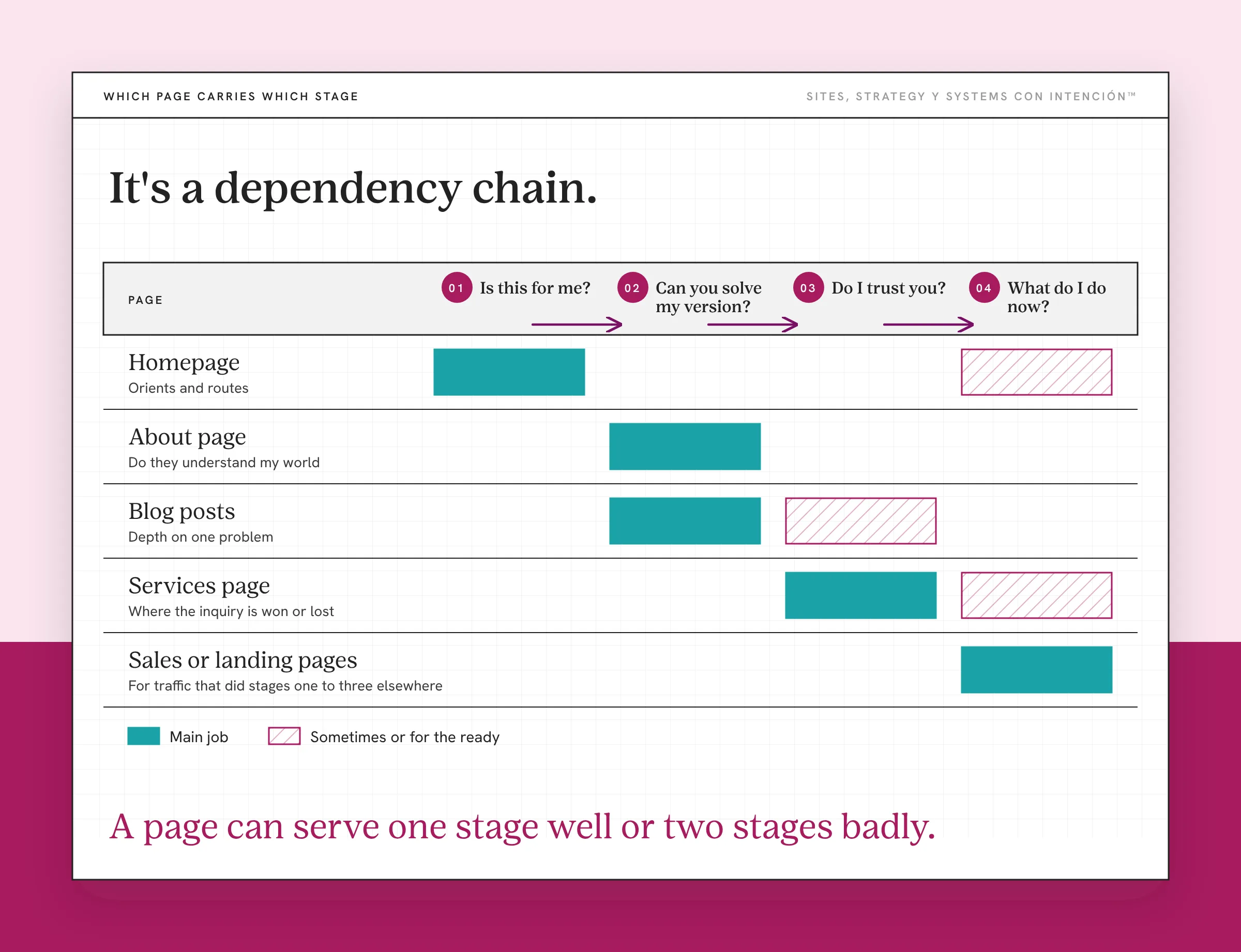
Which Page Carries Which Stage?
This is the part worth writing down, because most sites have all four stages present and scattered.
Homepage: stage one, mostly. It orients and it routes. If you sell one offer, it can close too.
About page: stage two. Do they understand my world. The personal material earns its place by answering that rather than by being personal.
Blog posts: stage two, sometimes stage three. Depth on one problem is the strongest stage-two evidence you can publish.
Services page: stage three, plus stage four for the people who are ready. This is the page where the inquiry is actually won or lost, where you convert website visitors into clients. Ese es el punto donde se decide.
Sales or landing pages: stage four only, for traffic that already did stages one through three somewhere else. Those are a different kind of page, with different rules for sales and landing pages.
When two stages pull against each other, a page can serve one stage well or two stages badly. When a services page tries to also do the orienting, it opens with who you are and buries what they came for. When a homepage tries to close, cold visitors bounce off a pitch they had no context for.
What Structuring for Conversions Will Not Fix
Three things sit outside this.
If you don't know which pages a site should have, there's no sequence to arrange yet. Planning the site structure is the step before this one.
If the menu buries the page where the decision happens, the sequence can be perfect and unreachable. Navigation order decides what they find. Sequence and navigation have to work together in any website strategy that converts.
And if they stall inside a page rather than between them, the sequence is fine and something on that page is broken, que es otra cosa. That's a different diagnosis about user experience.
Key Takeaways
- Structuring for conversions is sequencing. The order they meet things in, which is a different question from which pages exist.
- Four things get settled in a fixed order: is this for me, can you solve my version of it, do I trust you enough to move, what do I do now.
- It's a dependency chain. Skip one stage and the next one stalls, however good the page is.
- One page serves one stage well or two stages badly. Write down which page carries which before changing any of them.
- The strategic layer is where the leverage is. Technical fixes on their own rarely move conversion.
So which stage is my site losing people at?
La Digital Rueda asks a few questions about your site, your content and your backend. In about two minutes it shows you where the pressure is and it's free.
And if you'd rather have this sort of thing arrive in your inbox, Off the Clock is where I write about building something that keeps working while you aren't at your desk.
Frequently Asked Questions
What does it mean to structure a website for conversions?
Arranging what a visitor meets in the order they need it, so each page settles one question and hands them to the next. It's different from deciding what pages you need, which is architecture. A site can have exactly the right pages in exactly the right hierarchy while the order inside that hierarchy asks for commitment before it has earned any.
What are the stages a visitor goes through before becoming a client?
Four. Whether the site is for them, whether you solve their specific version of the problem, whether they trust you enough to take a step, then what that step is. Nobody experiences these as stages. Everybody goes through them, which is why a site that skips one produces interested visitors who never act.
Which page on my website should convert visitors?
The services page, for most service businesses. That's where someone decides whether this is what they need and whether they trust you enough to reach out. The contact page mostly has to not be terrible. When inquiries are flat and nothing on the site is broken, start there.
How many calls to action should a page have?
One primary ask, sized to the stage that page serves. Secondary options can exist when they're relevant and visibly secondary. Two asks of equal weight hand the visitor a decision about your website instead of a decision about your work, which is the most common version of this mistake.
What is the difference between website structure and website hierarchy?
Hierarchy is which pages sit under which, so it maps the site. Structure for conversions is the order a person moves through it, so it maps a decision. The two can disagree completely. A page four clicks deep can be the first thing a visitor needs.
Why is my website not converting even though the pages are good?
Usually because the pages are good individually and out of order as a set. Each one does something worth doing and none of them hands the visitor to the next thing they need. Good pages in the wrong sequence produce exactly the symptom you're describing, which is traffic that reads a lot and asks for nothing.
About the Author