
A park day has three kinds of line. One is the ride you queued ninety minutes for. One is the quick thing you walked onto because it was right there. The third is the map you stood at for thirty seconds to work out where you were going. Nobody confuses those three. Mira, the real confusion sits one page over from these two.
Founders try to make the homepage do all three jobs at once, ay bendito. When those jobs pull against each other, none of them gets done, y ahí está el lío: the page that suffers most is the one everybody lands on.
So this is three pages and the third one is where the damage usually is.
The Short Answer
A sales page carries one offer for one audience toward one buying decision. A landing page has the same focused shape with a smaller ask, usually a signup or a registration. The difference is the size of what you're asking for. Both are separate from the homepage, which orients strangers first. If you sell one offer, it can close too.
If You're Reading This Because It's Your Site
Reading more isn't the hard part. La Jugada is $47 and it tells you which layer this is actually sitting in.
Get it, $47What Is a Sales Page For?
No navigation, no distractions, nowhere else to go.
Everything on a sales page exists to move someone toward a single yes or no. That includes the price, the process, what is and isn't included, who it's for, who it isn't for and the objections they're carrying. If you remove the menu, it's because every other link is an exit from the only decision the page is built to produce. That's the opposite of how website navigation earns its keep.
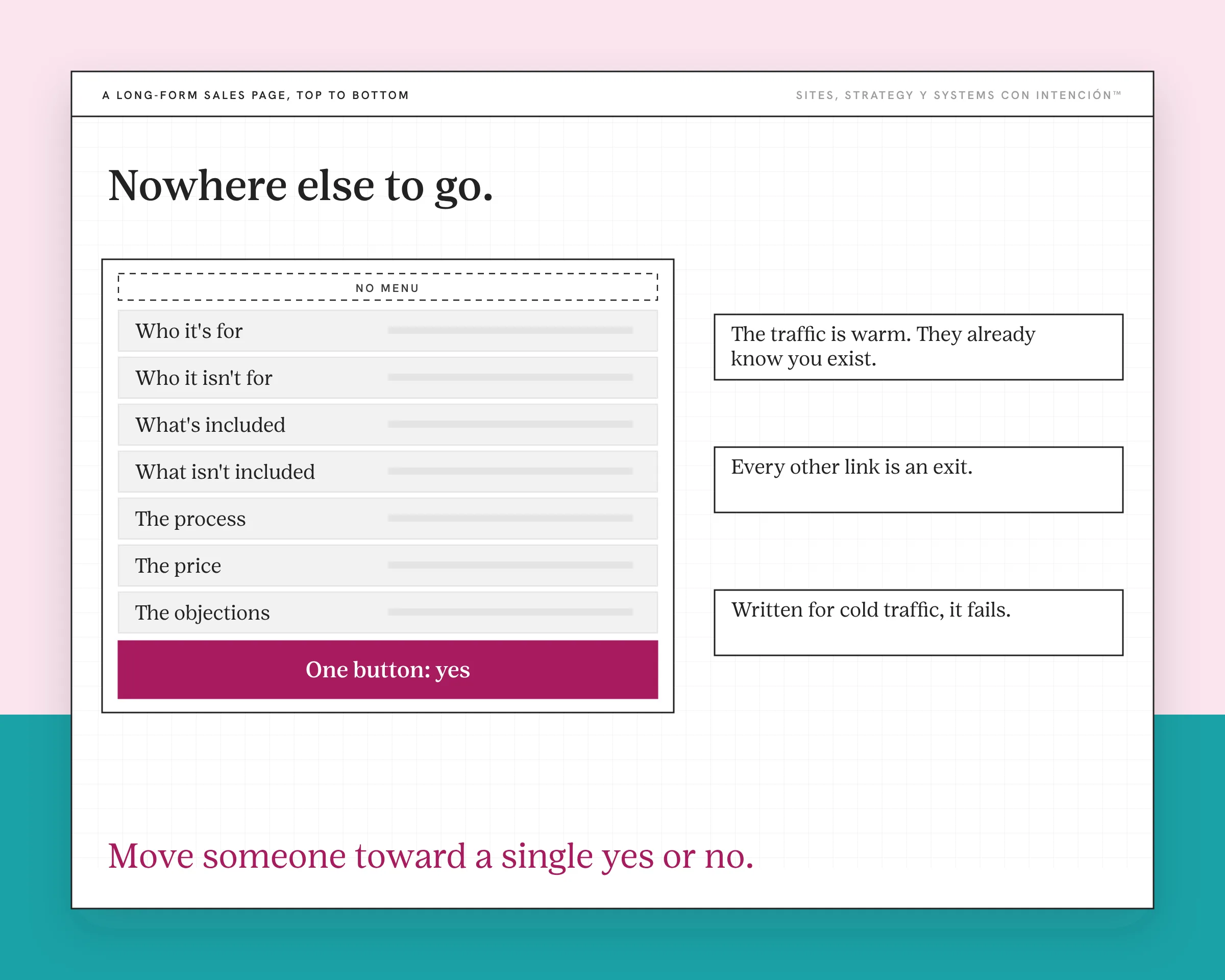
The traffic is warm. They already know you exist and they're evaluating whether to buy, which is why the page can skip the orienting entirely. Everything it does rests on website copy that helps someone decide. A sales page written for cold traffic fails, because it opens mid-conversation with someone who never had the first half.
What Is a Landing Page For?
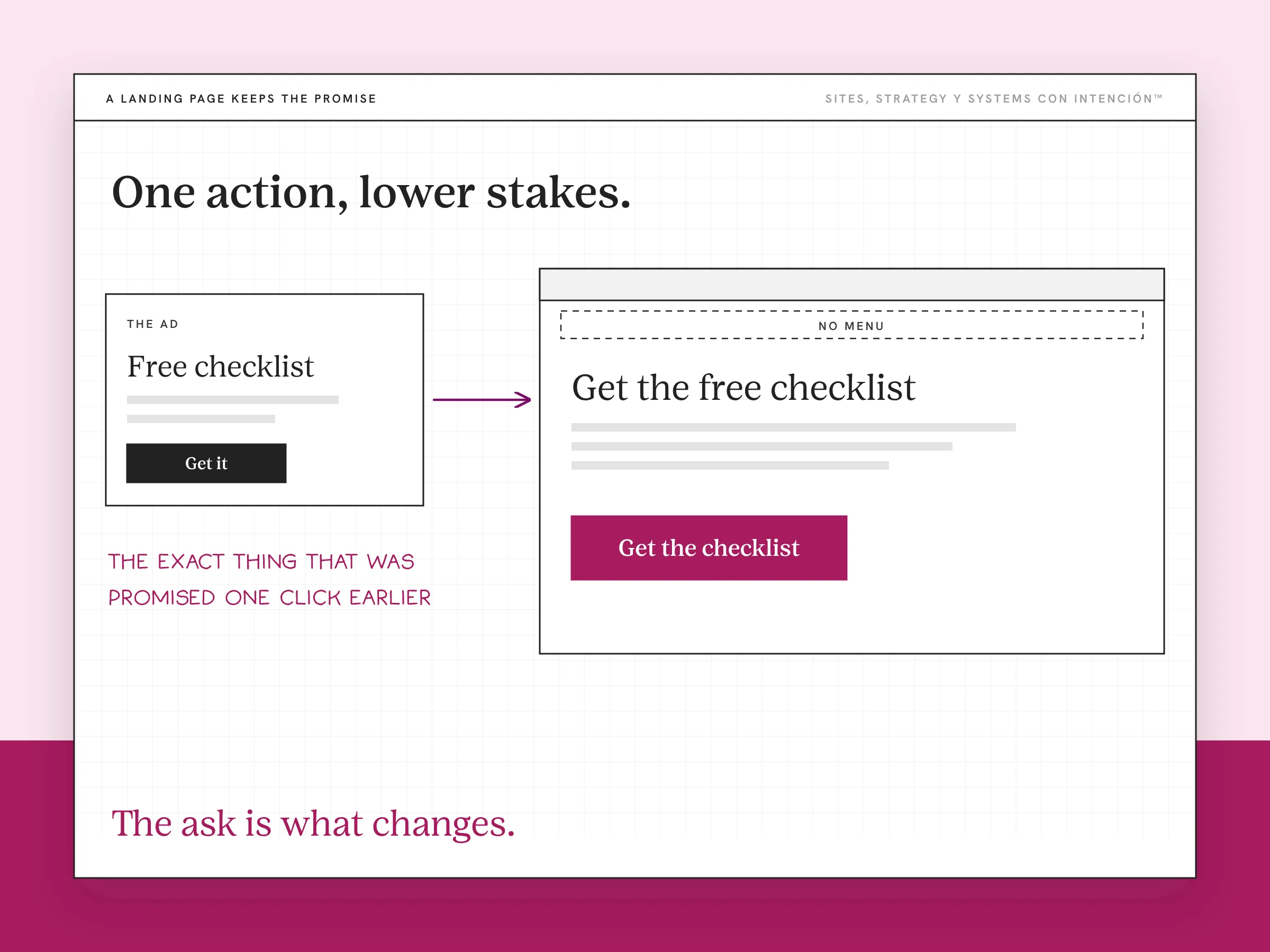
Structurally almost identical. The ask is what changes.
Sign up for the freebie, register for the webinar, join the waitlist. One action, lower stakes, plus a page that can be much shorter because there's less to overcome.
Landing pages usually sit at the end of a campaign, nada más, which is the other thing that distinguishes them. Google's own quality scoring treats landing page experience as a distinct factor, measuring how relevant and useful the page is to someone who clicked a specific ad. That's the whole discipline of a landing page in one sentence: the post-click experience has to deliver the exact thing that was promised one click earlier. On one client's site, a paid ad was sending clicks to an offer page that didn't match what the ad promised. That gap is exactly what a landing page is built to close.
I've also watched a client's landing page try to do too much. It was carrying the whole site's job on a page built for one action.
What Is the Homepage For?
The homepage takes everybody. Every source, every stage, every level of familiarity.
Its job is to answer is this for me fast, then route them to wherever they need to go next, which lines up with Nielsen Norman Group's homepage usability guidelines. When you sell more than one thing, the closing happens on a different page. Its whole output is that the right people stay and the wrong people rule themselves out early, which saves you both a call. That's a different job from either of the other two and it decides what should be on a homepage.
This is why the homepage keeps its navigation. Visitors there arrive without knowing what they need, so they need the routes. A landing page usually drops its navigation and a sales page can go either way. Fitting the page type to where the visitor is in their thinking is one of the first calls I make in website strategy.
How Do You Tell Which One You Need?
Two questions settle it almost every time.
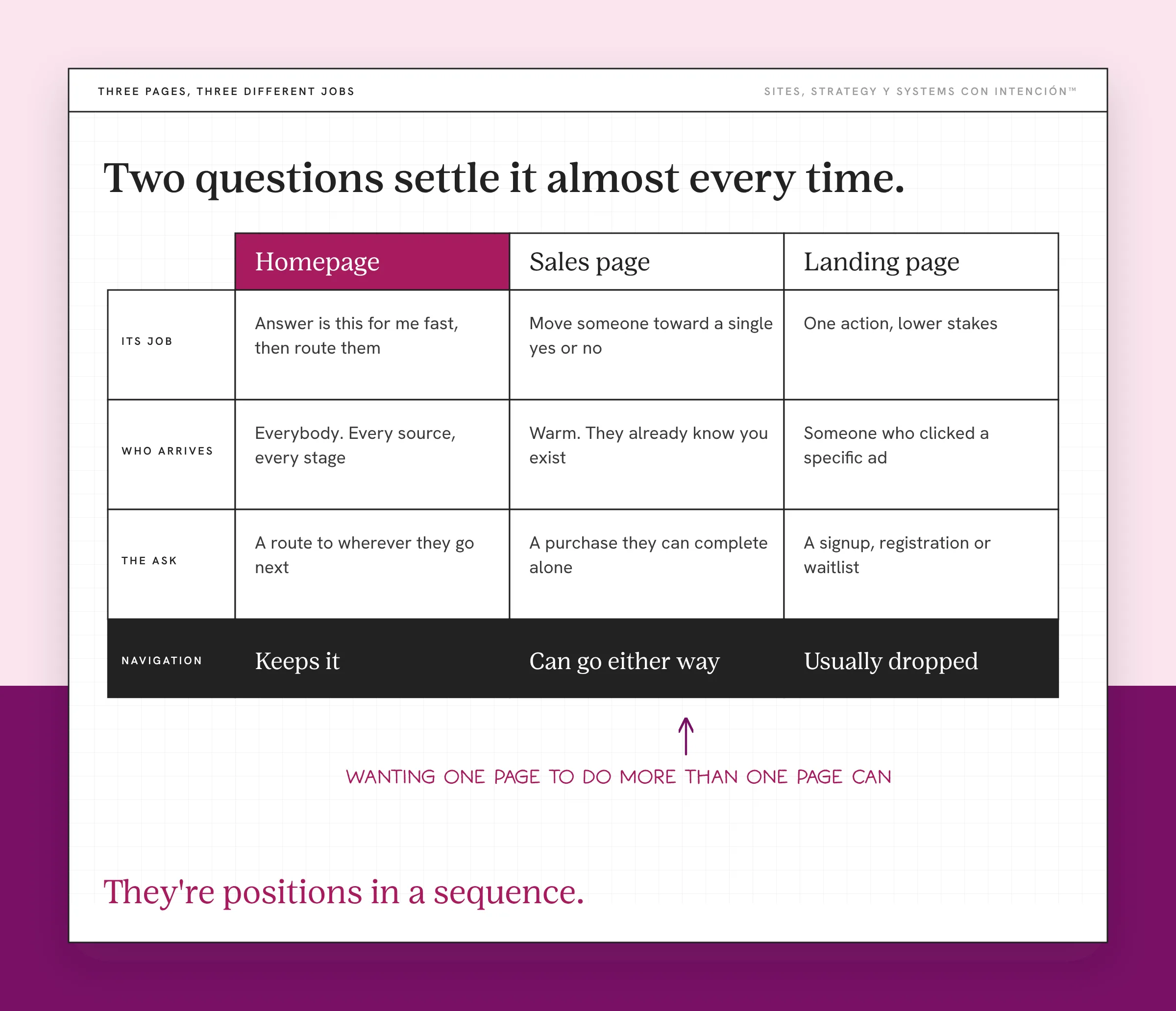
How did the visitor arrive? From a campaign, an email or somewhere they already know you: a sales or landing page is right, because the orienting already happened. From search, a referral or the wild: if they don't know what you offer yet, they need the homepage or a services page first.
How big is the ask? A purchase decision they can complete alone gets a sales page. A signup, registration or waitlist gets a landing page. A decision that needs a conversation first gets neither, así de claro. That's the case for service work that turns on trust and fit.
Which Two Mistakes Show Up Most?
Both of them come from the same instinct, which is wanting one page to do more than one page can. It's really a question of how many pages a website should have.
Using the homepage as a sales page. There's one offer you really want to push, so the whole homepage becomes about that offer. Pricing, process, testimonials, one big call to action. Then cold traffic lands there and bounces. Nielsen Norman Group's research on page visits found people often leave within 10 to 20 seconds, so a page has to show its value fast. Those visitors needed orientation and got a pitch. The homepage tried to close before it earned the right to. A business with one offer is the exception, because there the homepage and the sales page can be the same page.
Building a sales page for an offer that needs a conversation first. High-ticket work that turns on trust and fit doesn't close off a page, however good the page is. The page's job in that case is to get them to a conversation. Building it as a closer means measuring it against a job it was never going to do, then concluding the copy was wrong.
What Each Page Needs From the Others
None of these pages works alone, which is the part that gets missed.
A sales page needs somewhere for the orienting to have happened. A landing page needs a campaign that made a specific promise. The homepage needs a planned website structure with pages to route people to. They're positions in a sequence rather than three formats you pick between, which is why structuring the whole thing for conversions comes before deciding what to build.
And if the pages exist without a route connecting them, none of this helps. A website with no clear next step is the more basic problem and it's worth ruling out first.
Key Takeaways
- A sales page carries one offer to one buying decision, with no navigation and warm traffic only.
- A landing page has the same focused shape with a smaller ask, usually a signup or registration at the end of a campaign.
- The homepage orients strangers and routes them. When you sell more than one thing, it isn't built to close and it keeps its navigation for that reason.
- The most common mistake is turning the homepage into a sales page for one offer. Cold traffic needed orientation and got a pitch.
- High-ticket service work that turns on trust and fit doesn't close off a page. The page's job is to get them to a conversation.
Just tell me which page to fix first.
Answer five questions and share your link. In about 10 minutes you get a personalized read on your site, your marketing and your backend, plus the first move worth making. It's $47 and there's no call.
Want more like this in your inbox? Off the Clock is my week-ish newsletter about websites, systems and burnout-free business.
Frequently Asked Questions
What is the difference between a sales page and a landing page?
The size of the ask. A sales page carries one offer toward a buying decision, so it has to handle price, process, inclusions and objections. A landing page asks for something smaller, usually a signup or a registration, so it can be much shorter. Structurally they're close relatives: one offer, one audience, no navigation, one action.
Do I need a sales page or a landing page for my service business?
Often neither, at least not first. Service work that turns on trust and fit closes in a conversation, so the page's job is to get them to that conversation. A well-built services page usually does more for a service business than a sales page does, because the decision they're making is whether to talk to you. That page is where the inquiry gets won or lost, which makes it central to converting website visitors into clients.
Can my homepage be my sales page?
Not without cost. The homepage takes everybody who arrives, including people who have never heard of you, so it has to orient before it asks. A homepage rebuilt around one offer converts the people who were already sold and loses the ones who needed to work out whether they were in the right place.
Should a sales page have navigation?
No. Every link in a menu is an exit from the single decision the page exists to produce. That's the whole reason a sales page is built as its own page. If you find yourself wanting the navigation back, what you're describing is a services page.
What kind of traffic should go to a sales page?
Warm traffic. People who already know you exist and are evaluating whether to buy, usually arriving from an email, a campaign or your own site. Sending cold search traffic to a sales page fails because the page opens in the middle of a conversation the visitor never had the first half of.
How long should a sales page be?
Long enough to answer every objection someone could raise before buying, which is usually longer than feels comfortable. The useful test isn't length, it's whether a reader can reach a confident yes or no without needing to ask you anything. If they still have a question, the page is short regardless of the word count. How many asks it carries along the way is a separate decision about call to action placement.
About the Author