
Everybody looks at the form first.
Field count, button color, whether the page loads fast, whether the calendar embed still works. Worth checking once. When people aren't reaching the form, none of it's where the problem lives, because the visitor who never arrives at your form didn't fail at the form.
You don't bring the same arm out of the bullpen for every situation. Down three in the second is a different problem than one out in the ninth and nobody sensible warms up the same pitcher for both. Your site has the same job. The person who found you through a search at eleven at night and the person your former client texted last week are two different situations and one page is being asked to handle both.
Which is why the services page is worth reading before the form. That's where the decision usually sits and "usually" is doing real work in that sentence.
The Short Answer
How to convert website visitors into clients isn't one answer, because three things change where the decision gets made: how they arrived, how ready they already were and how big the thing they're buying is. The decision usually happens before they reach your form. The form can still lose them, so test it too.
If You're Reading This Because It's Your Site
Reading more isn't the hard part. La Jugada is $47 and it tells you which layer this is actually sitting in.
Get it, $47Where Does the Inquiry Actually Get Won?
It depends on three things and they stack.
How they arrived. A cold search visitor has nothing vouching for you. The page has to do the entire job: establish that you understand their problem, prove you can solve it, then say what happens next. A warm referral already arrived half-decided. Somebody they trust said your name, so the site's only job is confirming it. Those are different pages doing different work, no me digas that one layout serves both equally.
How ready they already were. Three weeks out, they're still working out what their problem even is and they get won by the page that helps them name it. Ready this week, they need scope, price and availability findable without digging. Make the second person read the education and you lose them to somebody whose page just answered the question. It's why Nielsen Norman Group tells you to show the price.
How big the thing is. A small engagement's decided on the page, whether that's a sales page or a landing page. A larger one gets decided on whether the site made them feel understood before they ever asked a question. That deciding happened across three pages and a week of thinking.
So no, there's no single place. But across all three the services page carries the most weight, because it's the page where they're actively deciding rather than orienting or confirming. That's the page to open first, before anything on the contact form.
What Does the Contact Page Have to Do?
It's got a low bar and it's worth clearing.
Clearing it means the page doesn't open with twelve fields. It doesn't ask for their revenue before anybody's had a conversation. It doesn't make them guess what happens after they hit send. The GOV.UK service manual's guidance on form structure puts the test plainly: for every question on a form you should know that you need the information, why you need it and what you'll do with it.
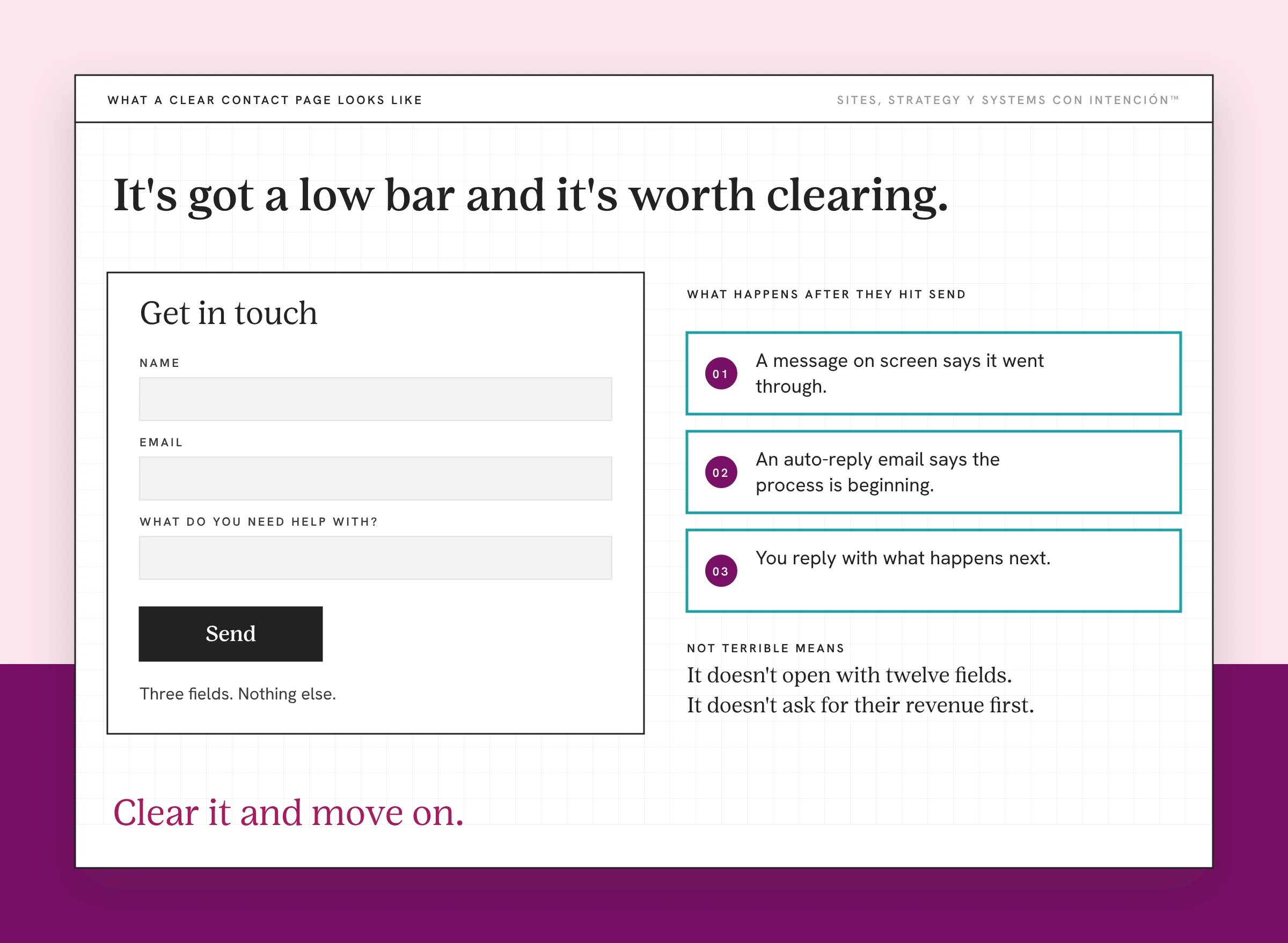
That's the whole standard. Clear it and move on, because past that point the contact page is rarely the thing standing between you and inquiries.
The Path of Someone Who Doesn't Reach Out
This journey's more ordinary than it sounds.
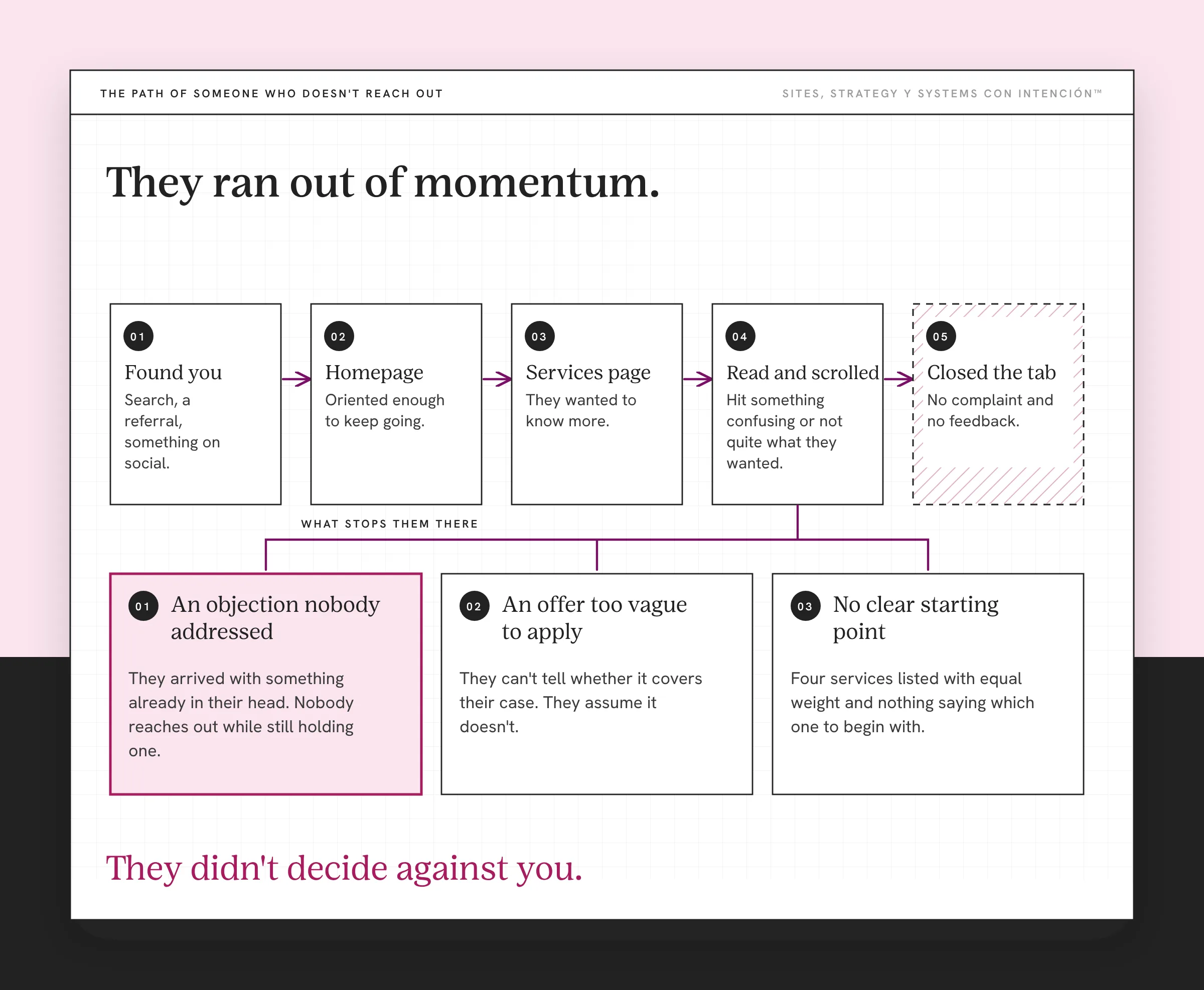
They found you somehow. Search, a referral, something on social. They landed on the homepage and got oriented enough to keep going, so the homepage did its job. They clicked through to services because they wanted to know more.
Then they read it, scrolled, hit something that was either confusing or not quite what they were looking for. Then they closed the tab.
They didn't decide against you. They ran out of momentum and nothing on the page rebuilt it. That distinction matters because the two problems have completely different fixes and almost everybody assumes the first one.
What Stops Them There?
Three things and each one's fixable on the page you already have.
An objection nobody addressed. They arrived with something already in their head. It's too expensive for where I am, my situation's more complicated than this, I tried something like this before and it didn't work. A page that never names the objection leaves them holding it, corazón. Nobody reaches out while still holding one.
An offer description too vague to apply to them. They can't tell whether it covers their case. Rather than ask, they assume it doesn't, because assuming no costs them nothing and asking costs them something.
No clear starting point. Four services listed with equal weight and nothing indicating which one somebody like them usually begins with. Choice overload is well documented: past a certain number of options people get slower, less satisfied and more likely to pick nothing at all. Your services page is a menu and it needs a recommendation before choice overload costs you clients.
What Is Momentum, Exactly?
It's the thing you're managing on a services page. Almost nobody describes it that way.
They arrive with some. Every sentence either adds to it or spends it. A paragraph that names their situation adds. A paragraph describing your methodology to somebody who hasn't decided they need you spends. Vagueness spends the most, o sea they have to work just to translate what you meant.
When it runs out they leave. Not dramatically, with no complaint and no feedback, which is why losing people with no clear next step is so hard to see from inside the business, claro.
So the services page has to be built for a decision rather than a description. A description hands them the translating and the translating is what spends it.
What Goes on the Page
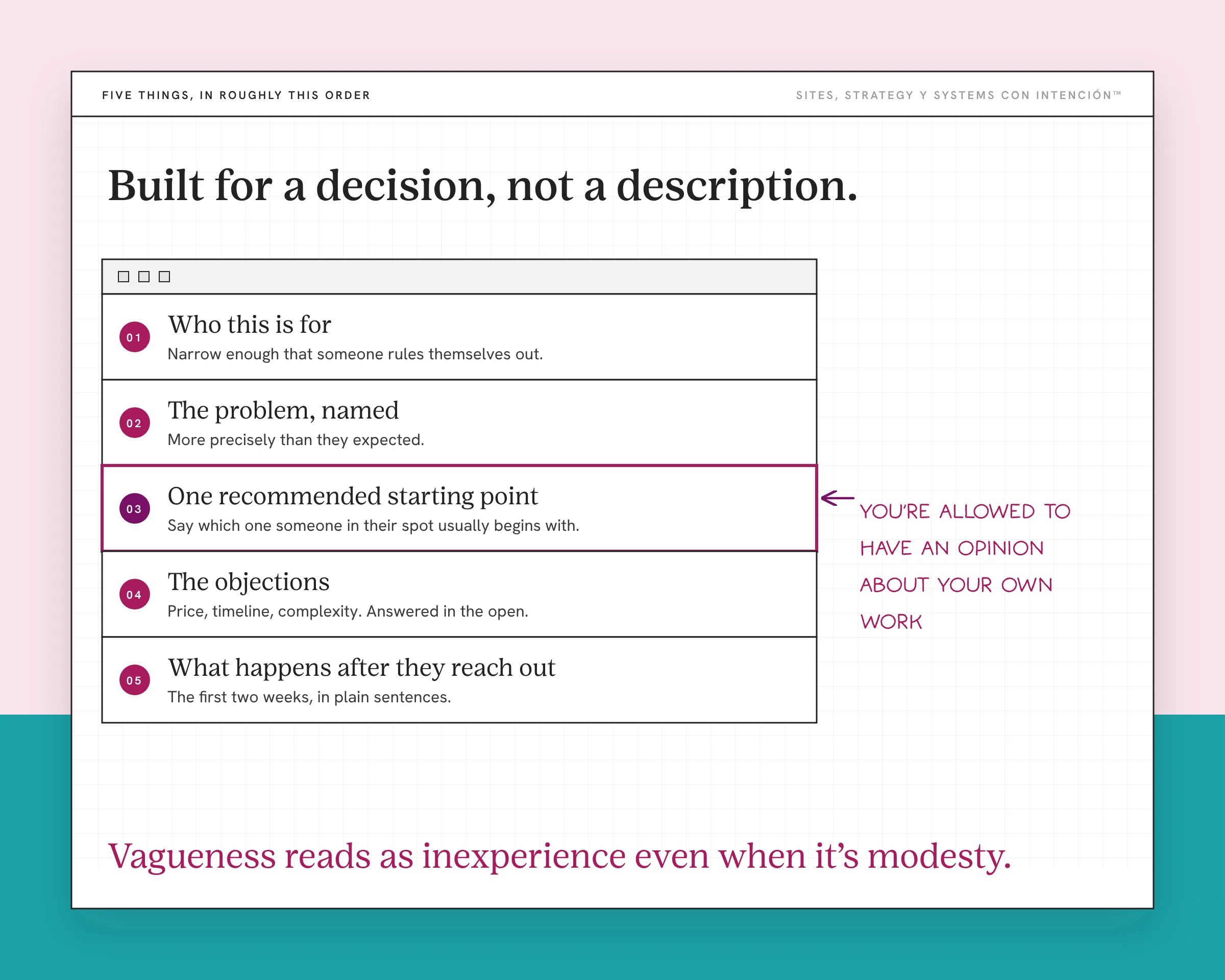
Five things, in roughly this order.
1. Who this is for, stated narrowly enough that somebody rules themselves out. The excluding half's what makes the including half believable.
2. The problem named more precisely than they expected. That's where trust gets built and it costs nothing. It's also what the whole site is being read for, which is why a site that skips it won't convert. It's the same move a well-written about page makes when it works.
3. One recommended starting point. If you have four services, say which one somebody in their spot usually begins with and why. Dale, you're allowed to have an opinion about your own work.
4. The objections, answered in the open. Price, timeline, complexity, whatever you hear on calls. The ones you hear most belong on the page.
5. What happens after they reach out. The first two weeks, in plain sentences. Vagueness here reads as inexperience even when it's modesty. Where that ask sits on the page is its own decision.
A services page doing its job means the call opens on logistics. On one client's site the copy started saying who the offer was for, showed a starting-at price and answered the repeat questions in an FAQ. They got fewer inquiries, but the ones that came in were a better fit and they fielded fewer repeat questions.
What Fixing the Services Page Won't Fix
Three things sit outside this.
If the homepage never oriented them, they never reached the services page at all. That's the homepage's job, a different page entirely.
If the menu buries services behind About and a blog, the page can be excellent and unvisited. Navigation order decides what gets found. It's one of those website strategy details that's easy to overlook.
And if the words describe rather than helping somebody choose, no amount of restructuring saves it. That's what website copy is for.
One more, because it's the most common wrong turn. More traffic doesn't fix this. A page that converts nobody at three hundred visitors converts nobody at three thousand and you'll have paid for the privilege of finding that out at scale. Pa' lante with the page first.
Quick Check: Is It Your Services Page?
Before touching the contact form, run through this.
- Can you clearly tell who each offer is for in one sentence, described as a situation somebody recognizes?
- Is there an obvious starting point for someone who isn't sure which offer fits?
- Does the page address the hesitation a buyer would show up with (timing, investment, fit)?
- Would a stranger who's never heard of you feel ready to reach out after reading it or would they need to talk to you first to feel clear?
If any of those are a no, that's where the inquiry is getting lost and the form was never the thing standing in the way.
Key Takeaways
- Where the inquiry gets won depends on how they arrived, how ready they were and how big the engagement is. Those three stack.
- Across all three the services page carries the most weight, because it's where they're deciding.
- The contact page has one low bar: don't ask for more than you need and don't hide what happens next.
- Three things stop them on the services page. An unanswered objection, a description too vague to apply to them, no recommended starting point.
- They rarely decide against you. They run out of momentum and nothing on the page rebuilds it.
I fixed my services page and inquiries are still flat.
In one private session from $350 we'll figure out where the inquiry is getting lost and what to change. Bring your site and your numbers. Notes are included.
Frequently Asked Questions
How do you convert website visitors into clients?
Match the page to who arrived. A cold search visitor needs the page to do the whole job; a referral needs it to confirm what they already heard. Then make the services page do the deciding: name who the work is for narrowly, describe the problem more precisely than they expected, recommend one starting point, answer the objections you hear on calls and say what happens after they reach out.
Why do people visit my website but never inquire?
Usually because they ran out of momentum on the services page. They were interested enough to click through, then hit something vague or unanswered and closed the tab. That reads like disinterest from your side and it almost never is. The tell's traffic that looks healthy with a contact page nobody reaches.
Is my contact form the reason I am not getting inquiries?
Rarely, though it's worth ruling out in ten minutes. If it asks for revenue, ten fields of detail or anything you don't need in order to respond, fix that. Once it asks only what you need and says what happens next, the contact page has cleared its bar and the problem's upstream.
What stops website visitors from becoming paying clients?
An objection the page never named. A description too broad for them to place themselves in. Too many options with no recommendation. All three produce the same behavior, which is a visitor who reads everything and asks for nothing. The person who wrote the page can't see any of the three.
Does website copy affect conversion for service businesses?
For a service business, a lot. You're selling a judgment call the buyer can't inspect in advance, so the words carry much of the evidence. Copy that describes leaves them to work out whether it applies. Copy that helps them decide does the work they came for.
Should I get more traffic if my website is not converting?
Not first. Traffic multiplies whatever rate you already have, so a page converting nobody stays a page converting nobody with a bigger bill attached. Fix whatever's stopping people on the page, confirm inquiries respond, then buy traffic once you know what it's buying into.
Does it matter how someone found my site?
It changes what the page has to do. Somebody who found you cold needs establishing, proving and directing, in that order, from scratch. Somebody a former client sent needs one thing confirmed. If your analytics show referral traffic converting well while search traffic doesn't, it could be who search is sending you. It could also be a page that only ever learned to confirm.
About the Author