Nobody deciding whether to hire you is reading your about page to get to know you.
They're reading it to decide whether they can trust you. Those two goals ask for completely different pages. The second one is the page almost nobody builds.
Think about the merch table at a show. Two shirts on it. One has the tour dates listed down the back in order, every city, which is a record of where the band has been. The other says one line that only makes sense if you were there. Pues, the second one always sells out first because it recognizes you. A boyband that has been touring for twenty years knows exactly which shirt is doing the work.
Your about page has the same two versions available to it. Most about pages print the tour dates.
The Short Answer
How to write about page copy starts with the page's job, which is to build trust fast enough that they click through to your services. It answers three questions in order: do they understand my world, do they have the credibility to help me, do I like how they think. Personal material earns its place by answering one of those.
If You're Reading This Because It's Your Site
Reading more isn't the hard part. La Jugada is $47 and it tells you which layer this is actually sitting in.
Get it, $47What Is the About Page Actually For?
One job: build trust fast enough that they click to the services page.
That's the whole brief. It isn't to be interesting, it isn't to be liked and it isn't to cover your history. They arrived with a question already in their head, the kind Nielsen Norman Group's About Us research documents. The page either answers it or sends them back to wherever they came from.
Which means an about page can be well written, warm, honest and completely unsuccessful, because those aren't the same standard. It's one of the few pages where a good writer is at a disadvantage, since the instinct to tell the story properly is the instinct that ruins it.
The Version That Costs You Trust
You know this page. You've probably written it.
It runs the whole story in chronological order, starting somewhere around childhood. The early interest, the job that wasn't right, the pivot, the I used to do X and now I do Y arc. It's well written and it's often moving. By the end of it the reader still can't tell whether you can be trusted to solve their specific problem.
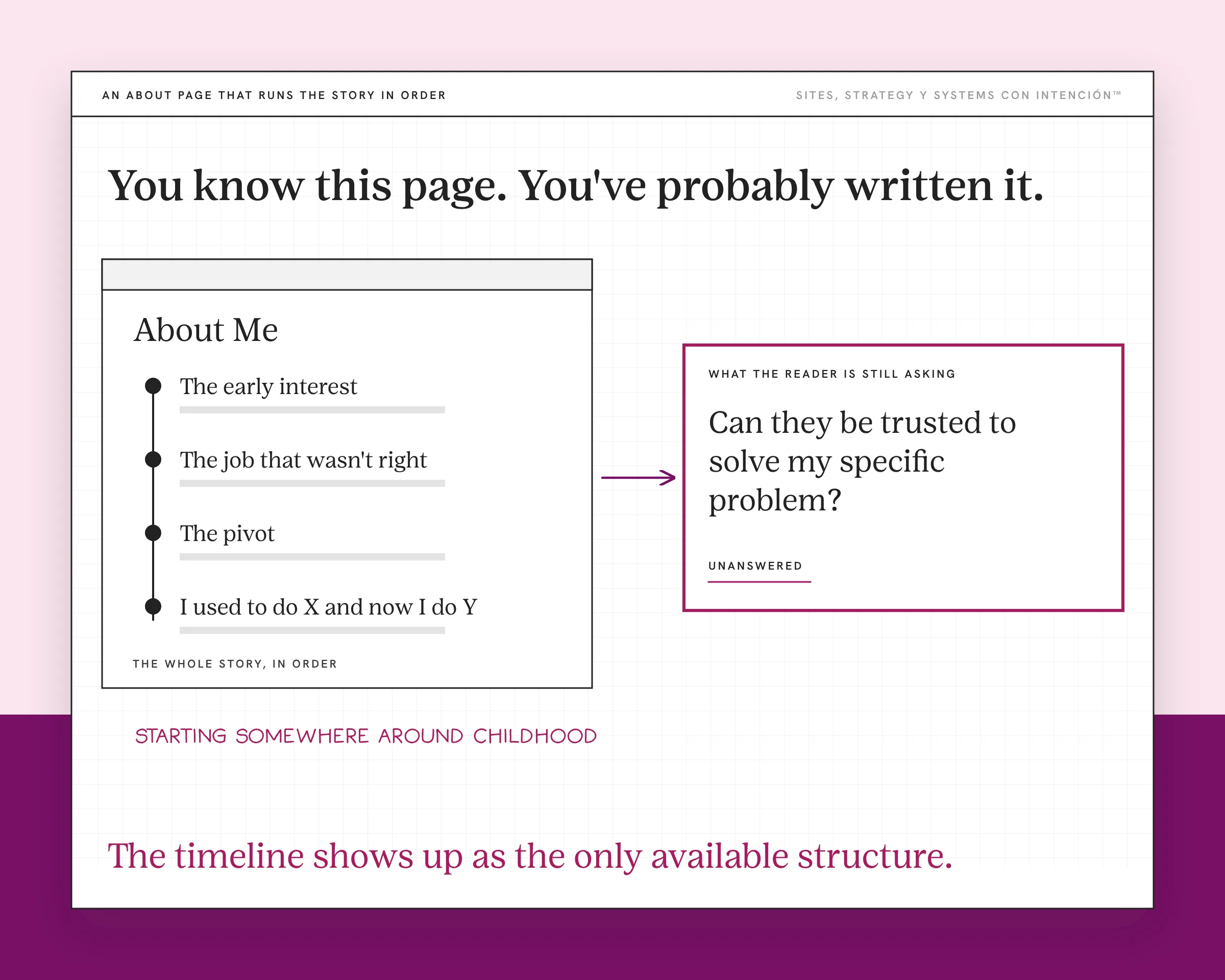
The personal material isn't what's wrong. It matters, but only in service of why you're the right person for this work. A detail that shows you've met their situation before is doing work. The same detail included because it's true about you is taking up space between them and a decision.
This is the most sympathetic mistake on the whole site, bendito. Nobody writes a chronology out of ego. They write it because a life story has an obvious order and a trust argument doesn't, so the timeline shows up as the only available structure.
The Three Questions, In This Order
This is the structure and it doubles as the test for every paragraph you're thinking about keeping.
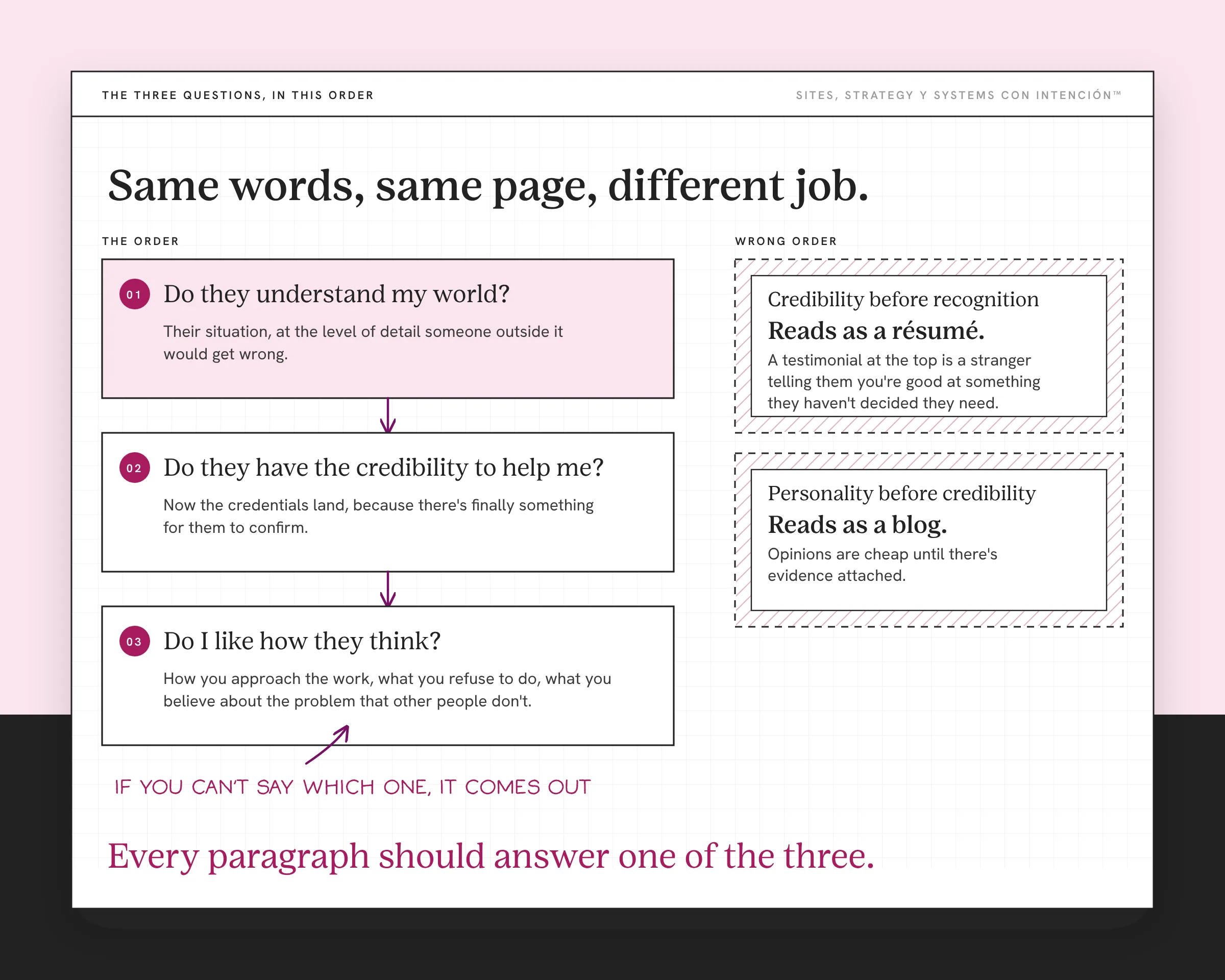
1. Do they understand my world. Not the industry. Their situation, at the level of detail someone outside it would get wrong. This is where you earn the right to be read any further.
2. Do they have the credibility to help me. Now the credentials land, because there's finally something for them to confirm. Years, volume, the kinds of businesses you've worked on, the mistakes you made early enough to recognize quickly now. It's the same thing Google's guidance on helpful content asks of any page: whether it shows first-hand expertise.
3. Do I like how they think. The part people skip or the part people make into the whole page. It's how you approach the work, what you refuse to do, what you believe about the problem that other people don't. Brand voice carries this and opinions carry it better. I've seen it on my own site: once the copy sounded like me, people started quoting lines of it back to me in inquiries and DMs, saying they felt like they knew me before we'd ever spoken.
What Happens When You Get the Order Wrong?
The same material stops working, which is the part that's hard to believe until you watch it.
Credibility offered before recognition reads as a résumé. A testimonial at the top of the page is a stranger telling them you're good at something they haven't decided they need. Move that identical testimonial below a paragraph that names their situation and it turns into confirmation. Wepa. Same words, same page, different job.
Personality offered before credibility reads as a blog. You come across as somebody with opinions before you've come across as somebody with a practice. Opinions are cheap until there's evidence attached.
I've reordered a client's About page exactly this way. It opened on the situation their clients were in and the credentials moved underneath, where they had something to confirm.
So every paragraph on the page should be answering one of the three. If you can't say which one, it comes out.
Where Should the Personal Story Go?
Wherever it answers one of the three, which is usually question one or question three.
Stanford's web credibility research makes the mainstream case for this: show the real people behind the site, give their credentials, then humanize the organization with bios that cover family or hobbies. That instinct is sound. The refinement is that humanizing only helps when it's answering a question they're already holding.

The origin story works when the thing you pivoted away from is the thing they're currently inside. Then it reads as recognition. The hobby works when it explains how you think about the work. Otherwise it's warmth in a place where they wanted evidence, nena. Warmth doesn't survive the comparison they're about to run between you and two other people. That comparison is what a service business website has to be built for.
About Me or About Us?
The search results for this are full of organizations. Your reader usually isn't one.
For a solo or a small business, those two pages are the same page. Trying to sound like a company costs you the only advantage you've got. We have over a decade of experience serving clients across industries is website messaging that could belong to anybody and it answers none of the three questions. Mija, the "we" is doing the opposite of what you hired it for.
The plural is worth using when there are other people whose work they'll encounter. If they're going to work with you, the page should sound like you. That's accuracy, not informality.
What to Cut
Four things. On a page built as a timeline, cutting them shortens it a lot.
The chronology. Order the page by their three questions. The timeline is the structure I see most and it's the wrong one for this job. The same reordering logic runs across the whole site when you structure it for conversions and it's the same argument planning a website structure makes about pages.
The mission statement. I believe every business deserves a website that works tells them nothing they can use. Everybody says it, which is how you can tell it isn't yours. It's a common website copy mistake.
The credentials with nothing to confirm. A logo wall before recognition is decoration. Move it after question one and it becomes evidence.
Anything that exists because about pages usually have one. A team photo with one person in it. A values list. A timeline graphic. A template asks for these and the template isn't looking at your business. If it isn't answering one of the three questions it's sitting between them and the services page, which is an organizing problem as much as a writing one.
What the About Page Won't Do
Three things sit outside it.
It won't close anybody on its own. The about page hands them to the services page. That's where the inquiry gets won or lost and where website visitors turn into clients.
It won't orient a stranger. If they arrived at the about page first and can't tell what you do, that's the homepage's job leaking into this one. It also won't matter much if the menu buries it, since nav order decides what gets found at all.
And it won't rescue copy that describes when its job is to help them choose. That shows up on every page, which makes it the whole job of website copy. Copy that helps someone choose is the center of my whole approach to content strategy.
One ordering note. If you haven't settled who the work is for and who it isn't, the about page can't answer question one. That decision comes before writing the website copy, on this page and every other one. It's also what turns a reader into a lead worth following up with.
Key Takeaways
- The about page has one job: build trust fast enough that they click to services.
- They aren't reading it to get to know you. They're reading it to decide whether they can trust you, which is a different page.
- Three questions in order: do they understand my world, do they have the credibility to help me, do I like how they think.
- The order is what makes the material work. A testimonial before recognition is a stranger's opinion. The same testimonial after it is confirmation.
- Personal material earns its place by answering one of the three. Chronology is the wrong structure and the most common one.
I'd rather talk through who my about page is really for.
Book one private session on your real question. Bring your site and whatever's bugging you about the page. It starts at $350 and notes are included.
Frequently Asked Questions
What should an about page include?
Three things in order. Evidence that you understand the reader's situation at a level of detail an outsider would get wrong. The credibility that confirms it, once there's something to confirm. Then how you think about the work, including what you refuse to do. Anything that doesn't answer one of those three belongs somewhere else or nowhere.
What are common mistakes on an about page?
Telling the whole story in chronological order starting from childhood. Leading with credentials before the reader has been recognized. Opening with a mission statement everybody in the industry shares. Including material because about pages usually have it. Each mistake produces the same result, which is a reader who finishes the page and still can't tell whether you can help them.
Should an about page be written in first or third person?
First person if you're branded under your name, third if you aren't. That's the whole rule. If your business carries your name, the reader came looking for you and third person puts a press officer between the two of you at the exact moment you want nobody there. If the business has its own name and its own team, third person is just accurate.
How long should an about page be?
Long enough to answer the three questions and no longer. When an about page runs long, it's usually because the chronology is padding it. Order the page by the questions and you'll usually find half of it was serving the timeline.
What is the difference between an about page for a personal brand and an organization?
For most small businesses there's no difference, because the personal brand is the organization. The pages diverge once the reader will work with someone other than you, at which point they need to know who that is. Writing as a company before that's true reads as inflation and it gives up the specificity that was working.
Where should the personal story go on an about page?
Wherever it answers one of the three questions, usually the first or the third. An origin story lands when the thing you left is the thing they're currently inside. A detail about how you think lands when it explains your approach to the work. The same detail included because it's true about you is what makes about pages long and unpersuasive.
How do you make an about page feel authentic without oversharing?
Authentic isn't a volume setting, so the fix isn't more disclosure. Pick the details that answer one of the three questions and write them plainly. A reader can tell the difference between somebody being open and somebody performing openness. The tell is usually whether the detail helps them decide anything.
About the Author