Think about a crowd screaming lyrics back at the stage. Nobody taught them those words in the room. They already believed the line before they walked in, which is why it lands as recognition. Mira, copy that works does the same thing. Every guide on this starts at step one when step one is already too late.
Define your goals. Then do your keyword research, then get clear on your audience. All of it reasonable, all of it skipping the one thing that determines whether any of the rest produces copy someone acts on.
I've watched people rewrite the same homepage over and over for months. The writing wasn't the problem any of those times.
The Short Answer
How to write website copy is mostly a sequencing problem. The writing goes badly when decisions that belong before it haven't been made. The first of those is who the work is for and who it isn't. Once that exists the drafting gets faster, because writer's block is usually an unmade decision showing up as a blank page.
If You're Reading This Because It's Your Site
Reading more isn't the hard part. La Jugada is $47 and it tells you which layer this is actually sitting in.
Get it, $47What Has to Be Decided Before You Write Anything?
Copy is downstream of positioning. That's the whole rule and everything below is what it means in practice.
When someone sits down to write a services page without having settled who the service is for, the page comes out describing the service. That's the only thing left to write about. The description is accurate. The reader can't tell whether it applies to them, so the page gets rewritten before long.
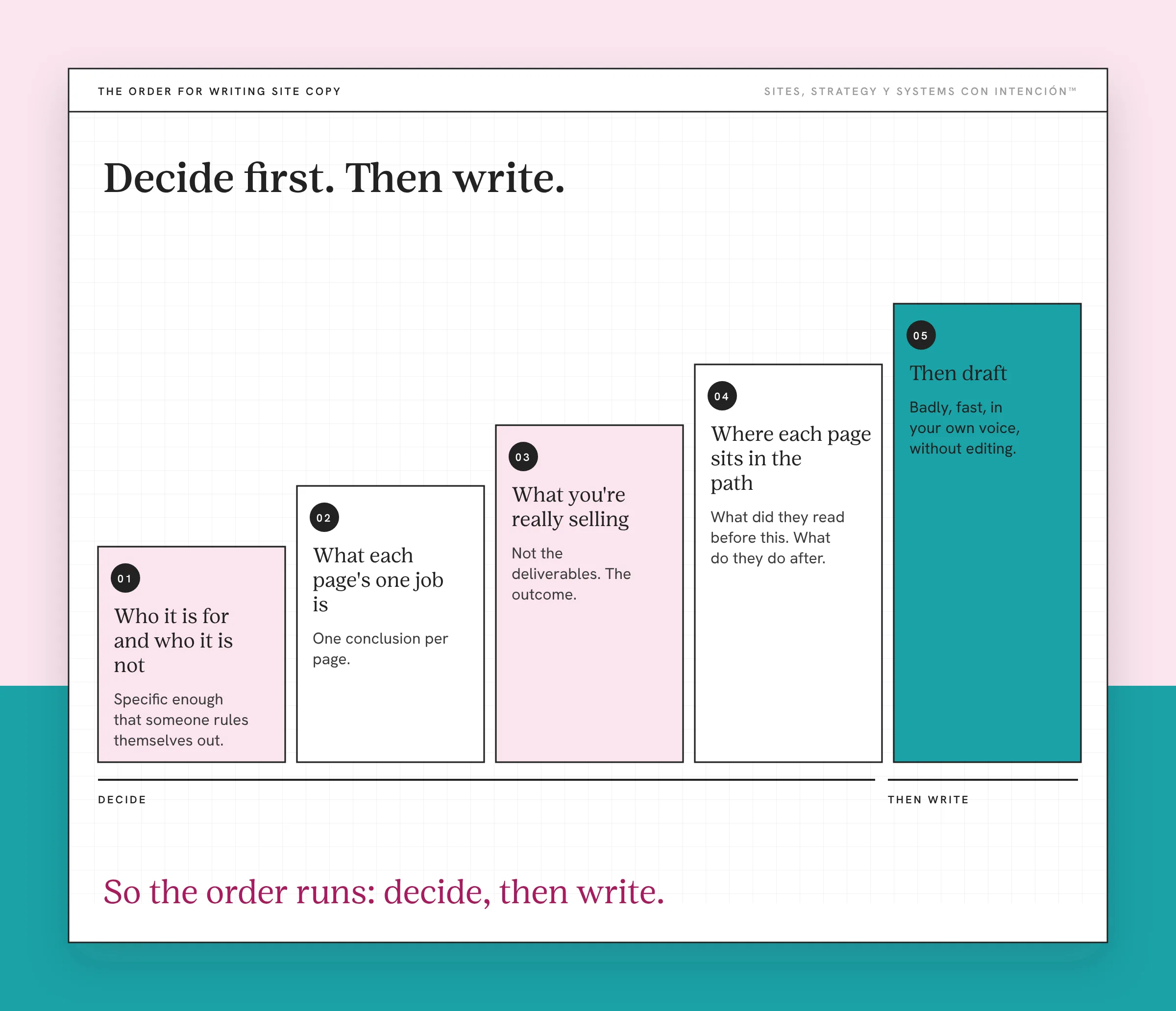
So the order runs: decide, then write. Y en ese orden. Deciding while writing is the default and it's why the page takes several attempts.
Step One: Who It Is For and Who It Is Not
The first decision is the one people skip hardest, because the second half of it costs something. It is also a positioning question, part of your website messaging strategy, before it is a writing one.
Naming who your work serves is comfortable. Naming who it doesn't serve feels like turning away money, especially on a site that's already producing silence. So the page gets written wide enough to include everybody and a page that includes everybody describes nobody. It's one of the most common website copy mistakes.
You have to be specific enough that someone rules themselves out. Compare two ways of saying who it's for. "For service-based businesses" costs nothing, sorts nobody and is how a website quietly loses you clients. "For founders with steady traffic and no inquiries" sends the wrong readers away before they reach your form, which saves you both a call.
This is also the decision the rest of the sequence depends on, the same one that decides what should be on your homepage. You can't rank what matters on a page until you know who is reading it. Why this kind of website copy converts is its own argument.
The Rest of the Sequence
There are four more decisions and they run in this order.
2. What each page's one job is. One conclusion per page. The services page is where someone decides your work fits their situation, the step that converts website visitors into clients. The about page is where they decide they trust you. When a page has two jobs pulling the reader in different directions, it does neither and you find out months later.
3. What you're really selling. Not the deliverables, the outcome, esa es la diferencia. People write the deliverables because the deliverables are knowable and the outcome takes work to articulate. The reader is buying the second one.
4. Where each page sits in the path. What did they read before this. What do they do after. Copy written page by page in isolation reads disconnected even when every page is good on its own. A service business website strategy treats the pages as one path, which is why how your website content is organized has to be settled first.
5. Then draft. Badly, fast, in your own voice, without editing. Your website structure is already settled by now. The draft is easier than people expect once one through four exist, because there's nothing left to decide while writing. Deciding before writing is how I run content strategy too.
What Does the Wrong Order Actually Cost?
What it usually costs is months.
The pattern I see is someone who writes it themselves, isn't happy with it, rewrites it, is still not happy. The site sits half-finished or underperforming for a season while they work up to the next attempt. Nobody sends an invoice for that. It's the more expensive version.

I've seen both versions with my own clients. On the project where we settled who it was for before anyone wrote a word, the copy took one round of edits. On the one where the copy came first, it went through several rewrites.
There's no number attached to this and I'm not going to invent one. What I can tell you is that the time that belonged to deciding goes into rewriting and the rewriting is what doesn't work.
Should You Hire a Copywriter?
Often, yes. And this is the part the rest of the internet can't tell you straight.
A lot of what ranks for this keyword was written by people who sell copywriting. Their advice about whether to hire a copywriter is shaped by the fact that they're the copywriter. I'm not one. Copy is part of the sites I build, so take this with that in mind.
Here is the honest answer. Hire one whose scope includes positioning. Failing that, have your positioning settled before you hire one.
That's the whole criterion. A copywriter handed unsettled positioning will produce beautiful copy for a business that hasn't decided what it is. You end up disappointed in work that was never the problem. A copywriter who does brand and messaging as part of the engagement is a different purchase. It's usually the right one if you haven't done step one.
And a good copywriter has technique that doesn't come from anywhere else. Rhythm, the way an objection gets handled before the reader has finished forming it, the reason one word outperforms its synonym. That's a craft. It's worth paying for once the decisions underneath it exist. Mailchimp's writing principles show some of the deliberate choices behind copy that reads as effortless: purpose, audience and what the reader needs to know get decided before anyone writes.
Can You Use AI to Write Website Copy?
Sometimes it's hard to start from a blank screen. AI helps with that and I'm not going to pretend otherwise.
What it doesn't do is know what it doesn't know about your business. Your positioning. Which clients you turn away and why. What twelve discovery calls taught you about the objection everybody has and nobody says outloud. None of that's in the prompt, so none of it comes back in the output.
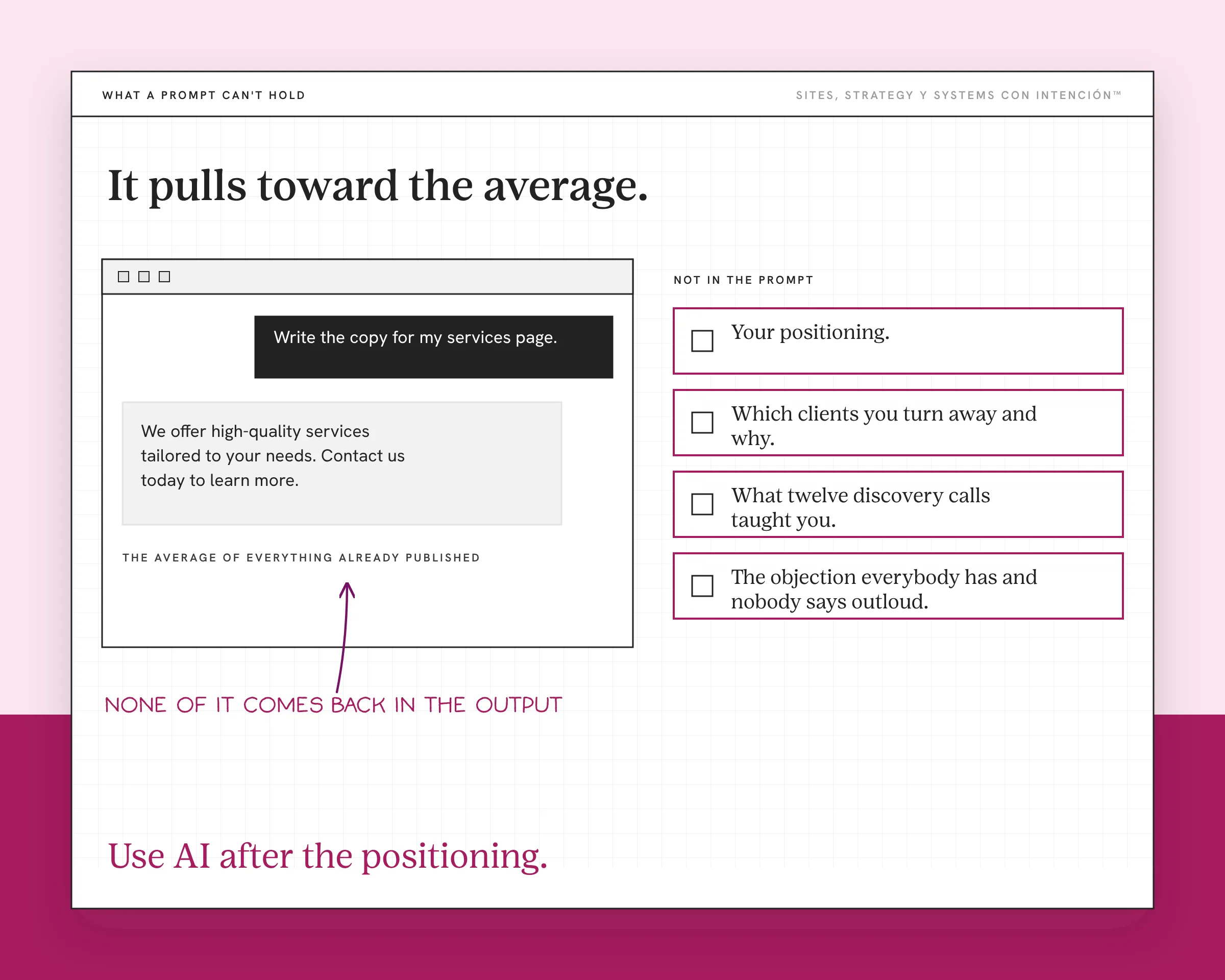
The other thing is that it pulls toward the average of everything already published on the topic, which is the exact opposite of what a service business needs. And a model has to be trained. An untrained model gives you the middle of the road. Training one on your positioning and your voice changes what comes out and that's only possible if the positioning already exists.
So the same rule applies to the tool as to the hire. Use it after the positioning. Nothing it produces is final. It's a draft, nada más. Treating a draft as finished is where this goes wrong.
How Do You Know You're Ready to Write?
One test. It takes under a minute.
Say outloud who the page is for, in one sentence, the way you'd say it to someone sitting across from you. Digital.gov's plain language principles start with writing for your audience too.
If it comes out clean, you're ready. If you hedge, list three kinds of client or hear yourself adding but also, that's step one still open. The blank page isn't the problem in that case and no amount of staring at it will help.
Key Takeaways
- Learning how to write website copy is mostly sequencing. The writing goes badly when decisions that belong before it are still open.
- Step one is who it's for and who it isn't. The second half costs something, which is why people skip it.
- Hire a copywriter whose scope includes positioning. Failing that, settle the positioning first.
- Use AI after the positioning rather than instead of it. Nothing it produces is final.
- The readiness test: say outloud who the page is for. If you hedge, step one is still open.
Just tell me what to fix before I rewrite my copy.
Share your link and answer five questions. It takes about 10 minutes and you get a personalized read on your site, your marketing and your backend, plus the first move worth making. It's $47 and there's no call.
Want more like this in your inbox? Off the Clock is my week-ish newsletter about websites, systems and burnout-free business.
Frequently Asked Questions
What are the essential steps for writing website copy?
Five. Four of them happen before you write. Decide who it's for and who it isn't. Give each page one job. Work out what you're really selling. Map where each page sits in the visitor's path. Then draft, badly and fast, in your own voice. The default is to start at the drafting and make the earlier decisions while writing, which is why it takes several attempts.
How do you write website copy that converts?
By deciding what you want the reader to conclude before you write a word, then cutting anything on the page that doesn't serve it. Copy that converts helps someone reach a yes or a no. Copy that describes leaves them to work it out themselves. They usually don't. The specificity that makes this work is the same specificity that rules the wrong readers out.
How do you know you are ready to outsource your website copywriting?
When you can say who the work is for and who it isn't, outloud, without hedging. If you can, a copywriter can do their best work. If you can't, hire one whose scope includes positioning and brand messaging rather than copy alone. Handing unsettled positioning to a writer produces good sentences about a business that hasn't decided what it is.
How much do website copywriting services cost?
Enough that the order of operations matters. I'm not going to quote a range, because rates vary by scope, market and whether positioning is included. A made-up number helps nobody. What I'll say is that the difference between a copy-only engagement and one that includes brand and messaging is the difference that determines whether you get something usable.
Can AI be used to write website copy?
For a first draft, yes. The blank screen is a real problem it does solve. What it can't do is know your positioning, which clients you turn away or what your discovery calls taught you. It also pulls toward the average of what is already published. Google's guidance on helpful content asks whether content clearly shows first-hand expertise. That's the part a model has none of. Use it after the positioning rather than instead of it.
What comes first, the copy or the design?
The decisions come first, then copy, then design. Design built around placeholder text produces boxes that the real copy then has to fit. The copy loses that argument every time. A designer working from finished copy can shape the page around what needs emphasis, which is a user experience decision as much as a visual one.
How long should website copy be?
Long enough to get someone to a decision and no longer. Length is the wrong variable to optimize. A short page that only describes fails exactly the way a long one does, with less to work with. The useful question is whether a reader can reach a yes or a no by the end.
About the Author