Someone found you at nine on a Sunday night. They read the whole site twice. They liked it.
Then they closed the tab, because there was nothing on it to do. No way to see whether you had space. No way to tell which of your three services was theirs. Nothing to book, start, download or decide at all. Just a contact form at the bottom that asked them to compose an email describing their problem to a stranger, on a Sunday, with no idea what happens next.
Your website strategy for a service business comes down to one question that has nothing to do with design. Can they do anything here? Or can they only read? Across 100+ service business sites I've worked on in 12+ years, that's the line that separates the ones producing something from the ones that merely exist.
One definition before we go further, because "strategy" gets used for everything. Website strategy here means the decisions about what your site is for: what jobs it does, which of them it does without you, what a visitor can finish on it. The colors come later. So does the copy.
The Short Answer
A brochure site describes your business. A strategic asset lets someone act on it without you. The difference is measured in what a visitor can complete on their own: understanding which service is theirs, seeing what working together involves, taking a real next step at the moment they decide to.
If You're Reading This Because It's Your Site
Reading more isn't the hard part. La Jugada is $47 and it tells you which layer this is actually sitting in.
Get it, $47Can Someone Actually Do Anything on Your Site?
Ask what a stranger can actually complete on your site, start to finish, without emailing you and without waiting.
On most service business sites the honest answer is: read. They can read what you offer, read about you, read a few testimonials. Then the path runs out. The only thing left is to write to you and wait, which is a strange thing to ask of someone who hasn't decided yet.
A site that works is interactive in the plain sense of the word. It responds. They pick the thing that matches their situation and the site shows them that path. They want to know if this is affordable, so the site tells them. They're ready now, so they book now, at nine on a Sunday, without you being awake.
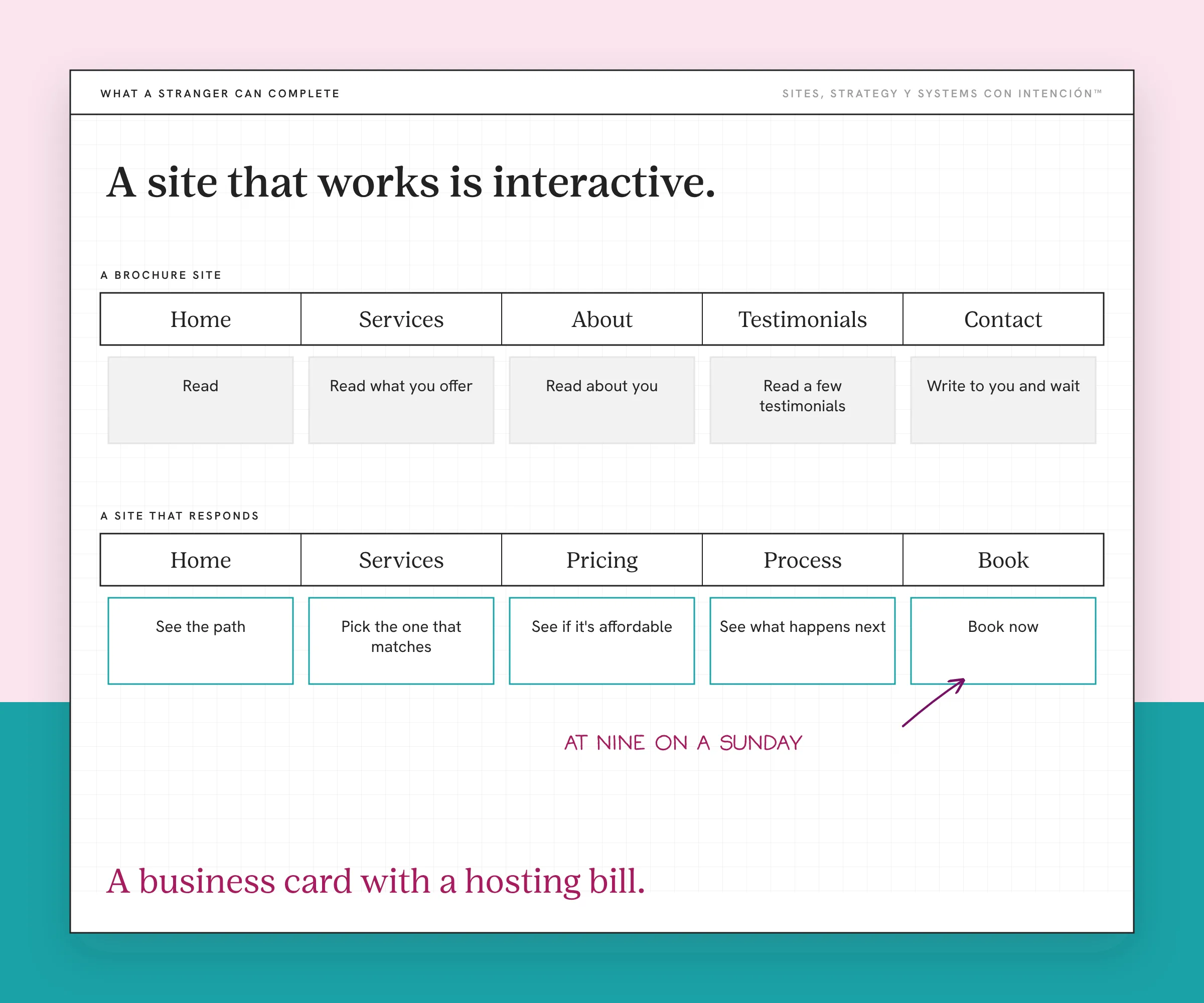
That's the whole distinction. It has nothing to do with how the site looks. Un sitio bonito that doesn't let anyone do anything is a business card with a hosting bill.
What Does a Strategic Asset Do While You Sleep?
Four jobs. A brochure does none of them, which is why it feels like it's working right up until you count what came from it.
It sorts people before you meet them. A visitor should be able to work out which service is theirs, plus whether they're a fit, all from the site alone. That's a positioning and messaging job before it's a design one. When it's missing, everyone reaches out the same way and you do the sorting manually on calls.
It answers the questions that otherwise arrive in your inbox. Pricing shape, process, timelines, what you need from them, what happens after they sign. Website copy that answers the real questions turns a discovery call from an interview into a conversation.
It builds trust without you in the room. This is what an about page is really for. It's why "about" pages built like a resume tend to earn less trust than ones that show judgment. Nielsen Norman Group's review of About Us summaries calls a page unfriendly when it opens without telling you what the organization does. Expensive thing to be, while someone is deciding whether to trust you with something that matters. Mira, they're not reading it for your biography.
It gives them a way to act at the exact moment they decide. Decisions are perishable. If the only available action is a contact form and a wait, you're asking them to hold that decision overnight. Overnight is where decisions go to die.
What Has to Be Underneath a Site That Works?
Those four jobs are what the site has to accomplish. Five decisions underneath them are what determine whether it can. Get one of these wrong and the job above it stops being possible, no matter how well the page is written.

Being findable at all, which is research and keywords, the basics of SEO. You can have the best site in the world and it doesn't matter if nobody gets there. This is the part that gets skipped because it happens before anything visible. It's where the different types of SEO either match what a service business needs or miss it.
Knowing who's arriving now, which is what buyer personas are for. The specific objection they're carrying when they land, plus the thing they have to believe before they book, measured against who's arriving today.
Nothing in the way, which is what UX and UI are for. Friction is rarely dramatic. It's a menu with too many items, a services page that makes them guess which one is theirs, a form asking for their revenue before anyone has had a conversation. Most of those are common website copy mistakes.
A next step that matches how ready they are, which is what a CTA is. On every page, including the ones nobody thinks of as conversion pages.
A path between the pages, which gets filed under internal linking and treated as an SEO chore. It's the difference between pages that work together as a system and a bunch of separate pages that happen to share a domain. It decides whether someone moves through your site or bounces around inside it.
The one I've watched come loose is the second. Lo he visto más veces de las que quisiera. The way it surfaces is unglamorous: I put a founder's site next to what they were selling. The services page pointed at one audience while the offers pointed at another. The clients they most wanted more of weren't described anywhere on the page.
They had read the shortage of right-fit inquiries as a marketing problem, so the effort kept going into more content and more visibility. All of it was being aimed by a site still built for the client they had stopped working with. The offer they cared about most was the one getting the fewest inquiries.
A foundation isn't a one-time build, y aquí está la parte que nadie revisa. It has to match the business it's holding. New offers, new positioning, a different audience than the one you started with. The foundation stayed where it was. The cracks turn up years later and the original build was usually right for the business that existed then. The business outgrew it and nobody went back to check.
Why Do Service Businesses Get This Wrong More Than Product Businesses?
A product site has an obvious job. There's a thing, it has a price, a button sits next to it. Nobody builds an e-commerce site and forgets to include the buying part.
Service businesses inherit the brochure by default, because the assumption underneath is that the real work of selling happens in conversation. The site introduces and the call converts. So the site gets treated as a place to look credible and nothing happens there.
That assumption held when the conversation was cheap and your calendar was empty. Once you're busy it inverts: every call the site could have prevented is now the constraint. The site stayed a polite introduction while the business became something that needs filtering.
Across the sites I've reviewed, fíjate, the ones that feel most "professional" are very often the most brochure-like. Restraint reads as polish. A site with nothing to click looks clean and performs like a pamphlet.
How Does a Brochure Site Show Up in Your Business?
You won't notice the gap from the traffic. You notice it from the shape of the work.
Discovery calls that start from zero every time, covering ground the site could have covered. Inquiries from people who were never a fit, since nothing filtered them, one of the quieter ways a website loses you clients. A month that was busy without moving anything forward. Referrals that hesitate, because sending your link requires a paragraph of explanation first.
None of that reads as a website problem. It reads as a you problem, which is why it goes unfixed for years. The business grew and the site kept doing the one job it was built for, which was describing a smaller version of you in its website copy. Ask my diagnostic question of it: does this site describe the business you're running right now? Or is it a time capsule from 18 months ago?
If several of those are true at once, the site is doing a different job than the one the business now needs. Calling it a website that isn't converting would be the kinder diagnosis.

Where Do the Conversions Actually Break?
Two of those five are where I see conversions break in ways people miss. Neither is the one people redesign first.
The CTA doesn't match where they are. Someone who landed forty seconds ago and someone who has been on your services page for six minutes need different next steps, yet most sites give them the same one. Every page ends with "book a call," including pages people read while they're still working out what you do. A first-time visitor isn't ready for a paid investigation. They might be ready for a two-minute read that tells them something useful. Sequencing the ask to their readiness is one of the most useful parts of conversion optimization on a service site.
The pages are strong and the path between them isn't. You can have a good services page, a good about page and a good case study, with no route that takes someone through them in an order that builds. That's a content organization problem. It's the one that survives a redesign when the redesign moves the furniture without changing the floor plan.
A third, quieter one: the site says it in copy with a voice nobody recognizes. They can't tell if they'd like working with you, so they keep looking. Voice is the most human part of content strategy and the easiest to lose.
Does This Mean You Need a Funnel or a Rebuild?
It isn't a funnel. If by funnel you mean the landing pages and emails built to sell one offer, a website and a sales funnel are different instruments and a service business usually needs the first to be solid before the second is worth building.
Most of the time it doesn't take a rebuild either. The gap between a brochure and an asset is usually four or five specific decisions. What makes it feel like a rebuild is that nobody has named which ones.
And it isn't only the website. The moment a visitor can book, download or apply on their own, something behind the site has to handle it without you. A booking link that leads to an empty calendar is worse than no booking link. The site can't be a strategic asset if the systems behind it are still you, manually, on a Tuesday.
Key Takeaways
- The question is whether a visitor can do anything on your site or only read it. That's the brochure-versus-asset line and design has nothing to do with it.
- A strategic asset sorts people, answers the inbox questions, builds trust without you, then gives them a way to act at the moment they decide.
- Service businesses default to brochures because the assumption is that selling happens on the call. That inverts the moment you get busy.
- It shows up as call-shaped symptoms first: discovery from scratch, misaligned inquiries, referrals that hesitate.
- Five things sit underneath a site that works: research and keywords, buyer personas, UX and UI without friction, clear CTAs, internal linking that makes the pages one system. A foundation has to match the business it's holding. Most of them stopped matching a while ago. The fix is four or five of those decisions. The hard part is naming which.
I'd rather talk through what my site should actually be doing.
Bring your site, your numbers and whatever's bugging you about how it works. We'll spend one private session on your real question and you'll leave with notes. Sessions start at $350.
Frequently Asked Questions
What is website strategy for a service business?
It's deciding what your site is for before you decide how it looks. That means choosing which jobs it does, which of those it does without you, what a visitor can finish on their own and what they still have to email you about. A service site with good strategy sorts people, answers the common questions and lets someone act the moment they decide.
How is a service business website different from a product website?
A product site has an obvious job: show the thing, price it, sell it. A service site has to do something harder, which is help someone decide whether an outcome they can't see yet is worth buying from a person they haven't met. That means the work is sorting, trust and sequencing.
What should a service business website include?
Enough for a stranger to self-select and act: a clear statement of who each service is for, the shape of what working together involves, honest answers to the questions that usually arrive by email, proof that's specific, plus a next step that matches how ready they are. A generic contact form that asks them to open the conversation themselves, with nothing around it explaining what happens next, is rarely enough on its own.
How do I know if my website is the problem?
The symptoms show up in your calendar before they show up in your analytics. Discovery calls that start from scratch, inquiries that were never a fit, referrals that need a paragraph of explanation attached. Traffic that arrives and leaves without doing anything. Any of those points at the site doing a smaller job than the business needs.
Do I need a full rebuild to fix this?
Not necessarily. Most of the gap between a brochure and a working asset is four or five decisions about sequencing, sorting and the next step. A rebuild is the right call when the platform itself blocks those changes. Working out which situation you're in is the thing worth doing first.
My website looks great. Can it still be the problem?
Yes. This is the common case. Looking professional and doing a job are unrelated. A restrained, elegant site with nothing to click reads as polished and performs like a pamphlet, which is why "it looks fine" delays the fix for years.
About the Author