You went looking for a straight answer about the types of SEO and came back with a list of twelve. Possibly fourteen. One of them had six and seemed suspiciously calm about it.
None of those lists is wrong, exactly. They describe a field the way a field describes itself to the people already working in it. What none of them does is tell you which of the twelve is your job, which is the only part you were asking about.
Uno piensa que the number is the point. Across 100+ service business websites over 12+ years, the number has never once been the useful question. I work in four.
Worth defining the word before we cut anything: a type of SEO is a discipline with its own skills, its own tools and its own person. A sub-task is a job that lives inside one of those disciplines. Most of what gets published as a type is the second thing.
The Short Answer
A service business works in four types of SEO: on-page, technical, local and answer-engine optimization. The fourth grew out of the first three and it's the newest reason to do them well. A fifth, off-page, is real and worth checking, though it's a discipline of its own rather than something most service owners run themselves. The rest of the list is usually sub-tasks carrying new names.
If You're Reading This Because It's Your Site
Reading more isn't the hard part. La Jugada is $47 and it tells you which layer this is actually sitting in.
Get it, $47How Many Types of SEO Are There, Really?
The count goes up for a reason that has nothing to do with search engines.
Every sub-task that gets big enough to sell becomes a type. Someone builds a tool for it, someone writes a guide, someone offers it as a package. By the time you read about it the thing has a name and a number and a place in the list. Image SEO is a real job. It's also three things you do on a page. Voice SEO is a real consideration. It's also a way of writing that you're either doing or not doing inside your existing copy.
Poco a poco the list grows. None of the additions are lies. They're just not disciplines with their own skills, their own tools and their own person.
You can feel the difference if you ask one question of any item on a twelve-item list: would you hire a separate person for this? For on-page, technical, local and off-page the answer is plausibly yes. For image SEO the answer is no. The reason you can't picture that job posting is that it isn't a job.
If the underlying question is what SEO even is and whether it's worth your time, that's why SEO matters for small businesses, a different and more foundational conversation. It comes before this one.
On-Page, Which Already Includes the One Called Content
On-page is everything you control on the page itself. Titles, headers, URL structure, meta descriptions, alt text, internal links and the copy.
That last item is the whole reason "content SEO" keeps appearing as its own entry. Content SEO is on-page SEO with the emphasis moved onto the words. The tasks are the same tasks, the tools are the same tools and the person doing it is the same person. Splitting them into two types gives you two lists to feel behind on.
Image SEO and voice SEO fold in the same place and for the same reason. Compressing a file and writing alt text is on-page. Writing in the way people ask questions outloud is on-page.
This is also where the highest-leverage work usually sits for a service business, because it's the only category where you own everything and need nobody's permission. The clearest version I can point at publicly is a photographer's site: titles, metadata, alt text and page copy rebuilt around what people were really typing, plus the redirects repaired after a platform migration had broken them. No link building. No ads. Comparing the three months before the work with the three months after, organic sessions from Google went from 63 to 258 and her target keyword moved from position 20 to 8.2.
Improving a post you already published and an internal linking strategy that connects your pages are both on-page. Both are available to you this afternoon.
Technical, Which Already Includes the One Called Mobile
Technical is whether search engines can crawl, read and index the site at all, punto. Site structure, speed, canonicalization, structured data, broken things, redirects.
Mobile belongs here. Y aquí me pongo pesada: I don't really consider mobile a type of SEO. It's a condition your site is in. A site that doesn't work on a phone has a technical problem, the same as a site that takes nine seconds to load or blocks its own crawlers. Treating it as a separate discipline suggests there's a mobile specialist to hire, when what there's instead is a technical problem with a specific symptom.
Good technical work is the automation at midnight that still runs two years later, the one nobody has thought about since and nobody has ever praised. You find out it existed on the day it stops. Technical is also where an outdated site that has fallen behind the business tends to show it first. Structure built around an older version of the business keeps working perfectly while pointing in the wrong direction.
What Counts as Local SEO?
Local is the layer that decides whether you appear when someone searches with a place attached. Or with no place attached and an obvious local intent.
The unglamorous core of it is NAP: name, address, phone, consistent everywhere it appears. Directories, your Google Business Profile, your own site, the places you've forgotten you're listed. Consistency is most of the work and it's tedious, which is why it goes undone.
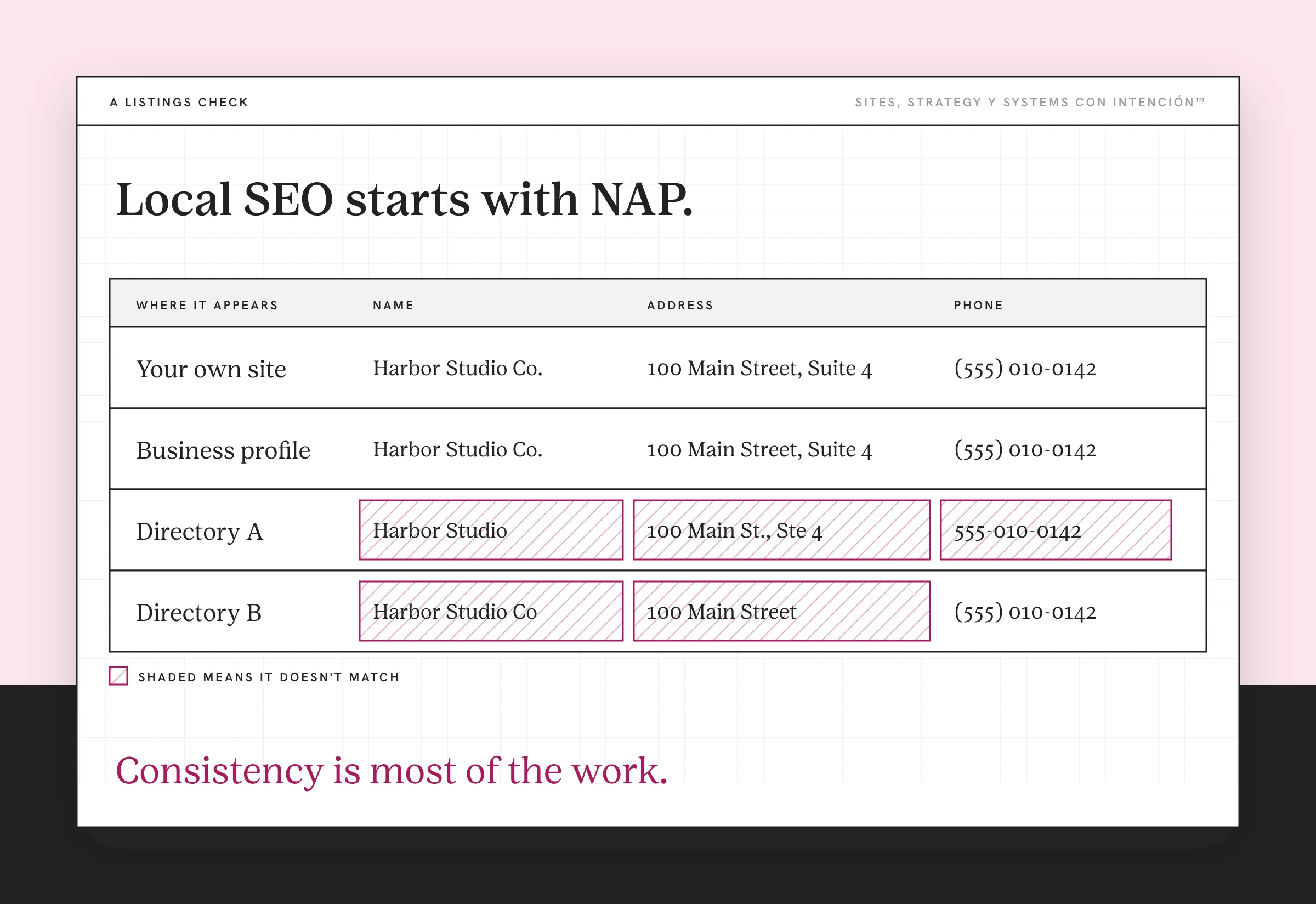
The count is what catches people out. There are more directories than anyone expects, each one needing to say exactly the same thing. What I find is almost always the same business described slightly differently across places someone stopped thinking about years ago.
Local is a full discipline with real depth. It deserves its own treatment rather than a paragraph here. What matters for this list is that it's on it, it's one of the four and NAP is where it starts.
Are Answer Engines a Different Kind of SEO?
This is where I part company with most of the lists.
All search is search to me. The question "what is AI SEO and how is it different from classic SEO" gets asked constantly right now. My answer is that the difference is smaller than the marketing around it. People ask questions. Something answers them. The surface has changed shape more than once. A plain list of ten blue links became a SERP with a map pack, a snippet and now a summary sitting above all of it. It'll change again. The work underneath has stayed recognizable: be findable, be clear, answer the actual question and be the source someone would cite.
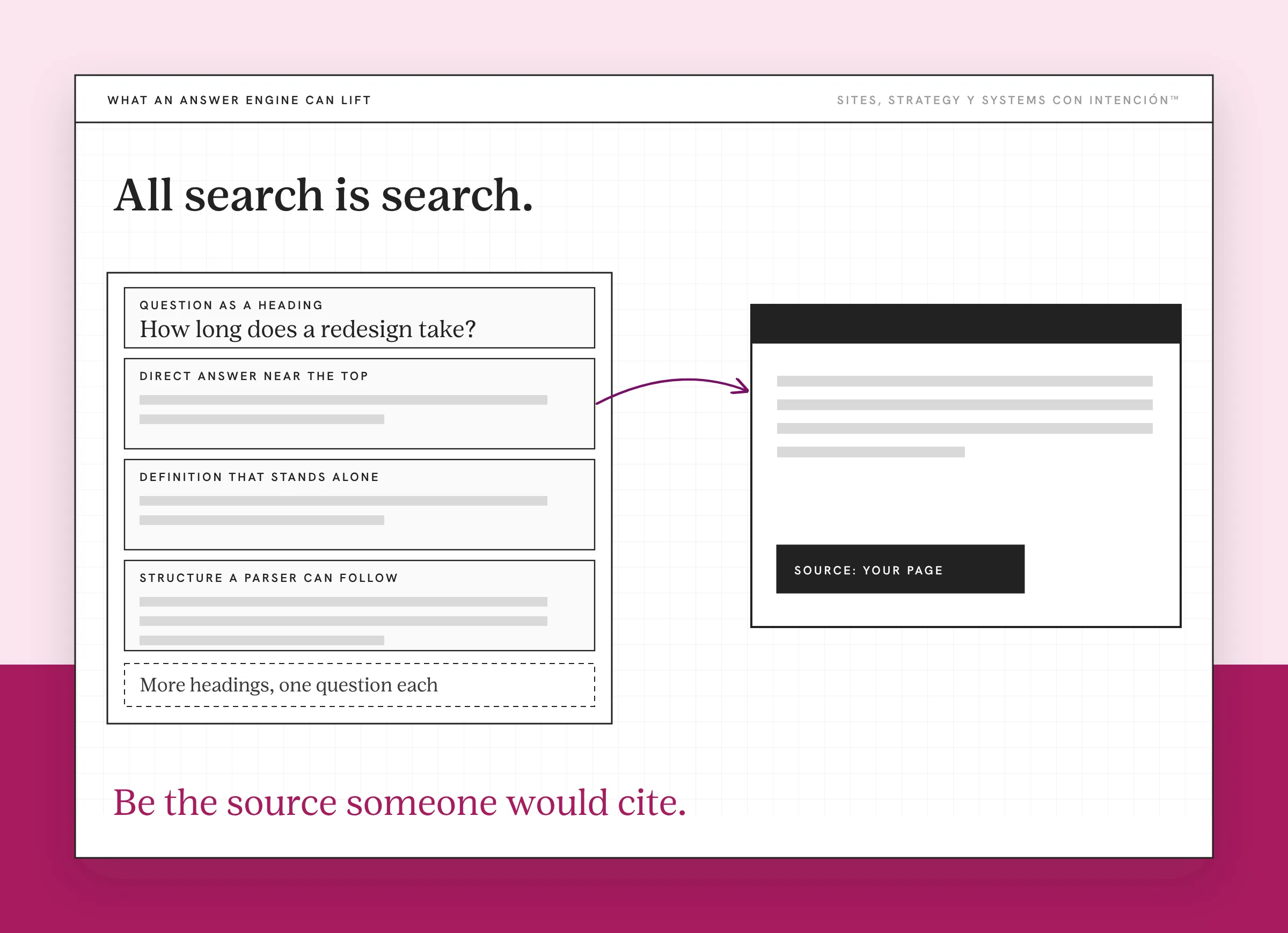
Pero aquí está the practical version. Optimizing for answer engines means writing so a machine can lift a clean answer out of your page without mangling it. A direct answer near the top. Questions as headings where the question is the actual section. Definitions that stand alone. Structure a parser can follow.
Read that back and notice it's also just good writing for people in a hurry. That's the point. It's why it sits fourth on my list. It grew out of the same job and it's the newest reason to do that job properly.
Off-Page Is Real. It Is Also Not Something I Sell
Off-page is everything that happens away from your site: links, mentions, citations, coverage, other people saying your name. Eso no lo controlas tú.
It matters and I check it on every site I look at. I want to be straight about the next part. Most articles on this topic explain off-page as though you're about to go and do it yourself. Off-page is a real discipline and it can take one dedicated person. Done properly it's outreach, relationships, pitching and follow-up, indefinitely. That's a role. It isn't a task you slot in between client work.
Al final del día, that's why I don't sell link building. Not because it doesn't work.
What is available to a service business is a different route into the same outcome: be a source. Reporters and writers need experts to quote, constantly. The platforms that match them to you are open to anyone willing to answer well. HARO is back, run by Featured now. Peter Shankman, who started HARO in the first place, runs a separate free list called Source of Sources. Qwoted is the third one worth knowing. You answer a query in your actual area of expertise, you get quoted and the mention usually comes with your name on it. That's how I've ended up in Marketer Magazine, Grit Daily and DevX, all of them roundups or expert Q&As, answered in the gaps of a working week. Some placements carry a backlink and some are only the mention. Both are worth having.
That's off-page you can do on a Tuesday, without hiring the dedicated person.
The Ones That Belong to a Different Business
E-commerce SEO is a genuine discipline and it isn't yours. Product schema, faceted navigation, category architecture, inventory that changes weekly. If you sell services, none of that's your problem.
International SEO exists and it's real. It starts to matter when you operate across languages or countries. Worth knowing the term.
Video and YouTube SEO is a real field with its own rules. If video is your primary channel it deserves proper attention from someone who works in it. If it's one of several things you post, it isn't a discipline you're behind on.
None of those three are being dismissed because they're unimportant. They belong to businesses shaped differently from yours.
So: Four
On-page, technical, local and answer engines. Those are the four a service business works in. They're enough to be getting on with.
Off-page sits next to them: worth checking, worth understanding, worth being a source for. It isn't worth pretending you'll run it as a program while also running your business.
What you cut was never twelve disciplines. It was four disciplines with eight aliases, plus a few that were always someone else's. The relief of a shorter list is that the work has edges now, so you can tell whether you've done it. The amount of work didn't change. That shorter list is the SEO half of any content strategy I'd build for a service business.
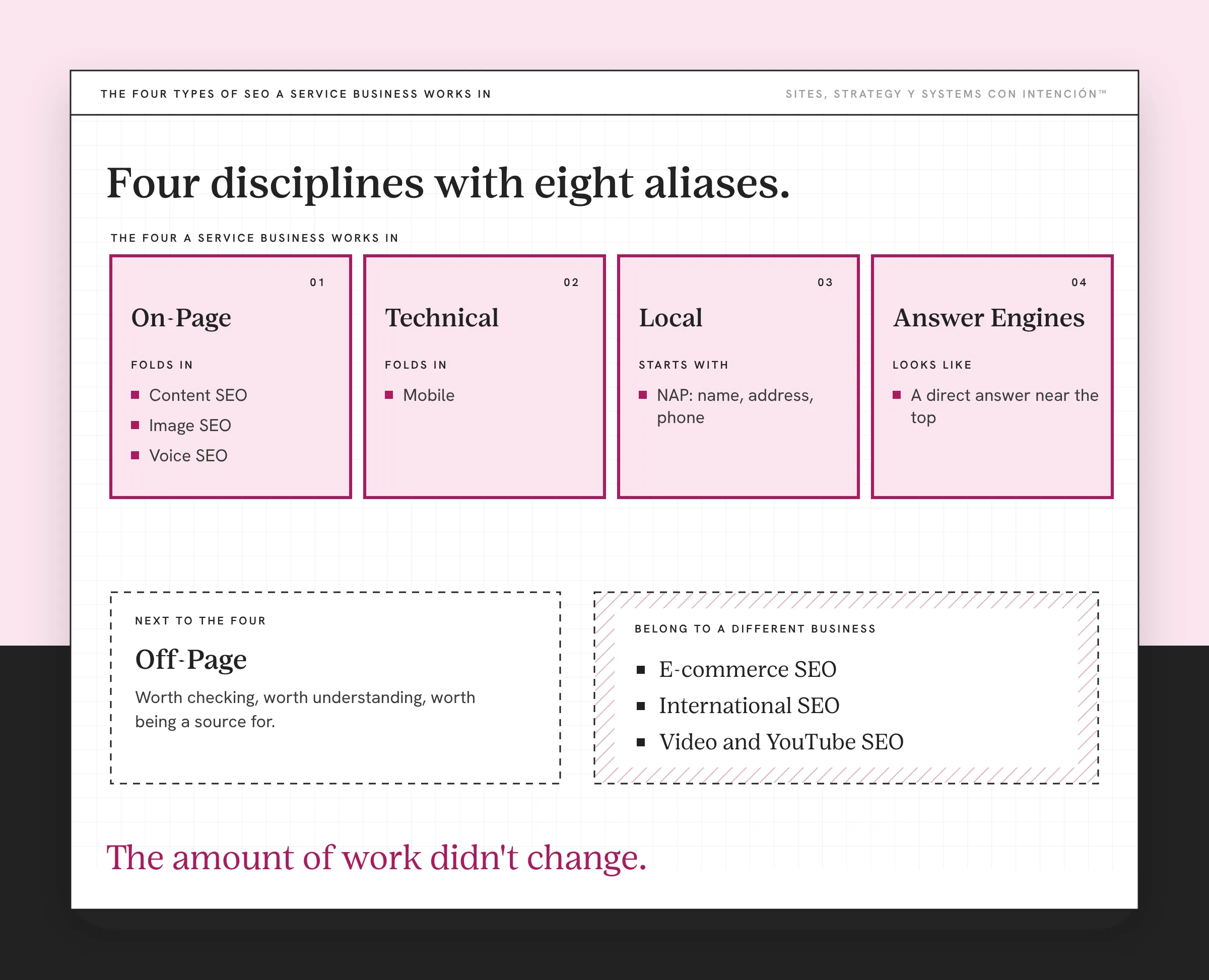
That photographer's 63 to 258 wasn't a twelfth discipline nobody had told her about. It was on-page and technical, done properly, on a site she already had.
Key Takeaways
- There are four types of SEO a service business works in: on-page, technical, local and answer-engine optimization.
- Content SEO is on-page SEO with the emphasis moved to the words. Image and voice fold into the same place.
- Mobile is a condition your site is in. A site that fails on a phone has a technical problem.
- Off-page is a real discipline that can take one dedicated person, which is why being a source beats trying to run link building yourself.
- The useful test on any twelve-item list: would you hire a separate person for this? If not, it's a task inside a type.
Okay, so which kind of SEO is my site weak on?
La Digital Rueda asks a few questions about your site, your content and your backend. It's free, takes about two minutes and shows you where the pressure is before you put time into any of the four.
And if you would rather have this kind of thing land in your inbox, Off the Clock is where I write about building something that keeps working while you aren't at your desk.
Frequently Asked Questions
How many types of SEO are there?
Depending on the article, four, six, twelve or fourteen. The number moves because sub-tasks get marketed as disciplines once someone builds a tool or sells a package for them. A more useful test than counting is asking whether you would hire a separate person for it. By that measure there are four that matter to a service business, plus off-page alongside them.
What are the 4 types of SEO?
On-page, technical, local and answer-engine optimization. On-page is everything you control on the page, including the copy. Technical is whether search engines can crawl and read the site at all. Local is geographic visibility, starting with consistent name, address and phone details. Answer engines is writing so a machine can lift a clean answer out of your page.
What is the difference between on-page and off-page SEO?
On-page is the stuff you control right now: titles, headers, structure, internal links and copy. Off-page is everything that happens somewhere else, mostly links, mentions and citations from other sites. You can fix on-page this afternoon. Off-page depends on other people, which is why it's its own discipline and often its own full-time job.
Is content SEO a separate type?
It's usually listed as one and it works better as part of on-page. The tasks overlap almost entirely, the tools are the same and the person doing them is the same person. Treating content as a separate discipline mostly creates a second list to feel behind on. Writing well for search is on-page SEO with the emphasis on the words.
What is AI SEO, is it different from regular SEO?
All search is search. People ask a question and something answers it. The place those answers show up keeps changing, but the work underneath hasn't: be findable, be clear, answer the actual question and be worth citing. Writing for answer engines just means making it easy for a machine to pull out a clean answer, which happens to be good writing for a reader in a hurry too.
Do small businesses need all types of SEO?
No. Trying is how people stall. E-commerce SEO is irrelevant to a service business. International matters only if you cross languages or borders. Video is a real field and only worth real attention if video is your main channel. Four types cover most service businesses properly, so doing four well beats doing twelve badly.
Can I do SEO myself or do I need to hire someone?
All four can involve work you do yourself. On-page and local are where most owners start and where most of the available gain sits. Technical gets harder as sites get more complex, so it depends on your platform and what is wrong. Off-page is ongoing outreach, so it's usually where hiring help pays off first. How complex your site and market are decides when help makes sense.
About the Author