The pitch for repurposing is usually arithmetic. One blog post becomes eight pieces, eight becomes a month, you fill the calendar without writing more. All true. It explains why people start. It doesn't explain the thing that happens after a few months of doing it.
What changes is what people think you are. I've been publishing this way for years across a blog, a newsletter, a podcast and several feeds. The shift was never in the output.
Quick definition, since the word gets stretched: repurposing here means taking one idea and expressing it properly in the form each channel wants. Copying a paragraph from your blog into a caption isn't that.
The Short Answer
Content repurposing builds authority through consistency rather than volume. When someone meets the same idea from you on a blog, in a newsletter and on a feed, they stop reading it as a post. They start reading it as your position. Saying one thing in several places is what makes it legible as a point of view.
If You're Reading This Because It's Your Site
Reading more isn't the hard part. La Jugada is $47 and it tells you which layer this is actually sitting in.
Get it, $47Authority Is a Pattern, Not a Piece
Harmony is the same song sung from different parts. Nobody in the room thinks they're hearing four songs. Mira, people rarely decide you know what you're talking about from a single post. They decide it from a shape they notice across several.

Think about how you concluded that someone in your own field is worth listening to. It was almost certainly not one article. It was that you kept meeting the same argument from them, in enough places and with enough consistency. At some point it stopped feeling like content and started feeling like a position they hold. Ahí es donde se nota la diferencia. It takes more than one encounter to register.
Psychology covers part of this. The Decision Lab defines the mere exposure effect as the tendency to prefer things simply because they're familiar. Its examples run from brand logos to campaign ads. What I'm describing goes a step past that definition and it's my own read: repeated encounters with the same idea from the same person build the sense that the person has a position rather than opinions.
So the unit of authority is the pattern rather than the piece, which means the thing you're building when you repurpose is recognizability.
Why Does Consistency Beat Volume?
Publishing more doesn't produce a pattern. It usually produces noise with your name on it.

Consider two people posting the same number of times a month. The first covers eleven different topics, each competent, each unrelated. The second returns to three ideas from different angles, in different formats, for the same eleven slots. Same effort, same volume. Only the second one is legible.
The first person is doing content. The second is building a position, so a reader who encounters them twice has already learned something about what they think. A reader who encounters the first person twice has learned that they post.
This is the part that makes repurposing more than an efficiency trick. It forces consistency by construction. If the newsletter, the post and the short-form all came out of one idea, they can't drift, because there's nothing for them to drift from.
What Does This Look Like in Practice?
The mechanism only works if the repurposed pieces are the same idea.
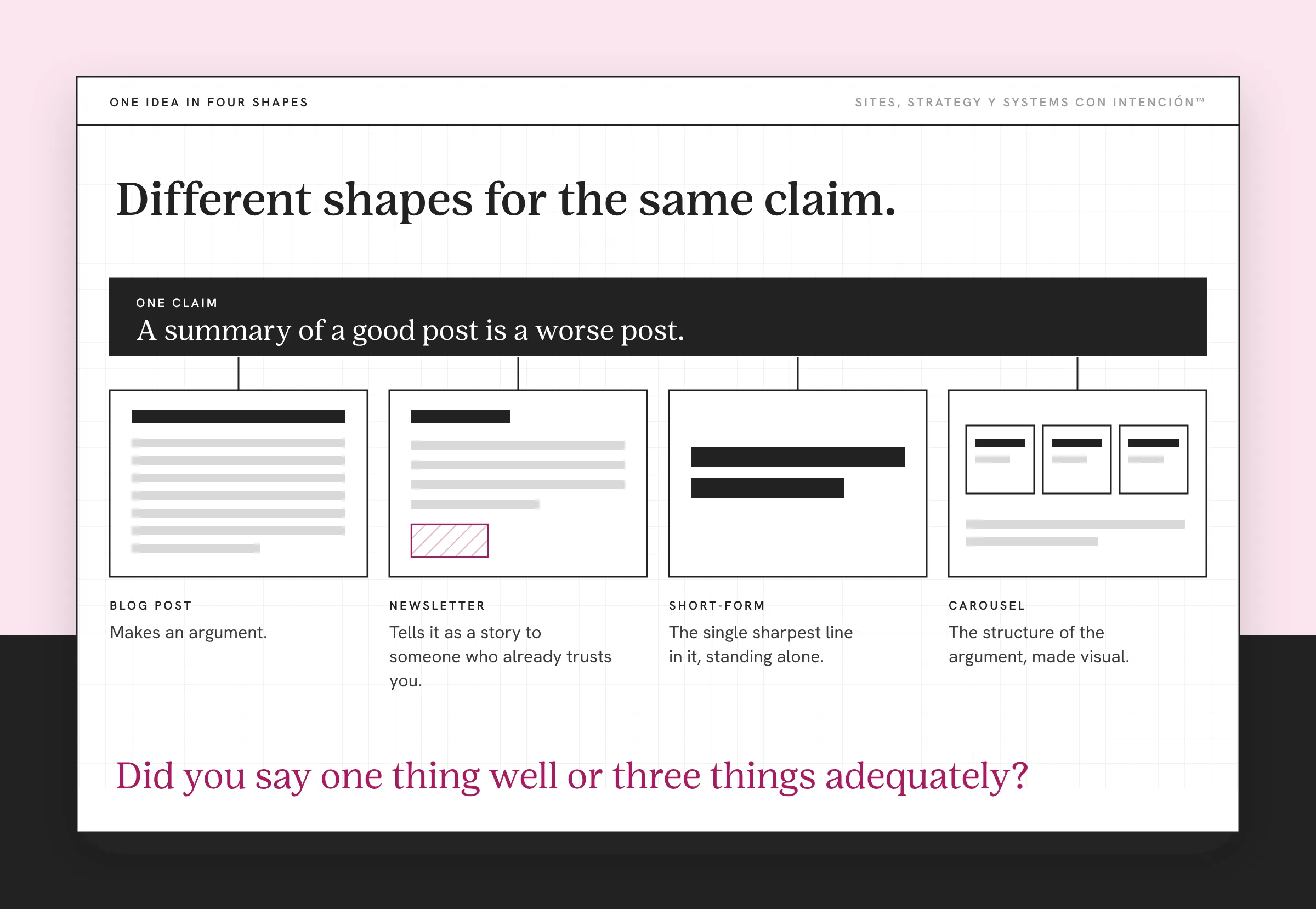
A blog post makes an argument. The newsletter version tells it as a story to someone who already trusts you. The short-form version is the single sharpest line in it, standing alone. A carousel is the structure of the argument, made visual. That's how to repurpose blog content: different shapes for the same claim, each built for how people consume that format.
Copy-paste fails at exactly this. A paragraph lifted from a blog post reads as exactly that, so the reader clocks it as recycling. Same words in a new place gives the reader the same encounter twice, moved.
The test is whether someone who saw all three would feel you said one thing well or three things adequately.
What Is Worth Repeating?
Not everything you write deserves to become a pattern. Some of it shouldn't.
The ideas worth repurposing are the ones you'd defend: the position you'd still hold in a year, the thing you find yourself saying on every discovery call, the argument you're slightly known for already. Those are the ones where repetition compounds into authority.
There's a real failure here worth naming. Repeat something you haven't thought hard about and you build recognizability for a position you don't hold, which is worse than being unknown, de verdad. The consistency is only an asset if the thing being made consistent is right. That's why this is a strategy question before it's a production question. It's the same question your website messaging answers about what you stand for.
The practical version: pick the two or three ideas your business runs on. Let those be the ones that show up everywhere, siempre las mismas. Evergreen content ideas, built to keep working rather than to be timely, survive this treatment best, since you'll be returning to them for a long time.
Mine are three. I'll name them so this isn't abstract. Sites, strategy y systems, which is the claim that a business problem almost always sits in one of those three and you have to look at how all three connect to find it. Looking at all three doesn't mean all three need fixing. That it should keep working while you're away, which is the whole argument for building infrastructure instead of hustle. And that all search is search, which is my position on AI search and answer engines being the same job wearing a new surface.
Those three sit underneath most of what I publish, in some form, going back years. They're what I think, which is the only reason repeating them doesn't get boring to write.
What It Does for Search, Briefly
The same consistency that makes a reader recognize you makes a search engine able to place you.
Covering one territory repeatedly, from different angles, with pieces that reference each other is what topical depth means in practice. A pillar and the posts around it is that idea given a structure. Repurposing feeds it, because every properly repurposed piece is another expression of the same territory. It's why repurposing sits at the center of any content strategy built to last.
That's a real benefit and it's the second-order one. The first-order benefit is that a person remembers what you think.
Key Takeaways
- Repurposing builds authority through consistency rather than volume. The unit of authority is the pattern.
- Someone who meets the same idea from you three times reads it as a position rather than a post.
- Two people can publish the same amount and only the one returning to a few ideas becomes legible.
- Copy-paste doesn't count. Same words in a new place is the same encounter moved.
- Only repeat what you'd defend in a year. Consistency makes a position stick whether or not it's a good one.
I keep posting. Why isn't any of it adding up?
Start with La Digital Rueda. It's free and takes about two minutes. A few questions about your site, your content and your backend show you where the pressure is.
And if you'd rather have this sort of thing arrive in your inbox, Off the Clock is where I write about building something that keeps working while you aren't at your desk.
Frequently Asked Questions
How does content repurposing build authority?
Through consistency rather than output. Authority is a pattern someone notices across several encounters, so meeting the same idea from you in a few different places is what turns it from a post into a position you hold. Publishing more without returning to the same ideas produces volume without that pattern.
Is repurposing just posting the same thing everywhere?
No. That version doesn't work. Copying a paragraph from a blog post into a caption reads as recycling, so the reader registers it as the same encounter moved rather than a new one. Real repurposing expresses one idea in the form each channel wants: an argument, a story, a single sharp line, a visual structure.
How many ideas should I be repurposing?
Few. Two or three positions your business runs on, returned to from different angles over a long time. The failure mode is trying to repurpose everything, which reproduces the noise problem with extra steps and no pattern at the end of it. If you can't name your two or three without thinking, that's the more useful problem to solve first.
Does repurposing help SEO?
Yes, as a second-order effect. Covering one territory repeatedly with pieces that reference each other is how topical depth gets built, which helps a search engine understand what you're about. The primary benefit is still that a person remembers what you think.
How long before repurposing produces authority?
Longer than a content calendar and shorter than people fear. It depends on how often the same reader encounters you, which is why consistency of idea matters more than frequency of posting. A reader who meets your argument three times over two months has more sense of your position than one who saw eleven unrelated posts in a week.
What if I do not know which ideas to repeat?
Notice what you already say without planning to: the thing that comes up on every call, the point you make when someone asks what you do. That's usually the position you already hold. Repurposing tends to make an existing pattern visible rather than inventing a new one. Worth knowing that nobody can name their own until someone asks them directly, so being unable to list yours today means very little.
About the Author