

You've changed your content strategy more than once now.
You went consistent. Then you went long-form. Then someone said the answer was topic clusters, so you tried that. Somewhere in there you also tried posting less and making each one count. Mira, none of it moved the needle enough to tell you which version was right.
So you're here, considering evergreen. Build once, rank forever. It sounds like the version that finally stops the treadmill.
It can be, de verdad. I've watched content built this way carry a business for years. But "build once, rank forever" is a conditional promise and almost nobody says so outloud. Which is why so many people conclude their content is broken when the content was never the problem.
The Short Answer
An evergreen content strategy means building content around questions your audience will still be asking in two years. A post you write once keeps earning long after you publish it. It works when five conditions hold. Four of them are about your content. The fifth is about your site. That's the one capable of making the other four irrelevant.
If You're Reading This Because It's Your Site
Reading more isn't the hard part. La Jugada is $47 and it tells you which layer this is actually sitting in.
Get it, $47What Makes an Evergreen Content Strategy Different?
Evergreen content answers questions that don't expire. How to write your about page is a question people will still be asking next year, so that post is still working next year. Top website trends of 2026 has a shelf life measured in months.
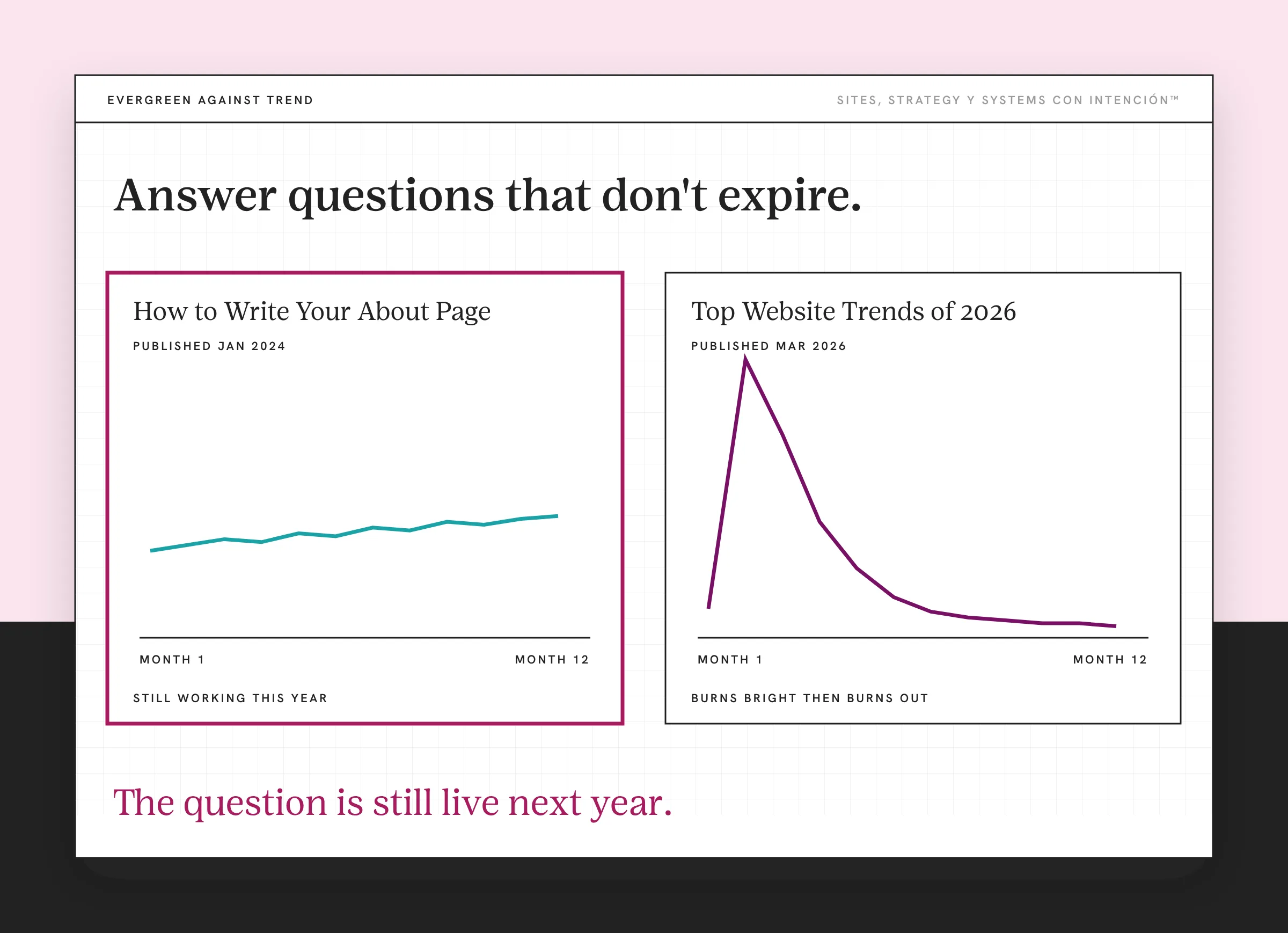
Trend content is the opposite and, claro, it isn't a bad thing. It burns bright then burns out. If it's your only strategy you've signed up for a full-time job you didn't ask for.
Evergreen blogs are the flan. Every Puerto Rican family has one person who brings it. Same flan, every Thanksgiving and every birthday and every time somebody dies. Nobody has ever once asked for something different. It isn't exciting and it isn't trying to be. It's the thing that's always good and always there and always doing its job, made from the same five ingredients it has always been made from. You aren't reinventing dessert every time someone comes over.
That's the whole appeal. One post, written properly, keeps working while you're asleep, on vacation or busy delivering the actual work you sell.
"My Blog Isn't Working" Means Five Different Things
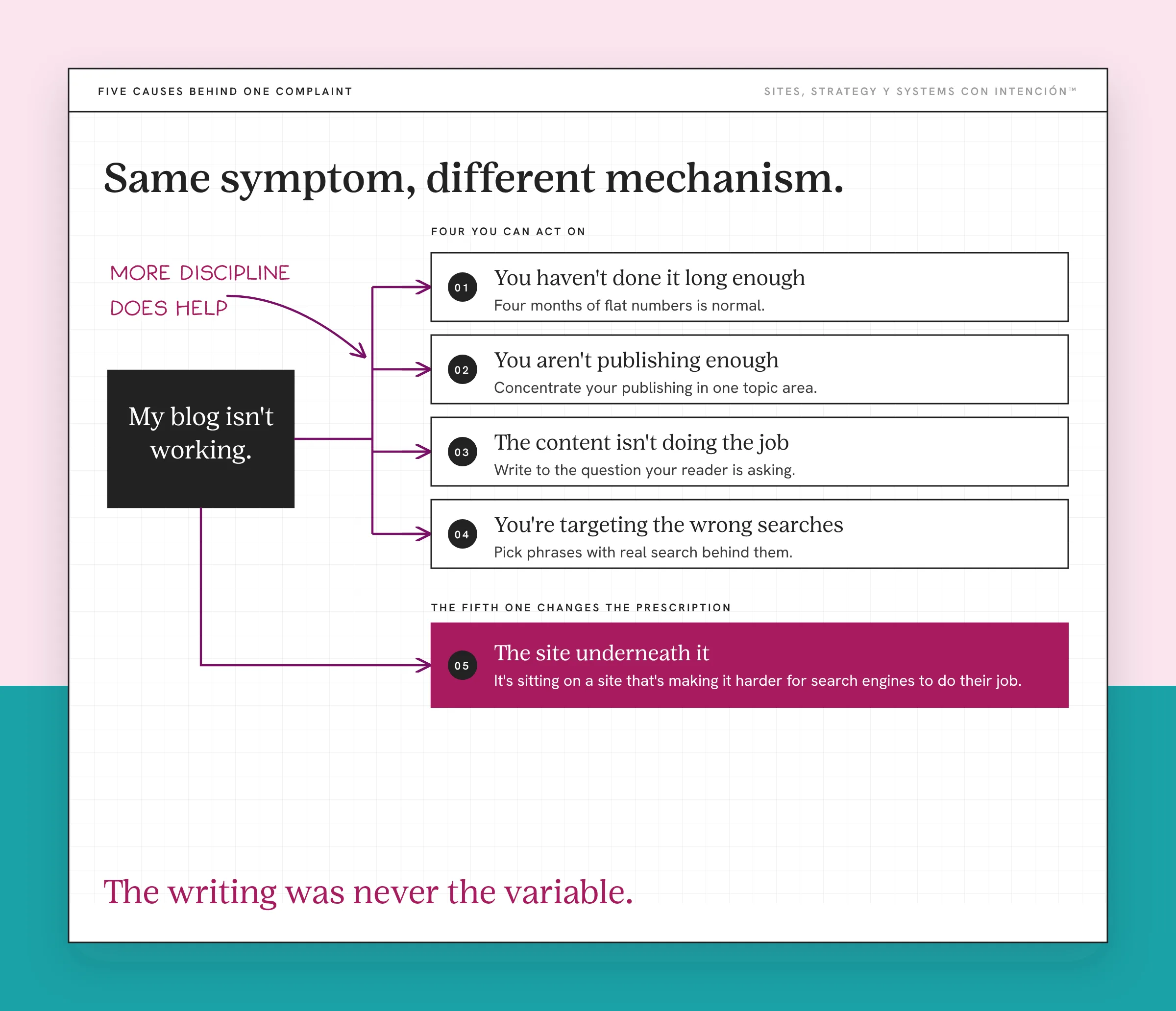
O sea, that sentence gets said to me constantly and it's never the same problem twice. Same symptom, different mechanism, different move, y cada una needs something else from you.
- You haven't done it long enough. SEO starts showing around six months and gets easier around a year, which is the actual long-term marketing timeline nobody quotes you up front. Four months of flat numbers is normal. It tells you nothing yet.
- You aren't publishing enough. Not volume for its own sake. Enough depth in one area that a search engine can read it as expertise.
- The content itself isn't doing the job. It exists, it's perfectly fine, it isn't answering the question anyone is typing.
- You're targeting the wrong searches. Good writing aimed at phrases nobody searches. Or phrases you have no realistic shot at.
- The content is sitting on a site that's making it harder for search engines to do their job.
Four of those are content problems. The fifth one changes the prescription entirely. That's the part almost nobody says. Punto.
The Four You Can Act On
For the first four, sí, more discipline does help.
Give it longer before you judge it. Concentrate your publishing in one topic area instead of spreading it across eight. Write to the question your reader is asking. Pick phrases with real search behind them that a site your size can plausibly reach.
Those are all real fixes and they're all yours to make. In my experience most people who feel stuck are somewhere in these four. Steady work on them usually takes about six months before it starts to show.
The Fifth One Changes the Prescription
You don't solve an indexability problem by becoming more disciplined about publishing.
That's the sentence I wish more people heard before they committed to another quarter of content. If search engines are having trouble crawling, indexing or making sense of your site, better posts land exactly where the last ones did. The writing was never the variable.
I want to be careful here, porque this gets oversold. Technical problems range from annoying to catastrophic. They aren't one discipline either, because SEO itself comes in different types. A slow page isn't the same as pages that can't be indexed. Plenty of sites with imperfect technical health rank perfectly well. Nobody should read this and conclude their content is doomed.
The narrower claim is the useful one: before you conclude your content strategy isn't working, make sure the site itself isn't part of the problem.
What Can You Check Yourself?
Bastante of this is visible without hiring anyone.
Search Console is the biggest one. If you've been publishing consistently and the page indexing report shows your pages aren't being indexed, if the Performance report shows indexed pages with no impressions at all or if crawl problems keep surfacing: that's the point where I'd stop blaming the posts and start looking at the site.
Then look at the pattern across everything you've published, old posts included. If it were a content problem you'd expect the recent work to lag while your established pages hold. When older content and your important pages are also invisible, the problem is bigger than keyword choice or needing more time. It's worth asking whether your site is hurting your business by becoming the constraint.

Site speed and mobile are clues, not verdicts. I'd never tell someone their site is slow, therefore that's why they don't rank. That's where the distinction matters. You can spot signals that the problem may be technical. That doesn't mean you can diagnose the cause from the outside.
Where Does Checking Yourself Stop?
Signal-spotting is free and you should do it. Cause-finding is different work.
The reason is that the signals overlap. Pages not indexed can mean six different things. Flat impressions across the whole domain can be technical. It can be structural. It can be a positioning or messaging problem where the site is targeting an audience that doesn't exist. From the outside you can see that something is off. Sorting out which layer is responsible takes getting into the site properly, which is what a website audit is for.
For what it's worth on the upside of getting it right: on one regional business I led SEO and web strategy for, blog content was tracked to $95,000 in attributed revenue as part of $1M+ from organic search overall. That was a team effort. I'm naming that because the number belongs to a group of people. What it does show is what content is capable of when the site underneath it is finally letting it work.
You've changed your content strategy over and over because nothing seems to work. I'd want to know whether the site is even giving that content a fair shot. That comes before telling you to write another twenty posts.
That's the question worth answering before you commit another quarter.
Key Takeaways
- An evergreen content strategy means building around questions that will still be asked in two years, so one post keeps earning after you publish it
- "Build once, rank forever" is conditional. Five things have to be true and only four of them are about your content
- Time, publishing depth, the content itself and keyword choice are all yours to fix. Most people stuck are somewhere in those four
- You don't solve an indexability problem by becoming more disciplined about publishing
- You can spot signals that the problem may be technical. That isn't the same as diagnosing the cause from outside
My blog isn't working and I can't tell which reason it is.
Bring your site, your numbers and the posts that aren't pulling their weight to one private session from $350. We'll figure out what's going on and what to do next. Notes included. Full audits are available and get quoted first.
Frequently Asked Questions
What is an evergreen content strategy?
It's building content around questions your audience will still be asking in a year or two, so each post keeps earning long after you publish. How-to guides, foundational explainers and answers to the things clients ask you repeatedly all qualify. The format matters far less than the question. If the question doesn't expire, the post doesn't either.
How is evergreen content different from trend content?
Trend content is tied to a moment, like an algorithm update, industry news or a seasonal launch. It can spike your visibility, but it doesn't last long. Evergreen content goes after questions people keep asking. Most businesses need some of both. It gets risky when the whole strategy is trend-based, because then every month starts at zero.
How long before evergreen content starts working?
Usually around six months before anything shows and about a year before it gets noticeably easier, then it compounds. That range moves depending on what you're starting with. A site with sound structure and some existing traffic moves faster than one going up from scratch.
My blog isn't working. Is it the content or the site?
Check Search Console first. If pages aren't being indexed, if they're indexed with no impressions at all, if crawl errors keep appearing: look at the site before you look at the writing. Then check whether older content and your main pages are also invisible. A whole flat domain points somewhere bigger than keyword choice.
Does technical SEO matter more than content?
Neither outranks the other. Framing it as a competition is where people go wrong. Technical problems range from annoying to catastrophic. Plenty of sites with imperfect health rank fine. What matters is knowing which one is holding you back. The fix for a content problem and the fix for an indexing problem have nothing in common.
How often should I update evergreen content?
Only when something has changed. Look for outdated tools, broken links, a headline that could be sharper or a CTA pointing at an offer you no longer sell. When a post is working, a short review beats a rewrite. Rewriting it is an easy way to lose ground you already gained.
About the Author