
When your marketing isn't getting the results you want, someone else's success can make the next idea look very convincing. They're getting attention with a new approach. You've been putting in the work. Of course you're wondering whether you should try it, too.
Sorting through marketing fads gets harder when the advice keeps changing. You save one recommendation, hear another and start wondering which one deserves a place in your business. That can get exhausting, bendito, especially when you still don't know why the last thing didn't work.
When someone brings me a trend, I hear "Everyone's doing this. Am I behind?" and "I saw someone get amazing results with this." Underneath both is "I tried something and it didn't work."
I work at an agency, so I try a lot of marketing strategies and tactics. I won't try a trend just for the sake of a trend, but I've tried plenty that made sense within a strategy. Before I recommend one for your business, I want to know whether your buyer would care and what you want it to accomplish.
The Short Answer
Marketing fads are approaches that attract attention briefly before interest fades. A marketing trend reflects a developing change in how people behave or how businesses reach them. Before adopting either, consider your buyer, your goal and the problem you're trying to address. Test on a limited scale where appropriate, then review what happened.
If You're Reading This Because It's Your Site
Reading more isn't the hard part. La Jugada is $47 and it tells you which layer this is actually sitting in.
Get it, $47What's the Difference Between a Marketing Trend and a Fad?
A trend can reflect a broader change in consumer behavior. A fad tends to be a shorter burst of interest. You often get a clearer view of the difference after some time has passed.
The Digital Marketing Institute's comparison of trends and fads looks at how interest develops and whether there's substance behind it. That distinction is useful, but it won't tell you whether a particular approach belongs in your business.
A popular format might work for a brief campaign. A lasting change might deserve more planning. Either way, you still need a reason to participate.
I remember watching inbound marketing gain prominence. Bringing people to a website with useful content, offering a relevant lead magnet and collecting leads through that experience opened up possibilities for businesses. There was a purpose connecting those pieces.
HubSpot describes inbound marketing as attracting people through useful content and experiences tailored to them. That buyer focus matters to the way I evaluate new approaches.
I've also watched social media become more focused on video, with Reels and TikTok bringing different ways for brands to participate. That doesn't make every video idea a good fit for every business. Video marketing could help you explain something your buyer struggles to understand. A particular short-form video joke might have very little to do with that same buyer.
There's room to try something new, con ganas, when you've got a reason for trying it. The newness alone doesn't tell you what it'll do for your business.
Why Does Another Marketing Trend Feel Like the Answer?
If you're disappointed with your results, a different tactic gives you something concrete to change. You can make the post, join the platform or buy the tool. It feels like you're doing something about the problem.

Before that becomes another commitment, I want to know what "not working" means.
Are the right people finding you? Do they understand your product or service? Are they interested enough to visit your site but unsure what happens next?
Those are different problems. They deserve different decisions.
For example, suppose people are reaching your service page but asking questions the page should have answered. Sending more visitors there could increase the number of confused inquiries. You'd want to look at the message and the page before adding another way to send people to it.
You can review how the next step is presented and where your call to action sits as part of that check. Someone who's interested needs to understand what they're being invited to do.
The frustrating part, mija, is how much effort you can put into marketing without getting an answer to why it isn't helping. Changing several things at once can make that even harder to untangle.
Look at what your analytics can tell you alongside the inquiries and conversations you're having. A marketer can help interpret that information, but first you need a clear question. "Are people finding the service page?" gives you something more specific to investigate than "Why isn't any of this working?"
You might find a reason to test another approach. You might find that something already in place needs attention first.
Would Your Buyer Care About This Trend?
At Disney, everyone can be running toward the newest ride. Before you follow, do your people even want to get on?

Your group might love that kind of ride. They might have come for something else entirely. The crowd tells you what's popular. You've still got to consider the people you're spending the day with.
I bring that same question to digital marketing. Would your buyer be interested in this? Would it help them understand something, enjoy hearing from you or take a relevant next step?
Consider these illustrative possibilities:
| Approach You're Considering | Question to Ask Before Trying It |
|---|---|
| A trending video style | Can it explain something your buyer needs without making the message harder to follow? |
| Influencer marketing | Does this person's audience include people who could benefit from your offer? |
| A new marketing platform | Is there a reason to expect your buyers there? Can you maintain a useful presence? |
| Personalization in your follow-up | Would it make the response more relevant to what someone asked? |
These are starting questions. Influencer partnerships, for example, need a closer look at the audience, the relationship and the work involved. A list of followers won't answer all of that.
Listen to how your buyers describe what they need. Notice where they ask questions and what helps them make decisions. An industry-wide report can suggest something to investigate. Your own conversations help you assess whether it applies.
It's tempting to assume everybody must be interested because the trend keeps appearing in your feed. That "otra vez?" feeling when you see it for the tenth time says something about your experience. It doesn't establish that your buyer wants it.
You also know things about your business that a roundup of the latest trends can't account for. The service takes a certain amount of explanation. Your buyers have particular concerns. Your marketing strategies need to account for those details.
How Can You Test a Trend Without Diving All In?
When an approach fits your buyer and has a clear job, you may be able to try a limited version before making a larger commitment.
I tailor that advice to the trend. Trying a different content marketing approach might involve adapting an existing explanation. Testing paid promotion or a partnership brings different costs and decisions. They shouldn't all get the same testing instructions.
Before you begin, write down what you're trying to learn and what you're prepared to put into it. Include the work that happens after the first response, too. An idea that brings inquiries needs a way to handle them.
For a hypothetical service business trying an explanatory video, that might mean:
- The question: Will this explanation help suitable buyers understand the service?
- The limited version: Adapt one existing explanation before committing to an ongoing series.
- The useful evidence: Look at whether people engage with the explanation, visit the relevant page or ask better-informed questions.
- The work involved: Account for planning, recording, editing and responding.
That's an illustration of a decision process. It isn't a prescription for how many videos you should make or how long every test should run.
You can check your own evergreen content for something useful to build on. Original content you've already developed may give you material for a relevant experiment.
The excitement can run ahead of the plan. You're ready to try the idea, de verdad. Suddenly you're considering new software and three more marketing channels. Bring it back to the question you're trying to answer before expanding the commitment.
You'll need enough relevant evidence to interpret what happened. The time and activity required will depend on the approach, your audience and the result you're measuring. A quiet first attempt doesn't establish that the idea can never work.
How Do You Decide Whether to Keep Going?
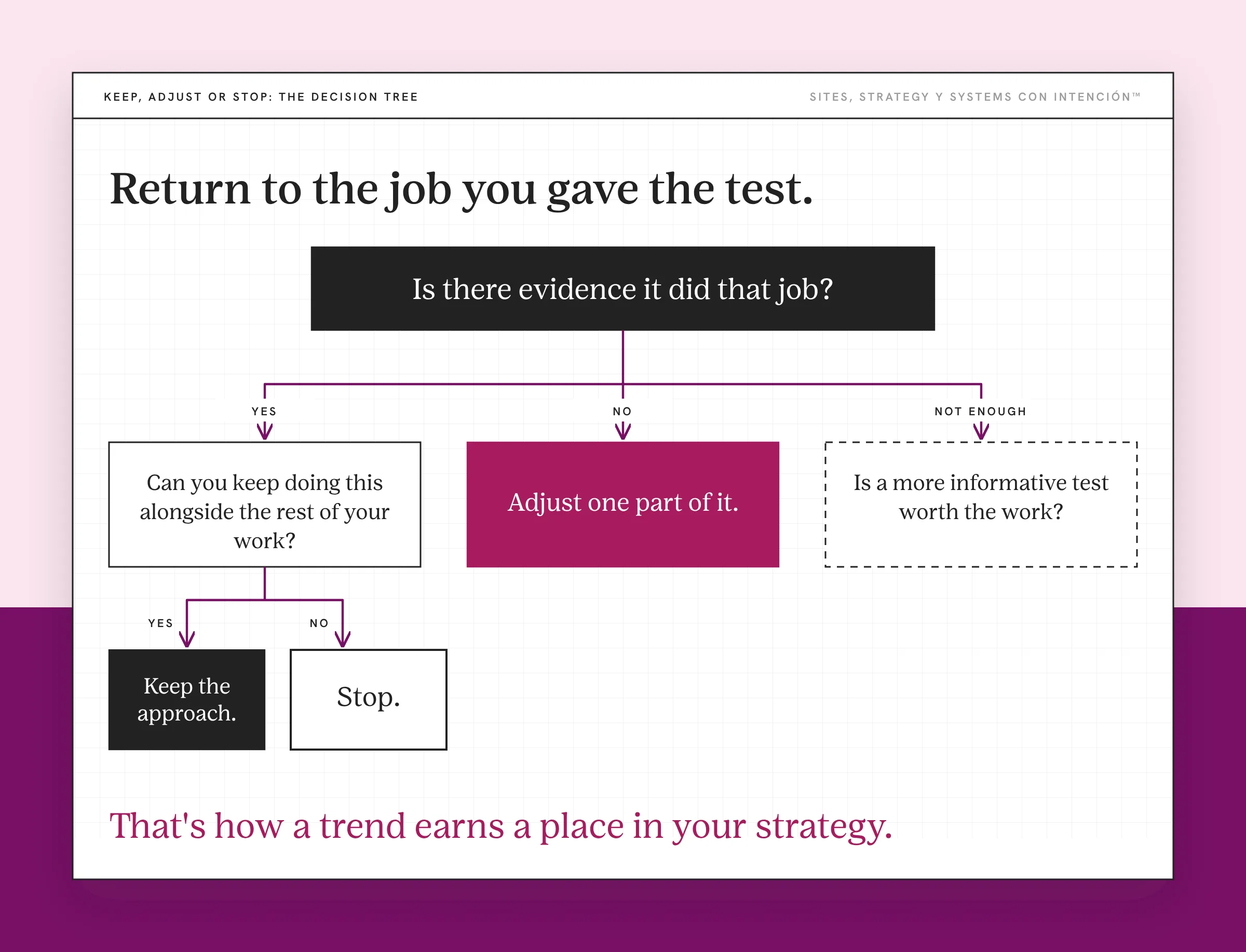
Return to the job you gave the test. If you wanted to help people understand a service, look for evidence of that understanding. If you wanted qualified inquiries, review who contacted you and what they needed.
Social media engagement can tell you that something drew a response. You'll need more context before deciding whether that response helped the business.
It can be exciting, wepa, to see people paying attention. Keep that excitement alongside the question you started with so you can judge the result on its own terms.
When a test involves spending money, ROI means return on investment. Be clear about which costs and outcomes you're counting. Immediate sales might be relevant to one test while another is investigating an earlier step in the buying process. Don't report a sales return you haven't measured.
Then consider the effort. Can you keep doing this alongside the rest of your work? Would you need help? Consider whether automation would support a process that's already useful before adding another tool.
You might keep the approach, adjust one part of it or stop. If the evidence is too limited, the next decision might be whether a more informative test is worth the work.
As you optimize what you've tried, stay specific about what you're changing and why. Otherwise, it's easy to keep revising the tactic without learning much about whether it fits. Testing on purpose keeps your content strategy in charge of the trend.
You don't have to predict the entire future of a trend to make a thoughtful decision today. Start with the buyer, name the result you're working toward and consider what you can reasonably test. That's how a trend earns a place in your strategy.
Key Takeaways
- Marketing fads can attract attention briefly; popularity alone doesn't establish buyer relevance.
- Define what isn't working before deciding which new approach to try.
- Evaluate a trend against your buyer's interests, your goal and the work involved.
- Tailor a limited test to the approach and review evidence that relates to its intended purpose.
Before I try another trend, where's my marketing actually stuck?
Answer a few questions about your site, your content and your backend in La Digital Rueda. In about two minutes you'll see where the pressure is before you add anything new. It's free.
Frequently Asked Questions
Can marketing fads work for a small business?
They can be useful when they fit the buyer, the business and a specific purpose. A short-lived idea could suit a limited campaign without becoming part of your ongoing plan. Consider what you expect it to accomplish and what participation will cost in time or money. A burst of attention needs context before you can judge its business value.
Is every new marketing trend a fad?
No. Some new approaches reflect changes in how people find information, communicate or choose what to buy. Others attract interest for a shorter period. You may not know how long a particular development will last while it's happening. You can still assess whether it serves your buyers and whether a limited test would help you make a better decision.
How can a small business decide which trends to try?
Start with the buyer and the result you want. Ask whether the approach could help address a problem you've identified, then consider the resources it would require. Your existing inquiries, customer conversations and website behavior can help you frame that decision. Choose something you can evaluate meaningfully. Another business's success isn't a reason on its own.
Does a marketing test need a big budget?
The resources depend on what you're testing. Adapting an explanation you already have may require your time and existing tools. Paid promotion or a partnership can involve other costs. Define a limited version that can answer a useful question before committing more. An inexpensive test still needs to produce information you can interpret, so cost alone shouldn't decide its design.
Should you stop a test that isn't helping?
Review what happened before deciding. Check whether the intended audience encountered it, whether the next step was clear and whether you've gathered enough evidence to judge the result. You might adjust the approach, continue with a clearer question or stop investing in it. The decision should reflect what you've learned and what further testing would require from the business.
About the Author