
You're four months in. You've been publishing. The site is up, the posts are going out, you did the thing everyone told you to do.
And nothing is happening. Not nothing exactly, there's a trickle. Two people found a post, someone downloaded something. But the graph is basically flat and you've started doing the math on how much time you've put into this.
So you go looking for how long a long term marketing strategy is supposed to take. Every article you find says the same word: patience, be patient, it takes time, stay the course.
Todavía nobody tells you the number. Y eso es lo que jode. Nobody tells you how to know whether you're being appropriately patient or wasting a year without knowing it.
Month four is where I watch people quit, which is usually right before the part where it starts.
Nobody judges a Mets season off one series in April. A team that starts 4 and 8 isn't a bad team yet. Everyone in the sport knows it, which is why nobody fires a manager in week two. Marketing gets no equivalent grace, so month four feels like a verdict when it's barely a sample.
The Short Answer
A long term marketing strategy usually starts showing up around six months and gets noticeably easier around a year. That range moves depending on what you're starting with. The distance between starting from nothing and accelerating something that already works is most of the difference.
If You're Reading This Because It's Your Site
Reading more isn't the hard part. La Jugada is $47 and it tells you which layer this is actually sitting in.
Get it, $47How Long Does It Actually Take?
Six months before it starts. About a year before it gets easier. And it compounds from there, poco a poco, which is the part that makes the wait worth anything at all.

It's also slower than people think. I want to be straight about that, porque the gap between what people expect and what happens is where most of the quitting lives.
Here is the shape of it on a real project. A small local business, no history of sustained investment, no existing authority at all. I ran it solo. In under six months it went from 121 ranking keywords to over 310, with a 400%+ year-over-year increase in organic traffic and click-through rate moving from 1.6% to 3.1%. Zero paid ads.
Six months rather than six weeks, on a site with nothing behind it when we started. That matters more than it sounds like it does.
A faster version exists and it's public, so you can check it. A photographer whose platform migration had wiped out her search visibility went from 63 organic sessions from Google to 258, a 310% increase, comparing the three months before the work with the three months after. Her target keyword moved from position 20 to 8.2. The difference is that they already had a site with history behind it. The starting point sets the clock more than the effort does.
Why Isn't It One Number?
The six-month figure is a starting point for a conversation. Six things move it. They don't move it equally.
1. What links to you, not how old you are. This is one I see people get wrong. Domain age isn't doing what you think. Google's John Mueller has said plainly that "domain age helps nothing". In a later reply to a post asking whether domain age impacts Google rankings, he wrote "primarily those who want to sell you aged domains." What an older site has is links and history it had time to accumulate, which is a real advantage. The calendar isn't. If your site went up last month you're behind on links. Links are something you can start on today.
2. Whether the site was any good to begin with. This is the biggest one. If the structure and the website messaging are already sound, everything you do lands on something built to hold it. If they aren't, you're sending traffic to a page that can't convert it. At that point the timeline stops being about marketing.
3. One good topic cluster beats eight scattered posts. The standard advice is publish more. I'd rather you publish two posts a month that all belong to one cluster than eight that belong to nothing. Depth in one area is what search engines can read as expertise, punto. Volume across ten unrelated topics reads as noise. It also burns you out faster.
4. What you're up against. Competition sets which keywords are realistically available to you, which sets how long before anything moves. A local service business can rank for terms a national brand would need a year and a link budget to touch. That's a shorter runway.
5. Whether you keep going. The people I watch quit tend to do it around month four, right before the part where it starts. Then they start again six months later from zero. The clock resets every time, at a cost higher than the waiting would have been.
6. Whether anyone is already sending you people. A list, referrals, an audience that already trusts you. It won't replace search, ya, but it keeps the business fed while the slower thing builds. Referred people also arrive warmer, which matters for the test below.
How to Tell Slow From Broken
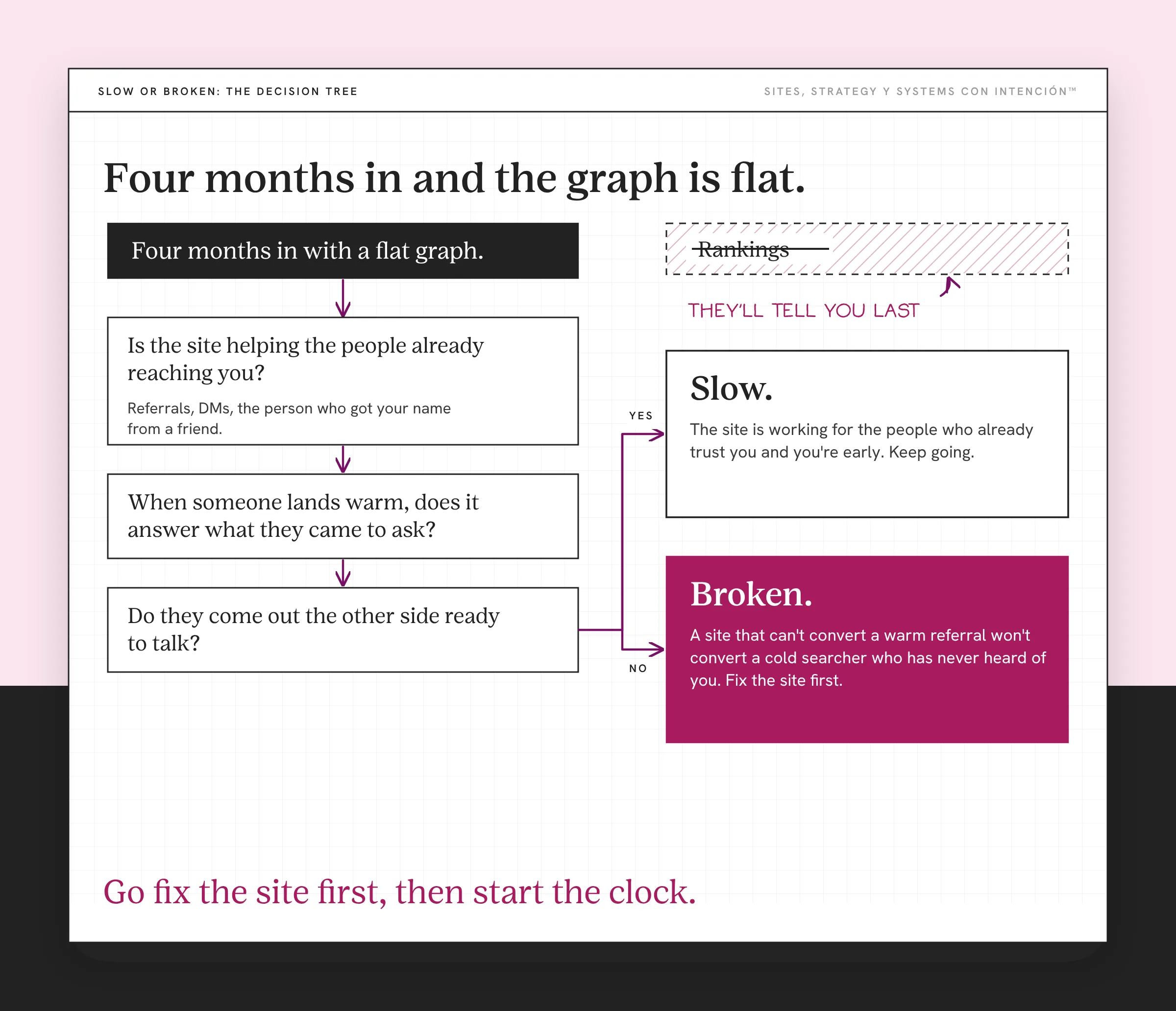
This is the question underneath the question. Four months in with a flat graph, is that normal or is something wrong?
Stop looking at rankings to answer it. They're the slowest signal you have and they'll tell you last.
Look at the people who are already reaching you. Referrals, DMs, the person who got your name from a friend. Is the website helping them? When someone lands on it already warm, does it answer what they came to ask? Do they come out the other side ready to talk?
If yes, the site is working for the people who already trust you and you're early. Keep going and check that it does the same job for strangers once search starts delivering them.
If no, more traffic isn't the fix and waiting isn't either. A site that can't convert a warm referral won't convert a cold searcher who has never heard of you. Go fix the site first, starting with what makes a website high-converting, then start the clock.
What Are You Actually Building?
Your website is the hub. The SEO and the strategy you put into it, plus the systems you build behind it, all accumulate in one place instead of evaporating the way a post does.
That's the difference between the two kinds of work. A short term marketing strategy spends effort and gets a result once. The long game spends effort and leaves something behind that keeps producing after you stop touching it. Lo que pasa es que almost everybody is only ever doing the first kind, so it always feels like starting over.
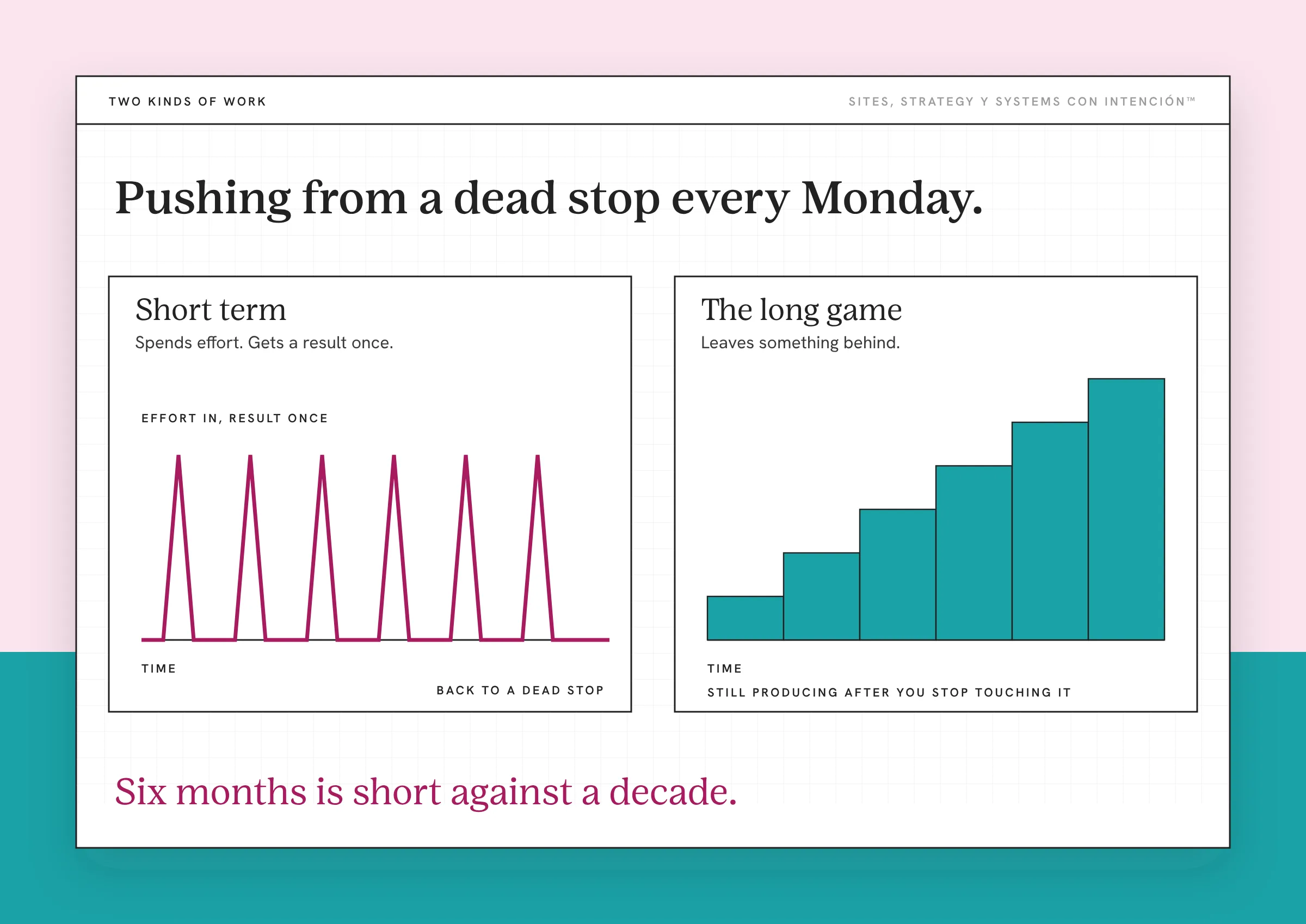
You're still going to work. Nobody builds an ecosystem and then walks away from it. Any article promising you that's selling something. You'll still spin the wheel. The difference is that at some point you're spinning one that already has momentum instead of pushing from a dead stop every Monday.
And if you already have a blog with some traffic on it, you're accelerating. That's a completely different job with a much shorter timeline.
You don't want to be famous for your blog posts the day you publish them. Usually that means something went awry. You want them still working two years from now, on a page you haven't opened since. That's the bar I hold every content strategy to.
Marketing is something you're going to do until your company closes. Así es. Given that, the only real question is whether the work you do this month is still doing anything for you next year.
Six months is short against a business you intend to run for a decade. It only feels long when you can't tell whether it's working.
Key Takeaways
- A long term marketing strategy usually starts around six months and gets easier around a year. It's slower than it sounds
- The timeline moves most on two things. Whether the site was sound to begin with. Whether you keep going past month four
- Domain age helps nothing. Links do, so a site that went up last month isn't out of the running
- Two posts a month in one good topic cluster will outrun eight scattered across unrelated topics
- Rankings are the slowest signal you have. The real test is whether your site converts the warm people already arriving. If it does, you're early. If it doesn't, you're broken
How do I tell if my marketing is slow or just broken?
La Digital Rueda asks a few questions about your site, your content and your backend and shows you where the pressure is. It's free and takes about two minutes.
Frequently Asked Questions
How long does a long term marketing strategy take to work?
Roughly six months before it starts showing and about a year before it gets noticeably easier, then it compounds. That range moves depending on what you're starting with. A site with sound structure and some existing traffic moves faster than one going up from scratch. Anyone giving you a fixed number without asking what you already have is guessing.
What is the difference between a long term and a short term marketing strategy?
A short term marketing strategy spends effort and produces a result once. A long term marketing strategy spends effort and leaves an asset behind that keeps producing after you stop working on it. Both are legitimate and most businesses need some of each. The trouble starts when you run only the first kind for years, then wonder why every month begins at zero.
Does domain age matter for SEO?
No. Google's John Mueller has said domain age helps nothing, then noted that the people claiming otherwise are usually selling aged domains. A Google patent describes using registration data to help spot spam, which is a different thing from rewarding age. What an older site really has is the links and content it had time to accumulate. A new site can start building both immediately.
Nothing is happening at four months. Should I stop?
Check the warm traffic before you decide. If people who already know you land on your site and come away ready to talk, the site is doing its job and search hasn't caught up yet. That's normal. Quitting now wastes the four months you already spent. If warm people aren't converting either, stop marketing and fix the site. More traffic won't rescue a page that can't close a referral.
How many blog posts do I need to publish?
Fewer than you think, in one place rather than everywhere. Two solid posts a month that all belong to a single topic cluster will outperform eight covering unrelated subjects. Depth in one area is what reads as expertise. Scattered volume reads as noise while burning you out faster.
Is a long term marketing strategy just SEO?
No. SEO is the part with the most predictable curve, which is why it gets used as the example. The wider thing you're building is an ecosystem: a site that answers questions, systems that catch what it brings in and content that keeps working after you publish it. SEO brings people. The rest decides whether their arrival is worth anything to you.
About the Author