
If running your business feels harder than it should, like you're constantly busy and the revenue still isn't consistent, there's a good chance you've already blamed yourself for it. You've tried new tools. You've reorganized your backend, maybe more than once. You keep telling yourself you just need to be more consistent, more disciplined, more on it.
If your systems feel heavy or confusing, especially your day-to-day operations and backend processes, that doesn't mean you're failing, mija.
What I see over and over at the traction stage, with solopreneurs, service providers and founders who've outgrown the systems they started with (or never really had any), comes down to three things. There's no real system at all, the tools don't talk to each other or the whole backend only works when you're actively inside it. The business runs, but only while you're holding every thread.
Most people don't recognize this as a systems problem at first. They assume the issue is marketing and go looking for more visibility, a better offer or a new strategy. The heaviness usually starts earlier, right when traction arrives and rest disappears. Growth without infrastructure doesn't feel exciting for long before it starts to feel like weight. If your business looks good online and feels chaotic behind the scenes… ajá. That's the tell.
By the end of this post you'll know why your systems feel stuck, why it gets mistaken for a motivation or marketing problem, how to spot misalignment before it turns into constant rebuilding or burnout and what it takes to build systems that support your work.
The Short Answer
When small business systems feel stuck, it's usually because they were built for an earlier season of the business and never evolved with it. Tools got added one by one, nothing talks to each other and the backend only works while you're inside it holding every thread. Alignment has to come before automation.
If You're Reading This Because It's Your Site
Reading more isn't the hard part. La Jugada is $47 and it tells you which layer this is actually sitting in.
Get it, $47Why Do Small Business Systems Break as You Grow?
The pattern repeats. Either there's no system at all or there are systems and nothing talks to each other. The backend only works when you're inside it. The moment you step away everything stalls and todo se cae, because the system depends on you.
A business that only works through your constant attention will strain long before it scales.
Usually you have the tools. The systems were built for an earlier season of the business. What worked when things were smaller, simpler and scrappier gets slower and clunkier as volume goes up. The business grows and the infrastructure stays where it was.
Small businesses need real systems too. Yours just didn't grow alongside your operation. What once gave you momentum now slows you down and you feel that friction every single day. And if the business only works while you're holding it together, congratulations: you're the glue and you're babysitting your business. Todo depende de ti y eso no es sostenible.
What Is a Business System, Really?
A business system is bigger than a single tool or piece of software. It's a set of connected decisions that helps your business run without you manually holding everything together.
Your business system includes:
- How leads are captured and managed
- How projects move from start to finish
- How invoices, payroll and payments flow
- How information is stored and updated
- How work gets done when you’re not actively thinking about it
In other words, a system is the combination of tools, processes and rules that support how your business operates.
Why Do So Many Small Business Systems Get Overcomplicated?
Usually because tools get added to solve one problem at a time without anyone looking at the full picture.
- One tool for email.
- Another for project management.
- Another for invoices.
- Another for client communication.
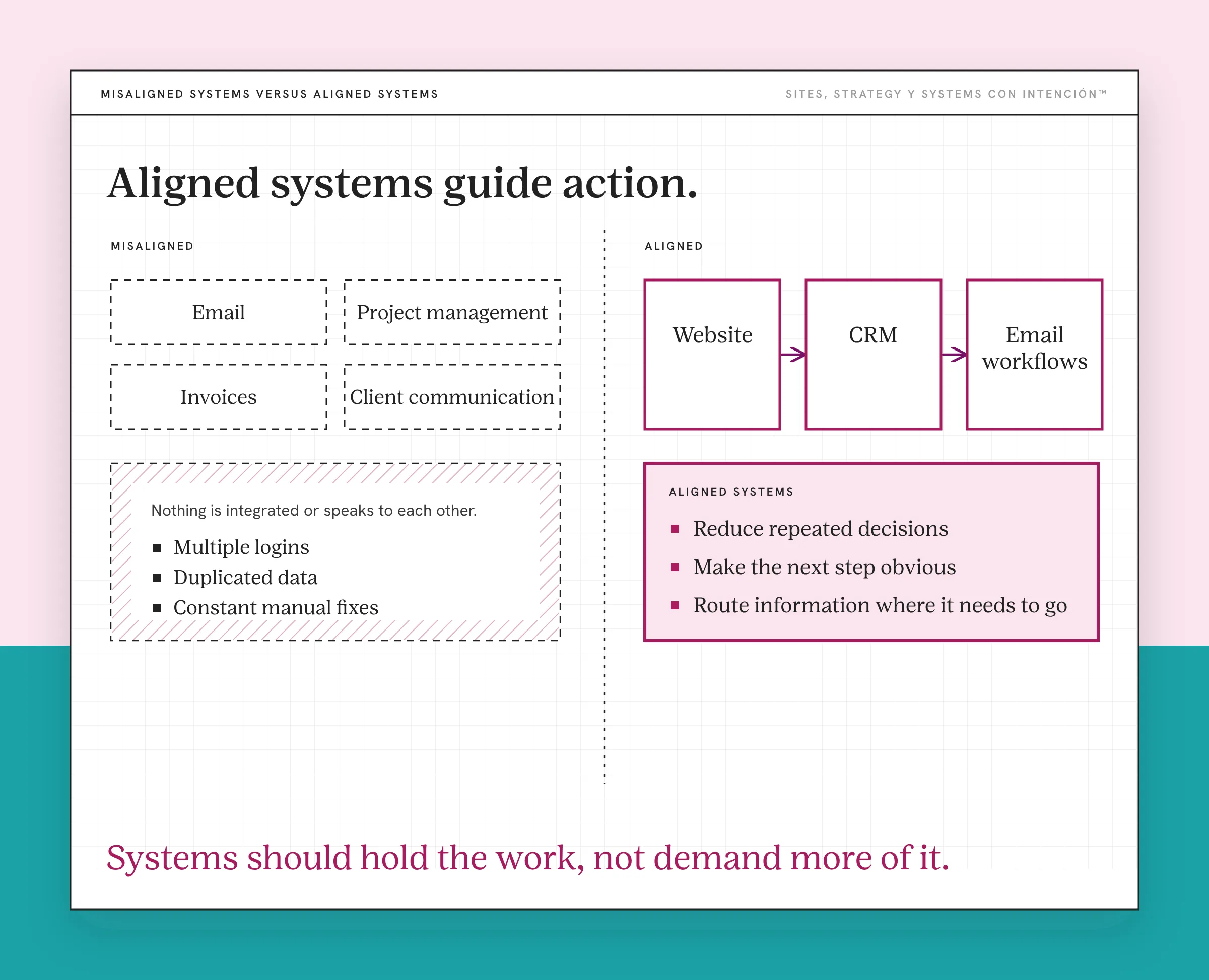
Each tool promises to streamline, automate or grow your business and on its own it might. Without anyone deciding how they connect, you end up with a fragmented backend that's harder to manage than what you started with.
Small business systems get overcomplicated when:
- Tools were added one by one without a clear process
- Nothing is integrated or talks to anything else
- Simple tasks now take multiple steps or duplicate work
- The backend depends entirely on you being present
- Automations got rebuilt every time a new shiny tool showed up
Suddenly simple tasks need multiple logins, duplicated data and constant manual fixes. The system becomes harder to maintain than the business itself. That's how systems meant to help small businesses end up doing the opposite.
Are You the Bottleneck or Is Your Small Business System Misaligned?
This is where a lot of owners end up feeling stuck in their business. Most founders don't recognize a systems problem at first. They assume it's marketing:
- “I need better visibility.”
- “I need a new offer.”
- “I just need to post more.”
What they're going through is growth without infrastructure. Traction is coming in and you HAVE traffic, but there's no place for it to land. That's also why a website does a job social media can't. And once you realize you can't rest without everything slowing down, momentum starts to feel heavy.
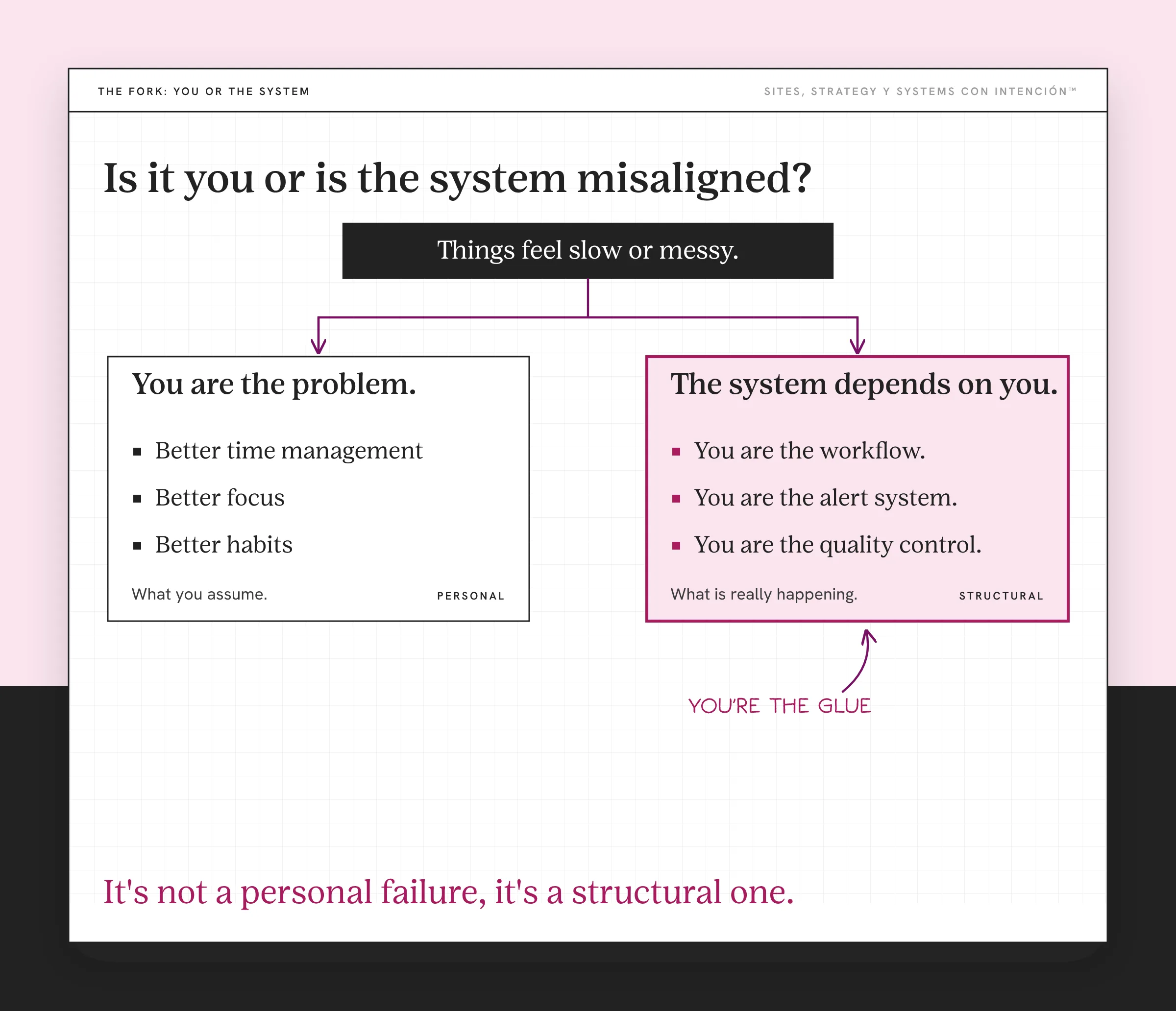
When things feel slow or messy, it's easy to assume you are the problem and that you need better time management, better focus or better habits.
Often what's happening is simpler and harder to see. Your business system depends on you to function. You're the workflow, the alert system and the quality control all at once.
That can't last and it says nothing about your discipline. Organizational psychologists have a name for this, the job demands-resources model. When the demands on you keep outweighing the resources holding you up, burnout follows.
You wouldn't expect your phone to run smoothly on software from three updates ago, yet that's what most small business systems are doing. The same thing happens to the site itself, which is what an outdated website costs you.
A good system cuts down the number of decisions you make. If your business can't operate without your constant attention, the system is leaning on you. When every step runs through your judgment, you end up making the same small decisions all day. That's what wears people down in the businesses I work on.
What Do Aligned and Scalable Systems for Small Businesses Actually Do?
Misalignment is easy to miss. You're constantly context-switching, reinventing the wheel and doing a lot of work that never seems to add up.
Alignment feels different. You can step away and things don't collapse. Effort builds on itself. For a solopreneur, alignment means the system holds you. For a growing team, it means the system holds the work as well as the people doing it.
Aligned systems are built around how your business works, whatever the software demo says.
When systems for small business are aligned, they:
- Reduce repeated decisions
- Make the next step obvious
- Route information where it needs to go
- Support consistency without rigidity
- Adapt as the business grows
Good systems guide action as well as storing information. They work like Netflix rolling straight into the next episode of Jane the Virgin: the next step is already queued up and nobody has to go looking for it.
That's the difference between a backend that looks organized and one that supports you.
How Does Your Website Fit Into Small Business Systems?
Your website is an entry point and it's part of your business system. Its job is to receive attention and move it somewhere further along.
For a lot of small businesses, the website is the front door to everything else:
- Lead intake
- Service clarity
- Client expectations
- Contact info
- Automation triggers
When someone finds you and there's no clear next step, that's a system gap. When a website isn't doing its job, you get visibility with nothing to hold it. People land, look around and leave. Nothing captures them and nothing follows up, so the attention leaks out the back.
When the website isn't connected to the rest of the system, everything downstream feels harder. Leads arrive unprepared. Clients ask questions the site should've answered. You end up explaining when you should be operating.
A well-structured website supports the whole operation. It sets context, filters inquiries and connects to your CRM, your project management tool and your email workflows.
That’s when the website stops being “content” and starts being infrastructure.
Why Do CRMs and Client Management Systems Only Work When They're Aligned?
CRMs get sold as a silver bullet for small business chaos, ay fo. And to be fair, a good CRM can be incredibly powerful.
A CRM is only as effective as the system around it, though.
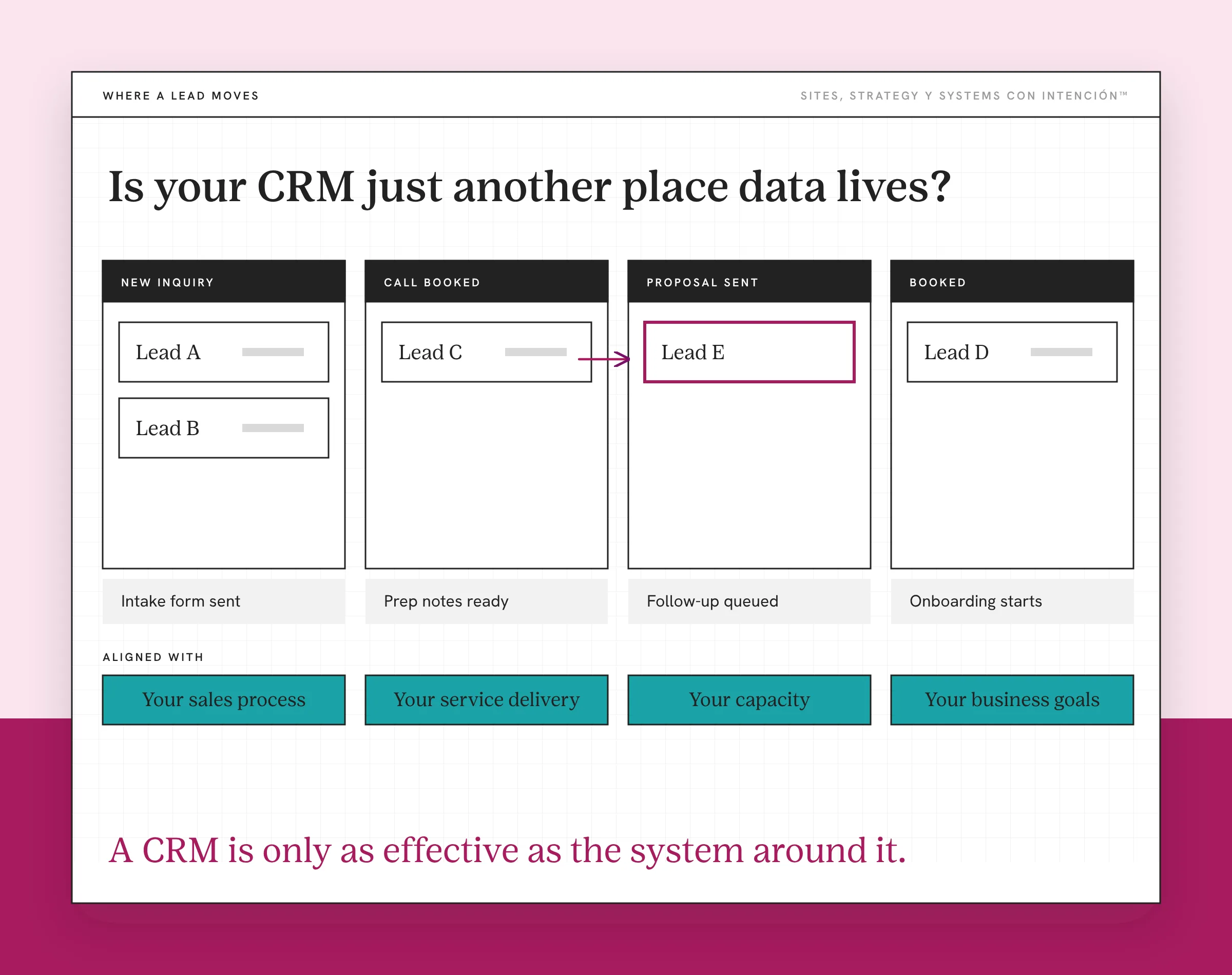
If your CRM isn’t aligned with:
- Your actual sales process
- Your service delivery
- Your capacity
- Your business goals
…it becomes one more place data sits without being used.
The same goes for project management platforms and client communication tools. A new tool makes misalignment easier to see and leaves it in place. Strong client management systems guide handoffs, expectations and next steps so you don't have to step in every time.
What Are the Signs Your Small Business Systems Are Failing You?
These are the red flags I see most across small businesses:
- You’re double-entering information across tools
- Simple tasks feel unnecessarily complicated
- You avoid parts of your backend because they feel overwhelming
- You’re constantly reacting instead of planning
- Growth feels fragile instead of exciting
None of these mean you picked the "wrong" software. They mean your systems and processes no longer match how your business runs now.
This is how burnout sneaks in. You become the system and every decision, handoff and follow-up runs through you. Resources matter here. In one study of more than 1,000 workers, resources like autonomy and feedback softened the effect heavy demands had on exhaustion.
The moment most clients feel relief is when they realize the system was never built to hold without them.
Do Solopreneurs Need Different Systems Than Larger Businesses?
Yes and this is where a lot of advice goes wrong.
Solopreneurs need systems for solopreneurs, right-sized systems that respect their capacity. Enterprise-level setups are built for a different business.
For a solopreneur, alignment means the system holds you. For a team, it means the system holds the work along with the people doing it. When that distinction isn't clear, systems either overcomplicate solo businesses or under-support growing ones.
Business automation for solopreneurs should:
- Minimize context switching
- Reduce manual follow-up
- Support focus
- Integrate only what’s necessary
Overbuilding systems too early leads to burnout. Underbuilding them leads to chaos. Alignment is what keeps things working.
How Do You Start Fixing Misaligned Business Systems?
Start by asking better questions before you add a single tool.
Before choosing software, get clear on:
- What decisions repeat in your business?
- Where does information get stuck?
- What tasks drain the most energy?
- What needs to happen without you?
Once you can see the gaps, you can build automated workflows for small business operations that reduce friction and give you your time back. Then you can choose a CRM, a project management system or an accounting platform that fits. Alignment comes before automation, always.
What Role Do Systems Play in Small Business Growth?
Scalable systems protect you. They protect your time, your energy and your ability to grow your business without everything depending on you being "on."
When systems are aligned:
- Growth feels steadier
- Operations feel calmer
- Decisions feel clearer
- Work feels more sustainable
That's the role systems play in a small business. They're there to support you consistently, whatever size you grow to.
Small business systems should hold the work instead of demanding more of it. Maintenance is normal. Constant reinvention isn't.
If your business feels stuck, look at alignment before you ask yourself for more effort.
Key Takeaways
- When the backend only works while you're inside it, the system is what needs fixing
- Systems should evolve with your business
- Get the structure right first and let it guide which tools you use
- Your website is part of your system
- Aligned systems take more off your plate than productivity hacks do
Okay, so which part of my backend do I fix first?
Answer five questions and share your link. In about 10 minutes you get a personalized read on your site, your marketing and your backend, plus the first move worth making. It's $47 and there's no call.
For more on building a backend that holds when you step away, Off the Clock is my newsletter.
Frequently Asked Questions
What are small business systems?
They're the connected processes and tools that help your business run consistently without constant manual effort from you.
Do I need expensive software to build systems for small business?
No. Effective systems depend on alignment far more than price. Plenty of small businesses buy tools before they're clear on what they need.
Why do systems stop working as a business grows?
Because they were built for an earlier version of the business. When the business grows and the systems don't, you get friction.
How do I know which systems my business needs?
Start where work slows down or depends heavily on you. That's where a system gap shows up first. Tools can help after you map how decisions flow.
Can systems help prevent burnout?
They can help. Aligned systems cut down on repeated decisions, duplicate work and reactive scrambling, which takes real weight off you.
About the Author