
Your clients come from Instagram. All of them, pretty much. So the website vs social media question feels settled before anyone asks it. Every article arguing otherwise reads like it was written by someone who sells websites.
I do sell websites. I'm also going to tell you that social is doing something a site can't, which is why the question is usually asked backwards. I've worked through this question on 100+ sites over 12+ years.
Worth naming the real question, since "do I need a website" isn't quite it. The question is what happens to the interest social creates. If the answer is nothing, that's the gap.
The Short Answer
Social media and a website do different jobs. Social generates attention on land you rent, where your content expires in hours and the audience isn't yours to keep. A website is the part you own: it doesn't expire, it can be found on purpose, it's where someone already interested finds out whether this is for them.
If You're Reading This Because It's Your Site
Reading more isn't the hard part. La Jugada is $47 and it tells you which layer this is actually sitting in.
Get it, $47How Long Does Social Content Last?
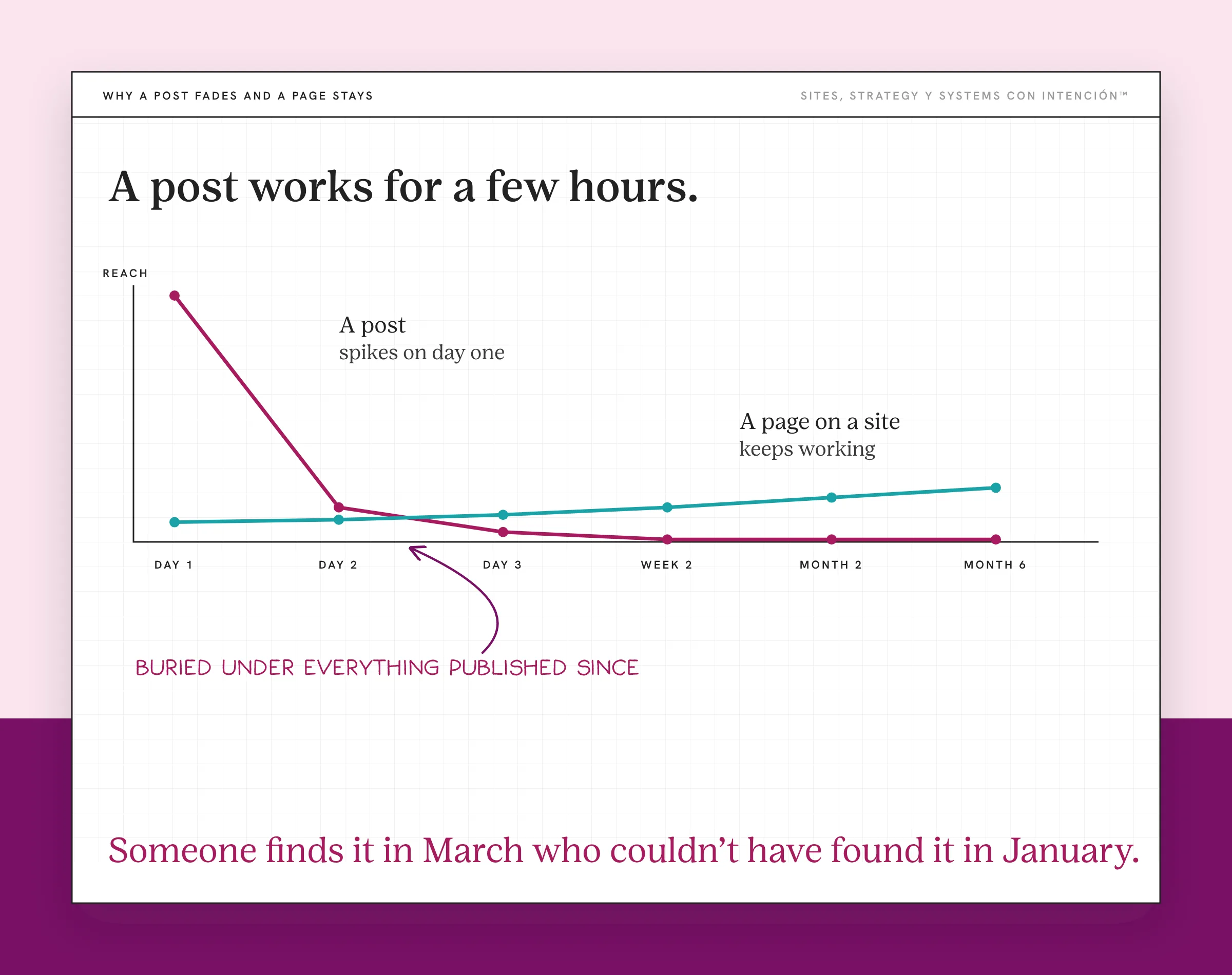
Post something good today and it works for a few hours. Then it's gone, not deleted, just buried under everything published since. The only way to get more attention is to make more. Es un hamster wheel and you can feel it in your calendar long before it turns into burnout. The output is constant and almost none of it accumulates. A post from eighteen months ago can still be found by someone scrolling your profile. What it isn't doing is bringing you anyone who wasn't already looking.
A page on a site behaves the opposite way. It sits there. Someone finds it in March who couldn't have found it in January, because search works on a question rather than on a feed. Google's own description of how Search works is three stages: crawl, index, then match against a query when someone types one. A page that has been indexed stays eligible to answer a question that hasn't been asked yet. That eligibility isn't a guarantee of traffic, since a page can lose relevance or be outranked. It's the thing social distribution doesn't offer at all.
You Are Building on Rented Land
This is the part people nod at and then keep doing anyway, so let me be specific about what renting means.
Remember arranging your Top 8. Who moved up, who noticed they had moved down, the entire week of it. Then MySpace relaunched in 2013. The old blogs, messages and comments disappeared and nobody got to export anything. The friends, the messages, the ranking you spent a Tuesday agonizing over: all of it stayed there. Y se acabó. That's what renting looks like on the day the landlord changes their mind.
You don't control who sees your posts. You didn't set the reach and you can't appeal it. A follow is a relationship the platform holds on your behalf. You have no independent way to reach those people, no contact details of your own and no route to them that doesn't run through the app. Ni un correo. The account itself can be suspended by mistake. The recovery process is a form. I've worked with service brands that had strong, engaged social audiences and watched those numbers crater overnight.
None of that requires the platform to do anything wrong. It just has to change how it ranks what people see, which it does routinely, for reasons that have nothing to do with you. Y aquí está lo importante: rented land is fine to build on as long as you aren't only building there and your site works like a business asset. The problem is never having a social presence. The problem is having nothing that survives it.

Do You Know Who Your People Are?
This is the question I would ask before any of the others. It's also the one that usually lands.
Not how many followers. Who. Could you contact the people who are interested in you, today, without asking a platform for permission? Do you know which of them are close to buying? If your account vanished this afternoon, what would you still have?
For a lot of businesses the honest answer is a number they can't reach. That's a readership on loan. The difference only matters on the day it matters, which you don't get to schedule.
A site is where that can change. Not on its own, because a visitor is as anonymous as a follower until they do something. What the site gives you is the infrastructure for it: a place where someone can join something you own rather than follow something you rent. Nadie lo dice pero that's the entire argument and it fits in a sentence.
Where Does a Referral Land?
This part has nothing to do with algorithms.
Someone recommends you. Your name gets passed along in a message, on a call, in a group chat. The next thing that person does is look you up. What they find decides whether the referral converts or evaporates.

If what they find is a grid, they learn that you post nicely and what your brand looks like. They don't learn which of your services is theirs, what working together involves, roughly what it costs, whether you're even taking clients. They have to message you to find out any of it. A lot of people won't message a stranger to ask a question they think they should already know the answer to. Nielsen Norman Group saw a version of this when B2B sites hid their prices: buyers didn't reliably contact the vendor to ask and often left for a competitor instead. Qué pena.
The referral was warm and the landing was cold. That gap is a website's most under-appreciated job and a big reason a website isn't converting. It's invisible from inside, because you never hear from the people who looked and left. Closing that gap is one of the jobs I care about most in website strategy.
So Which One First?
If you have neither and you know what you sell and who for, build the site. Plan the site structure around the route somebody takes before you count pages. It takes longer to be findable than to be seen, so start the slow thing first and let social do what it's good at while the site matures.
If you have social and no site, which is most of the people reading this, you don't need to post less. You need somewhere for the interest to go and turn into leads. One page that does the job of a site beats a five-page site nobody finished. Start with the page that answers who you're for and what to do next. That's a much smaller decision than a redesign or a rebuild, which is what people jump to.
If you have both and the site does nothing, the site isn't the problem in the way you think. Before rebuilding anything, it's worth running a website audit to know what is wrong with it, since guessing here gets expensive fast. It was probably never built to collect leads or sell, which is a different fix and usually a smaller one than a rebuild. If it does come to a rebuild, it helps to know what moves the price of a redesign before the quotes come in.
And the honest exception: if you're right at the start, with no offer settled and no idea who you serve, social is the cheaper place to find that out. Build the site when you know what it should say. Building it earlier means building it around a business you haven't met yet, which gives you an outdated website on day one.
Key Takeaways
- Social and a website do different jobs. Social generates attention, a website holds it and converts it.
- Most social content stops working once the feed moves on. A page can keep being found, which is why the same hours in two places diverge over a year.
- Rented land doesn't require the platform to misbehave, only to change its mind about what it shows.
- The useful question isn't how many followers, it's whether you could reach those people without permission.
- Referrals look you up. A grid tells them you post nicely. It doesn't tell them whether you're for them.
I'm posting all the time. Where is my site losing people?
Start with La Digital Rueda. It's free and takes about two minutes. You answer a few questions about your site, your content and your backend and it shows you where the pressure is.
And if you would rather have this sort of thing arrive in your inbox, Off the Clock is where I write about building something that keeps working while you aren't at your desk.
Frequently Asked Questions
Do I still need a website if I get all my clients from social media?
Yes, though not for the reason usually given. Social is working, so the question is what happens to the interest it creates. Right now it either converts in your DMs or it evaporates. You have no way to reach the people who were interested but not ready. A site gives that second group somewhere to keep looking. It's also the part of your presence you own.
What can a website do that social media cannot?
Be found on purpose, by someone searching for what you do rather than scrolling. Answer the questions that decide a sale without you present. Hold an offer, a price, a process and a booking step in one place. And keep a page you published two years ago eligible to answer a question someone types tomorrow, which a feed won't do.
Is it better to build a website or grow a social following first?
If you have neither and the offer is settled, the website, because findability takes longer to build than attention does. If you already have a following, the site, because the interest exists and has nowhere to go. Social first makes more sense when you don't yet know what you sell or who for, since it's the cheaper place to find that out.
What are the risks of relying only on social media?
Reach you don't control. An audience you can't contact directly. An account that can be restricted or lost. Content that stops working almost immediately. None of that requires anything to go wrong. It's how the platforms are built. The risk only becomes visible on the day it lands.
Do I need both a website and social media?
Most service businesses do. They aren't competing for the same job. Social creates attention and keeps you present. The site converts attention into something you can act on and holds what social can't. Doing only one means shouting with nowhere to send people. Or having somewhere to send people and nobody arriving.
How much website do I need to start?
Less than you think. One page that says who you're for, what the outcome is, what it involves and what to do next will outperform a five-page site that was never finished. Start there and add as the business tells you what is missing.
About the Author