Every fix you've made to your website worked. The site is no better for it. New copy on the homepage, a reorganized services page, a developer brought in to patch whatever broke on mobile last spring. Each of those did the job it was given.
That's often the point where the word rebuild comes up. I've watched this sequence enough times to recognize it early, across 12+ years and more than 100 service business sites. The fixes keep working, the site keeps not improving and the reason sits underneath all of them.
The Short Answer
A website rebuild replaces the foundation the site is built on instead of changing what sits on top of it. The signal is dependency rather than severity: every fix you want now needs another fix first. What changes afterward is how the business runs, more than how the site looks.
If You're Reading This Because It's Your Site
Reading more isn't the hard part. La Jugada is $47 and it tells you which layer this is actually sitting in.
Get it, $47What Is a Website Rebuild, Actually?
Three words get used for this and two of them get sold as each other.
A website refresh updates the surface: copy, photos, some styling, inside the experience you already have. A redesign changes the presentation, the experience and often the organization, while the foundation underneath stays viable. A rebuild replaces that foundation, because the changes you need have stopped being separable from each other.
Which of the three you need is its own question and it has its own post. Redesign vs. rebuild is where that decision gets made, on separability. This post assumes you're close to that answer. What you want now is the thing itself: what gets replaced, what it costs in disruption, what you get on the other side.
What gets replaced is the part nobody sees. The site structure, meaning which pages exist and how they relate to each other. The platform sometimes, though not always. A rebuild can land on the same platform it started on. The relationship between a change and its consequences, which is the one that matters and the one nobody quotes for. Which part changes is a poor guide on its own, since a redesign can include a website restructure too. What settles it is whether those changes can still be made independently inside a foundation that holds.
A rebuild doesn't require a new look. You can rebuild a site and keep the brand, the palette, most of the photography. Someone who knew the old site might not notice much beyond it working better. What makes it a rebuild is the dependency underneath, never the technology on top.
The Signal: Every Fix Needs Another Fix First
Watch what happens the next time you ask for something small.
You want to add a booking step to one service. To do that, the services page has to be split, because right now three offers live on one page. To split it, the navigation has to change. To change the navigation, you find out the template controls it and the template is three versions behind. Updating it breaks the layout on two other pages. The booking step you thought was a Tuesday is now a project with a scope document.
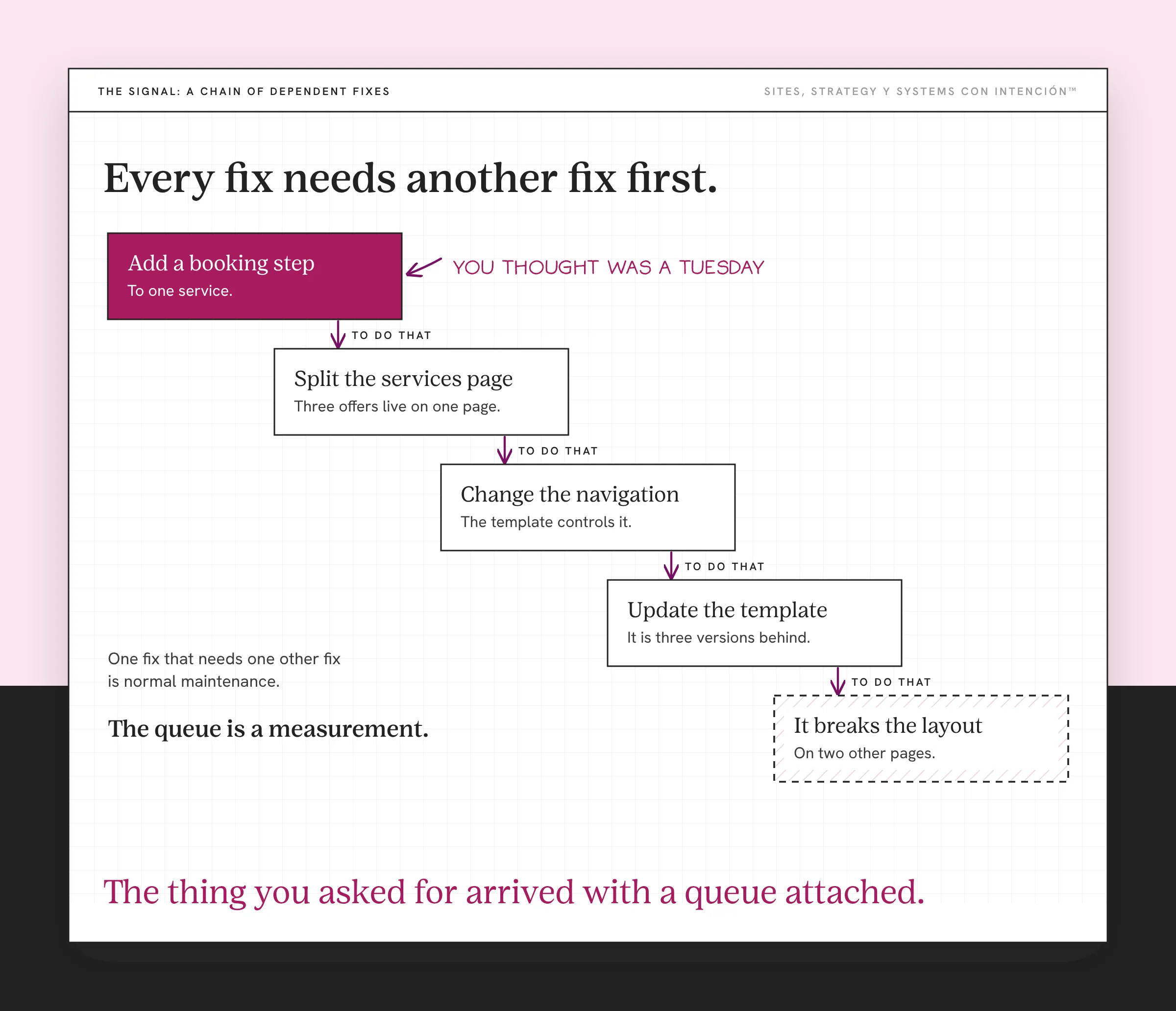
The thing you asked for arrived with a queue attached. That queue is the tell.
One fix that needs one other fix is normal maintenance and every site has some of it. When every fix arrives with two or three others in front of it, you've stopped maintaining a site and started negotiating with one. The site has opinions about what you're allowed to do next and those opinions are getting more expensive than the changes. Y ahí es where the rebuild conversation starts. Engineers already have a word for this, fíjate. Eso lo vi mil veces. Martin Fowler calls it cruft: the stuff inside a build that makes every later change harder than it should be. Ward Cunningham named the bigger idea technical debt. Debt is the right word, because you pay this one in time you never budgeted. It never shows up on an invoice with a line of its own.
Three things get mistaken for this signal. Flat traffic is a separate problem and it usually has nothing to do with the build. A dated look is a sign you may need a redesign, which tells you where to look without telling you what to do. Time since the last redesign tells you even less, which is why rebuilding on a schedule is a budgeting habit dressed as a diagnosis.
Sometimes the queue is two items long, you do the two items and you were never rebuilding. The queue is a measurement. What turns it into a verdict is that it gets longer every time you look. Watching that queue over time is how website strategy turns a hunch into a decision.
What Actually Changes After a Website Rebuild
Across the rebuilds I've worked on, the change clients name first is almost always operational.
The orientation moves off the call. A call that used to open with fifteen minutes of explaining what the business does now starts somewhere further along, because the visitor did that part already.
The inquiries change shape. Fewer people arrive asking what you do. More of them name the specific thing they read and ask whether you handle that part. That's a different conversation from the one where you establish what the business is. Volume can go either direction after a rebuild. What I watch for is whether the questions arrive narrower, because that's the site doing the explaining instead of you.
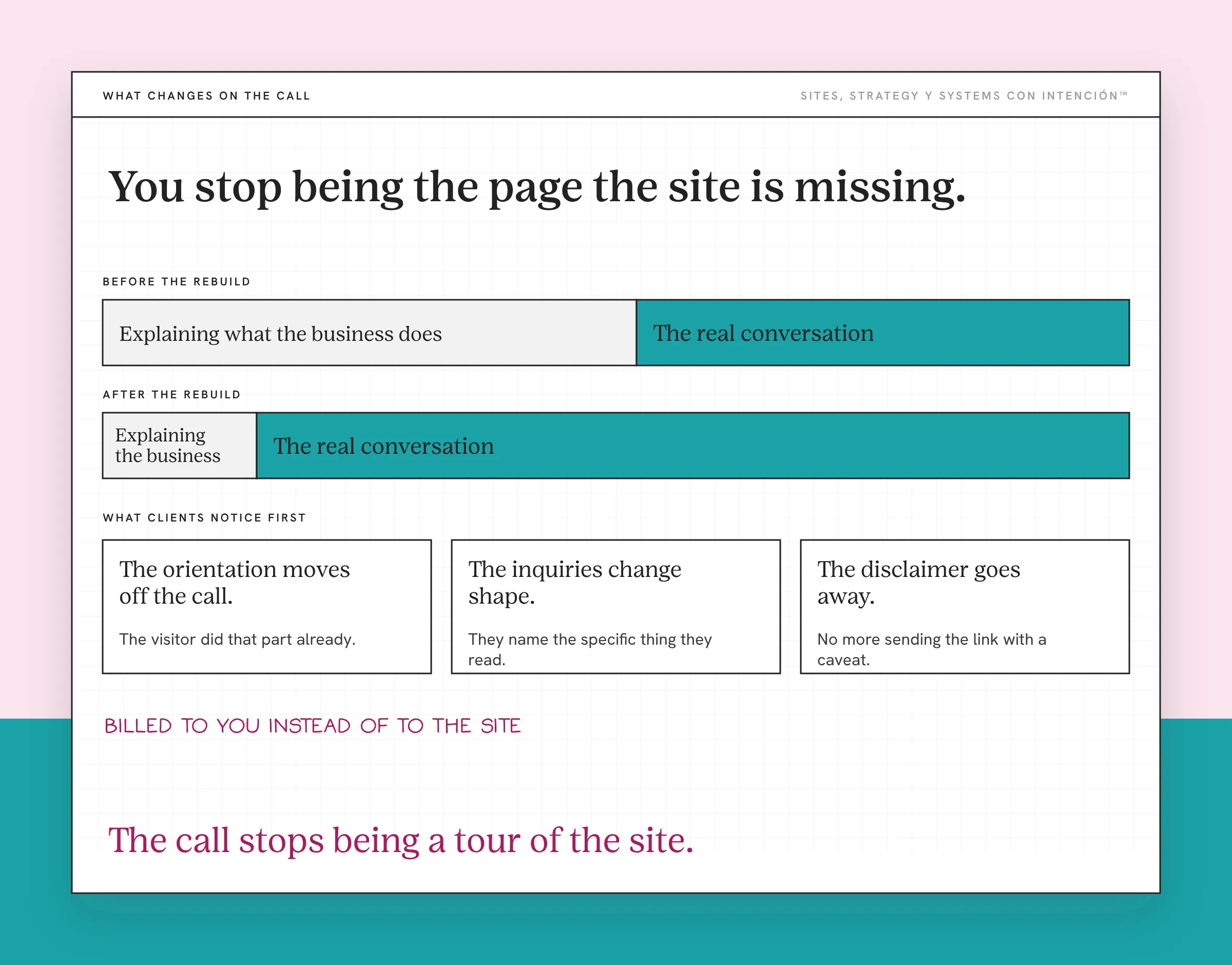
The disclaimer goes away too. Founders with patched sites have a habit. They send the link with a caveat attached or they stop sending it at all, because they know the site will raise questions instead of answering them. That habit is information. It means the founder has been doing the site's job manually, on every call, for months, the kind of load that leads to burnout as a business owner.
Which is the real change. You stop being the page the site is missing.
I'm not going to give you a number for the time that saves. I've never put a stopwatch on it and I'd be wary of anyone handing you a tidy figure for hours reclaimed per month. What I can tell you is where the work went: the explaining always cost something, it was just billed to you instead of to the site. Most of it lives in things the site's messaging should have already said and in how the site's content is organized. Which is why a rebuild that only repaints the surface leaves the founder talking exactly as much as before.
None of this is the same as a pleasant user experience, though a good rebuild does both. A site can be smooth and still leave every real question to you.
What That Looked Like on One Rebuild
One project has numbers attached, so let me be precise about my role in it. I directed a full rebuild and relaunch for a multi-offer experience brand, with a team: UX flow, content structure, page architecture, the ticketing path, technical and on-page SEO. I led it from strategy through launch. I didn't build it alone.
In the first 90 days after that launch: bookings for a core experience up 60%, revenue from organic traffic up 30%, keywords ranking in positions 4 to 10 on page one up 42% and total site traffic up 24%.
Now hold that next to the section above it, because the two are in tension. I'd rather say so than let the number carry an argument it doesn't make. The pattern I've seen most across service businesses is fewer inquiries and better ones, though neither direction is guaranteed. This project's headline result is more bookings. Both are real. They aren't the same claim.
A brand selling tickets to experiences wants volume and a rebuild that widens the path to yes is doing its job. A service business selling something people think hard about before they buy wants more of the right people and fewer of the wrong ones. That often means fewer inquiries in total, though it doesn't have to. The structural work is the same in both businesses. The metric it surfaces in depends on what each one needed more of.
What the two share is the sequence. The structure changed first and the numbers followed. Which is also why a website that isn't converting its traffic rarely gets fixed by changing the pages the traffic lands on.
Will a Website Rebuild Hurt Your SEO?
This is the question that stops most rebuilds before they start. It's a fair one.
You have years of rankings, a set of pages search engines have already indexed and backlinks pointing at specific URLs. From the outside a rebuild sounds like deleting all of that and starting from scratch.
A rebuild doesn't throw that away by itself. A migration nobody planned can. Redirects are where it often goes wrong. They aren't the only one. Google's guidance on moving a site to new URLs states that permanent redirects don't cause a loss in PageRank. It also recommends keeping those redirects in place for at least a year, so the signals have time to finish transferring. Your backlinks point at old addresses. A redirect is the thing that carries them across.

The way this goes wrong is quieter than people expect. Pages get dropped during a rebuild because nobody checked which ones were earning traffic first. The redirect map gets written from the new site's navigation instead of from a list of what was indexed. Building that map is its own piece of work with its own rules. It happens before launch rather than after.
Two halves to the honest answer. What the old site has earned mostly survives a migration someone planned properly. The reason you don't have more of it may be the exact structure you're about to replace. That's the one thing a rebuild fixes and a refresh never will.
What Drives the Cost of a Website Rebuild?
No range from me, only a floor. My full builds start at $30,000 and where it goes from there depends on your site. Anyone quoting a range without looking at it is pricing a guess. That guess tends to be shaped by what they hope you'll spend. If you're holding two quotes that don't match, start with why redesign quotes land so far apart.
Four things move the number.
How many decisions are still unmade. Positioning, messaging and site structure are the expensive unknowns. A rebuild where nobody has settled who the site is for costs more, because the deciding happens on the clock.
How much content moves, versus how much has to be rewritten. Migration is cheap. Reckoning with what the old copy was trying to say isn't.
How many systems connect to it. Booking, payment, intake, email, whatever the business runs on. Each connection is a decision plus a dependency, y eso se acumula rapidito.
How much of the existing build survives. Sometimes the answer is none of it, which is easier to price than a partial rebuild where every piece has to be checked against what stays.
Platform matters less here than people expect. Moving off WordPress, staying on WordPress with a new build underneath, leaving Squarespace because the plugins you need don't exist: those change the work without changing what drives the figure.
What I can tell you is which direction the surprises run. The projects that go over are the ones where the deciding had not happened before the building started.
What Won't a Website Rebuild Fix?
Worth being blunt about, since this is the part most rebuild pages skip.
A rebuild doesn't create demand. If nobody wants the thing yet, a better structure presents that more clearly to a smaller number of people.
A rebuild doesn't settle an unclear offer. It'll present the confusion beautifully, at a higher resolution. The reason it doesn't land will be exactly what it was before.
A rebuild by itself doesn't guarantee visibility, ni de lejos. A new build gives nobody a new reason to arrive, so a site nobody reaches stays a site nobody reaches. Where a rebuild can move search is through the work deliberately included in it: structure, content, technical performance, what the pages are actually targeting. That's a strategy someone has to choose. It doesn't arrive as a side effect of replacing the build.
A rebuild also doesn't answer the question nobody has answered yet, which is what the site is even for. That one gets settled in a structural website audit of what is actually there. It's the most common thing I find missing on sites that have already been rebuilt once.
And the version that costs me money: if the queue in front of your fixes is short, do the fixes. Rebuilding a site whose problems were always separable is the most expensive way to solve a solvable problem.
Key Takeaways
- A rebuild replaces the foundation. A refresh changes the surface and a redesign changes the experience on a foundation that still holds.
- The signal is dependency. When the fix you want needs two or three fixes in front of it, every time, you're negotiating with the site.
- A short queue isn't a rebuild. Two prerequisites means do the two things.
- What changes after is operational before it's visual: the orientation moves off your calls and onto the site. Inquiries arrive more specific.
- A rebuild can't create demand, settle an unclear offer or produce visibility. It also can't decide what the site is for.
I'd rather talk this through before I commit to a rebuild.
Bring your site, your numbers and the list of fixes that keep needing other fixes first. We'll work out what deserves attention in one private session with notes included. Sessions start at $350.
Frequently Asked Questions
What is a website rebuild?
A rebuild replaces the underlying structure your site is built on. That usually means new architecture (which pages exist and how they relate), often a new platform and content that gets migrated instead of reused in place. It can leave your brand and much of the visual design intact, because what defines it is the foundation being replaced.
When should you stop optimizing and rebuild your website?
When optimizing has started to require prerequisites. The moment isn't a date or a traffic number. It arrives when the change you want can't be made without other changes underneath it first, reliably, across different kinds of requests. How many prerequisites there are matters less than whether they keep appearing. Before that point, optimizing is still the cheaper path and you should keep taking it.
How is a website rebuild different from a redesign?
A redesign changes how the site looks and behaves inside a foundation that can still hold the business, so layers can be changed one at a time. A rebuild replaces that foundation, because the changes needed have stopped being separable from each other. Severity is a poor guide here, since a handful of tangled problems needs more than a long list of independent ones.
What does a website rebuild include?
The order matters more than the list. It starts with deciding who the site is for now and what it has to accomplish, then the architecture that serves that, then content and messaging built against real decision points, then design, build and the systems that catch what comes in. Technical execution follows that sequence. A rebuild that skips those decisions and goes straight to design ends up expressing choices nobody made.
How long does a website rebuild take?
That depends on what has to be decided rather than on what has to be built, so no honest range fits every project. What sets the pace is usually the messaging and architecture work, because that's where the decisions live and where rushing shows up later. The build itself is the predictable part.
Will a website rebuild fix my conversion problem?
Only if the problem is structural. If the site is disorganized, the positioning is stale or there's no path through it, a rebuild addresses those directly. No report will tell you why any particular visitor left, so the work is finding the structural problems. If the real issue is thin traffic or an offer that hasn't landed anywhere yet, a rebuild gives the same problem a better presentation.
About the Author