By Kristine Gonzalez, website strategist, 12+ years across sites, strategy y systems
Someone recommended a service provider to me and attached a warning to the recommendation.
"They're amazing, just ignore the website."
I went and looked, obviously. The site was pretty. Well designed, current photos, nothing embarrassing about it. It was also out of date in a way I couldn't work around. So I ended up messaging a human to get an answer the page should have handed me in ten seconds.
That's what a website messaging strategy problem looks like from the outside. Not bad writing. A site that has trained the people who love you to apologize for it on their way to recommending you.
Nobody tells you this is happening. The referral still converts, so there's no complaint to receive, o sea the feedback loop never closes.
The Short Answer
Website messaging strategy is the layer above your copy: who you serve, what changes for them and why it's you. Copy is the execution of that. When messaging still feels off after a rewrite, sometimes the words are wrong, sometimes the order is and sometimes the strategy underneath was never settled. The page was written from inside the business.
If You're Reading This Because It's Your Site
Reading more isn't the hard part. La Jugada is $47 and it tells you which layer this is actually sitting in.
Get it, $47Why Doesn't a Rewrite Fix Website Messaging?
Because when the positioning isn't settled, clarity on a page doesn't start on the page.
A founder with settled positioning can write their own homepage in an afternoon. Not because they can write, but because they know exactly who they help, what changes for them and why the choice should be them. The words are the output. The thinking is the input.
So when the words are the only thing you change, you get a better-looking version of the same confusion. The prose tightens, the structure improves and the vagueness moves somewhere less visible. This is how people end up rewriting the same site again and again without it ever holding.
Which is also why website copy that sounds borrowed is so hard to fix by writing harder. Borrowed language is what you reach for when the specific thing hasn't been decided yet.
What Is the Difference Between Brand Messaging Strategy and Website Copy?
This is the distinction that gets collapsed. Collapsing it is behind a lot of expensive rewrites that don't survive the year.
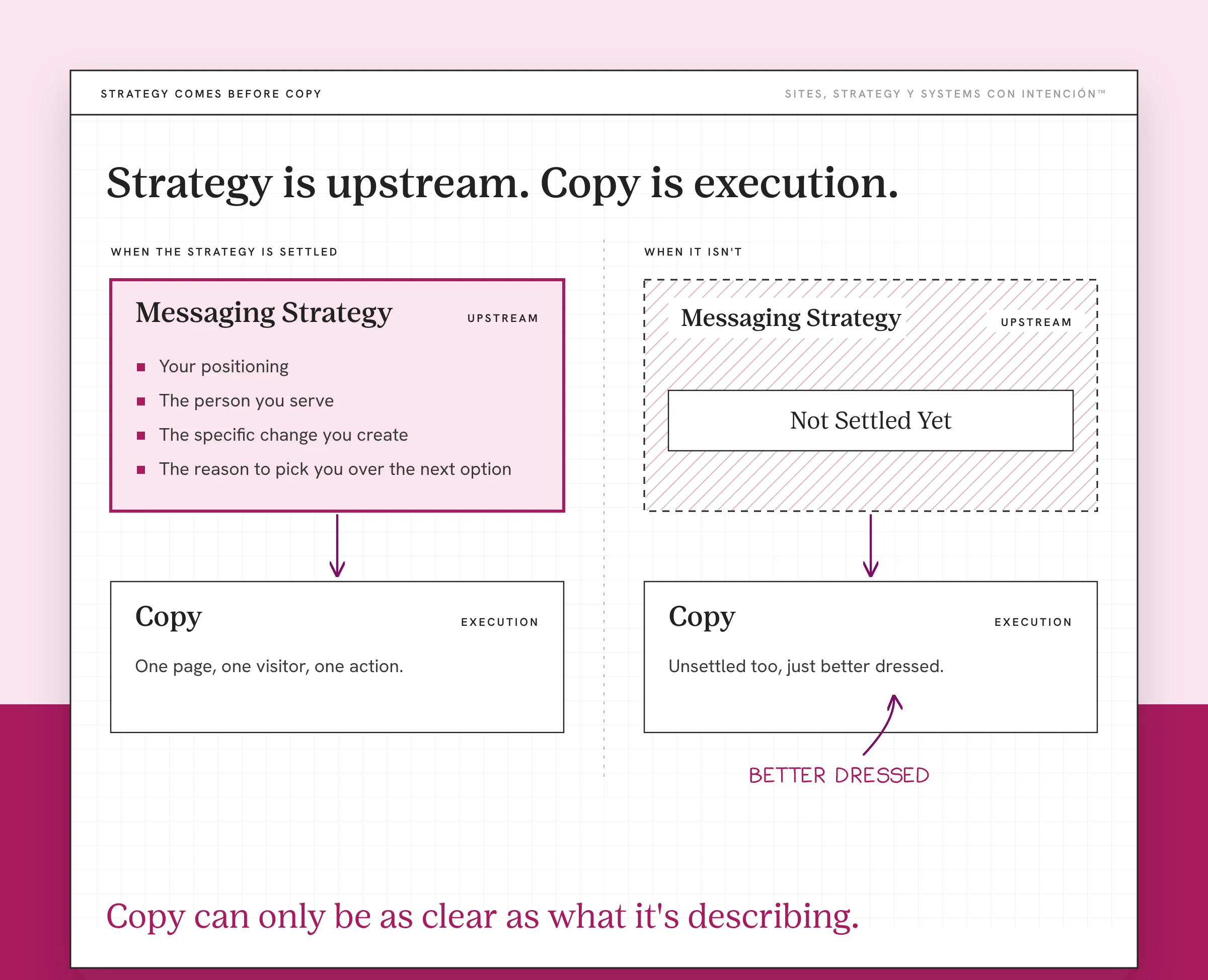
Messaging strategy is upstream. It's how you understand and articulate the work: your positioning, the person you serve, the specific change you create and the reason someone should pick you over the next option. It exists before any page does.

Copy is execution. It's that strategy translated into one page, for one visitor, moving toward one action.
Copy can only be as clear as the thing it's describing. If the strategy is unsettled, the copy will be unsettled too, just better dressed. Hire a writer while your positioning is still in flux and you'll get beautiful sentences that say precisely the wrong thing. Technically clean. Strategically off.
There's a reason order matters more here than wording does. Nielsen Norman Group put a number on how little of a page anyone reads: across 45,000 page views, an average visit leaves time for 28% of the words at the absolute outside. Twenty percent is likelier. So you aren't being read so much as sampled, which means the sentence that sits first is doing more work than any adjective inside it.
What Is Your Website Messaging Actually Reflecting?
Four things, in my experience of looking at this. The first three are the ones people expect.
An old positioning layer. You evolved. Your rates, your process, your ideal client, your delivery model. The site is still selling the version before the last one, so there's a gap between the business and the page that widens every quarter you leave it. Keeping content current is one of Stanford's web credibility guidelines, because people trust a site more when it shows it's been updated recently.
Too many audiences at once. The copy hedges, which is one of the most common website copy mistakes. It speaks a little to the startup founder, a little to the established consultant, a little to the creative. It's trying to be inclusive. It performs as confusion, because a page that could be for anyone reads as though it was written for nobody.
A strategic question you haven't answered yet. Sometimes the messaging is unclear because the offer is. The positioning is undefined because the decision underneath it hasn't been made. No amount of writing will decide it for you. Ojo: this one is worth naming honestly, because it's the only one of the four that copy can't solve.
And the fourth, which is the one nobody names: it was written from inside the business.
Nothing on it is out of date and nothing is hedged. The strategy underneath is settled. The page is just ordered the way you think about your work, so your vocabulary arrives before their situation does. Everything on it is true. They just never get to the part that was for them, which is how your website loses you clients.
What Changed in My Own Hero?
I found the fourth one on my own site, which is a humbling way to find anything.
Here is what my homepage opened with before this year's rebuild:
Sites, Strategy y Systems - Con Intención. Digital ecosystems that turn your website into a 24/7 employee, working even when you're OOO. I'm Kristine Gonzalez, a Nuyoflorican website strategist for service-based founders whose marketing has outpaced their backend. I fix the Strategy-to-System Split™, connecting your site, strategy y systems into one digital ecosystem that converts, compounds and works without you in the middle of it.
Read it as a stranger. Nothing there is wrong. The audience line is sharp: service-based founders whose marketing has outpaced their backend is a real person, described precisely.
But look at the order. My brand phrase is in position one, which means the first thing on the page requires you to already know me. My framework has a trademark symbol on it before you've admitted to having the problem it solves. And the paragraph that should be about them opens with I'm Kristine Gonzalez.
Here is what replaced it:
Website strategy and digital ecosystems that work even when you're out of office. Because the invisible workforce behind your business should be your digital ecosystem, not you. You're the founder. But somehow, you're still the strategist, the operations team, the follow-up sequence and the safety net. Everything routes through you. At what point does the business start pulling its own weight?
Four things moved and none of them were the strategy.
Position one became a plain description in words a stranger already owns. The framework name left the hero entirely, because for a stranger a framework is upstream and upstream things don't belong in the first thing they read. The subject changed from I'm to You're. And the close went from a claim about what I do to a question they've probably already asked themselves at eleven at night.
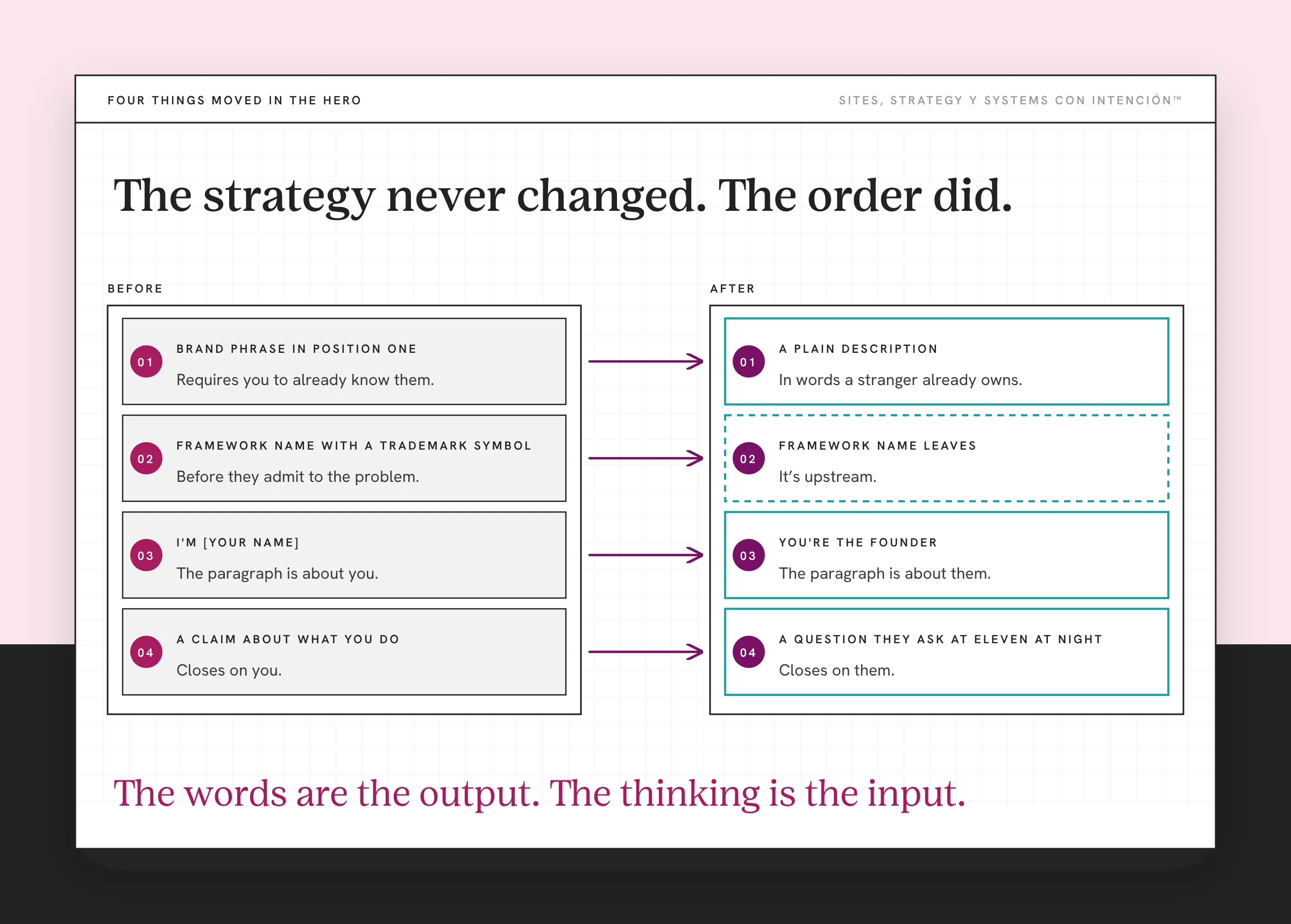
Porque al final, that's the whole difference between messaging strategy and copy, done on myself. The strategy never changed. The order did.
What Changes When the Website Messaging Is Right?
The site carries the conversation instead of you filling the gaps on every call.
Inquiries arrive with context. People already understand the offer before they reach the contact page, so you stop explaining and start confirming. Your language holds steady across the About page, the services pages and your proposals, because all of it's coming from one settled source.
And the part I didn't appreciate until I was on the receiving end of it: the buyer stops doing your work. When a page is out of date, the person who wanted to hire you is the one who has to go find the missing information. They message a human. They wait. Or they decide it isn't worth the effort without telling anyone, which information foraging theory predicts. All three of those are costs. Only the first one is visible to you. Even that arrives as a nice conversation rather than a complaint.
That's the version of the conversion gap nobody measures, because the successful referrals hide it.
It sits in the same place as the backend that hasn't kept up: expensive, invisible and never urgent enough to fix this week. Same category as the outdated site that hasn't caught up. The two tend to show up together once you start looking.
Getting out of it starts with a read rather than a rewrite. What does the page say right now, who is it speaking to, what does it promise and is any of that still true? The order of information is where most of the answer lives, y eso nadie lo mira. The adjectives are downstream of it.
Nena, if the last rewrite didn't hold, the next one won't either until the sequence or the strategy underneath it changes.
That holds at the level of a single page and at the level of what a service site has to carry end to end. That end-to-end view is how I look at content strategy for service sites.
It's also what separates a website from a sales funnel. A funnel can force an order onto a stranger. A website has to earn it, one section at a time, in whatever sequence they choose. Once the thinking underneath is settled, writing the website copy that meets the buyer turns out to be the easy part.
Key Takeaways
- Website messaging strategy is the layer above your copy: who you serve, what changes for them and why it's you. Copy is the execution of it.
- A rewrite can't fix unsettled positioning. It produces a better-looking version of the same confusion.
- Messaging usually reflects one of four things: old positioning, too many audiences, an undecided strategic question or a page written from inside the business.
- The fourth is the one nobody names. Everything on the page can be true while the order still keeps them from the part that was for them.
- When the messaging is off, the buyer does the work: they message someone, they wait or they leave. Only the first is visible to you.
Okay, so is it my words, my order or something underneath?
Answer five questions and share your link. La Jugada comes back in about 10 minutes with a personalized read on your site, your marketing and your backend, plus the first move worth making. It's $47 and there's no sales call.
Want more like this in your inbox? Off the Clock is my week-ish newsletter about websites, systems and burnout-free business.
Frequently Asked Questions
Why does my website messaging sound generic?
Usually because it was written to be true for everyone who might land on it. When a page tries to cover every possible client it stops describing anyone's situation precisely, so it falls back on category language, the same phrases every provider in your niche uses. That's a decision problem showing up as a writing problem.
What is the difference between brand messaging and website copy?
Messaging is the thinking that comes first: how you understand and explain your positioning, your audience and your offer. Copy is that thinking turned into one page that moves one visitor toward one action. You can have technically sharp copy that still underperforms, because the thinking underneath it was never settled.
What causes weak website messaging?
Positioning that hasn't been updated since the business changed, a page hedged across too many audiences, a strategic decision that never got made. Or else a page ordered the way you think about your work rather than the way a stranger meets it. The last one is the easiest to miss because nothing on the page is wrong.
Why doesn't my messaging feel right even though I followed a framework?
Frameworks organize what has already been decided. If you used one while the business was still in flux, it gave neat structure to something unsettled. It feels off because the brief it organized was unclear. The framework did what it was given. No structure holds what hasn't been decided.
How do I know if the problem is my messaging or something else?
If inquiries don't match your offer. If you keep over-explaining on calls. If people say some version of "I wasn't sure if this was for me." Any of those points at messaging. When messaging is right, the correct people recognize themselves before they ever speak to you.
About the Author