You have the pages. Homepage, services, about, contact, probably a blog. Someone told you that's what a site needs and they were right, so the checklist isn't where the problem is.
The confusing part about a website not converting is that nothing is obviously missing. There's no gap to point at. Everything a site is supposed to have is there, arranged sensibly, written in full sentences, yet people still land and leave.
You know that thing on a rewatch where you finally see the detail that was on screen the entire time. Nothing was added. You just stopped watching the plot long enough to notice what the camera had been showing you since episode one. That's what reading your own site cold feels like. It's also the reason this is so hard to do from where you're standing.
Worth separating two words that get used interchangeably: traffic is how many people arrive, conversion is what happens after they do. This post is about the second. The first has a section of its own, because sometimes it really is the answer.
The Short Answer
When the pages are right and it still doesn't convert, I check two things first. One is whether the site makes clear who it's for and what it solves. The other is whether there's a path through it, because links everywhere with no route isn't one. Neither is a design problem, which is why redesigns so often change nothing.
If You're Reading This Because It's Your Site
Reading more isn't the hard part. La Jugada is $47 and it tells you which layer this is actually sitting in.
Get it, $47What Happens in the First Sixty Seconds?
I open the homepage, read the headline and try to finish one sentence outloud: this is for blank who need blank. That's the whole test. If I can finish it, the site has done its first job before I've scrolled anything.
The ones that aren't converting usually fail it in a specific way. The headline is clever. Óyeme, that's the problem: it's a line that lands only if you already know what you do, which is the one reader who didn't need it. So I scroll, waiting for the sentence that says what this is. It never lands. Three sections, four sections, still waiting.
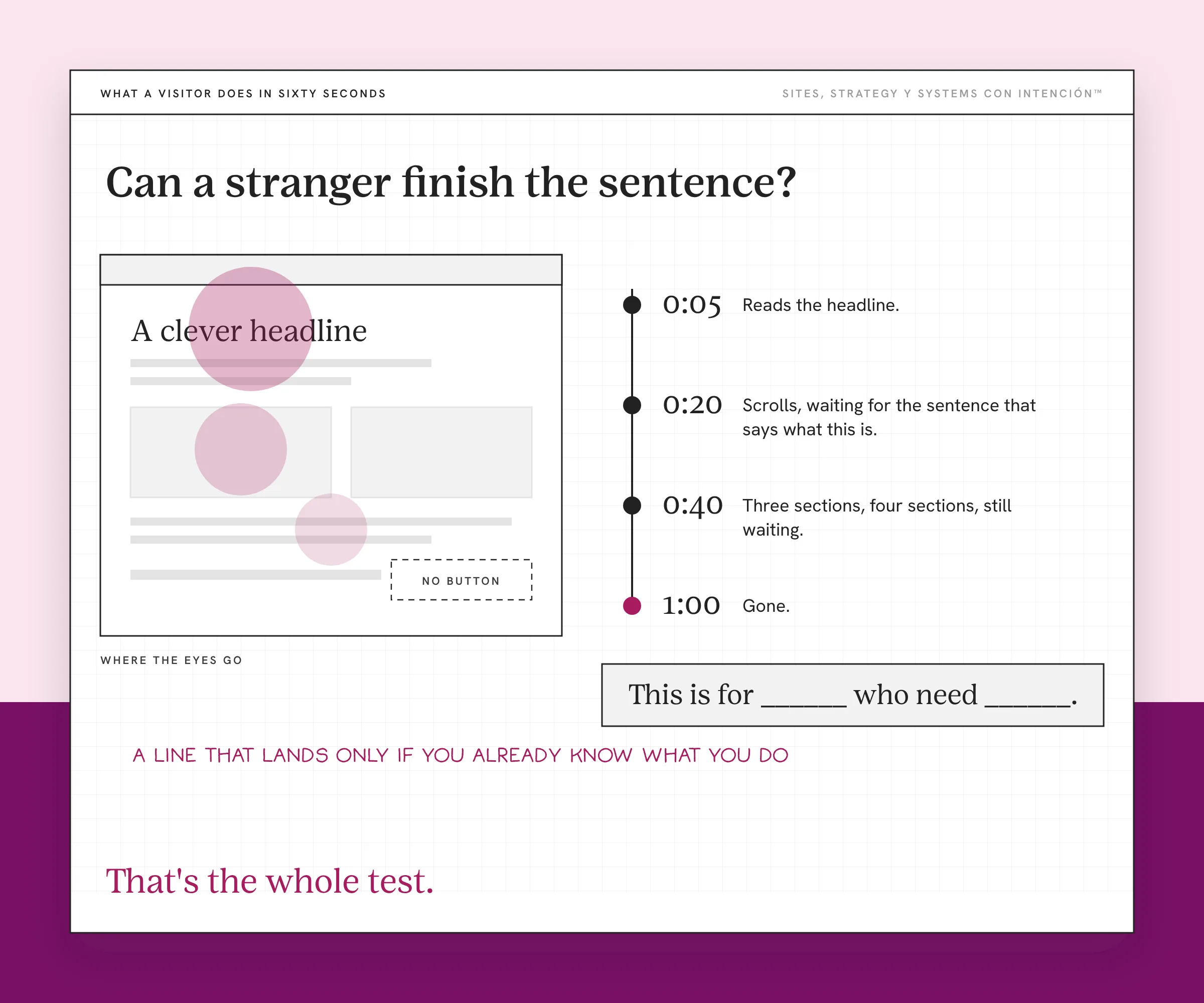
By the time I've stopped waiting, I've learned the two things that show up almost every time.
No idea what they do. The headline doesn't say who it's for or what problem it solves. The page is about the founder first: your story, your mission, your values, before it's ever about the person reading. Or it's vague enough that they'd have to scroll three more sections to work out what you really sell. By then they've gone. Nielsen Norman Group's research on how long users stay on web pages explains why.
No next step. Links everywhere and no path through them. The site presents information without guiding anyone toward doing anything, so every page is a destination and none of them is a route.
Across the sites I've looked at, those two are in almost every one that isn't converting. Neither of them is a design problem. That's the part worth sitting with, because redesigning the website is where the money usually goes.
Is It the Site or Is It the Traffic?
When nothing's broken and inquiries still aren't coming, this is the question to settle first, since the two problems look identical from inside and have opposite fixes.
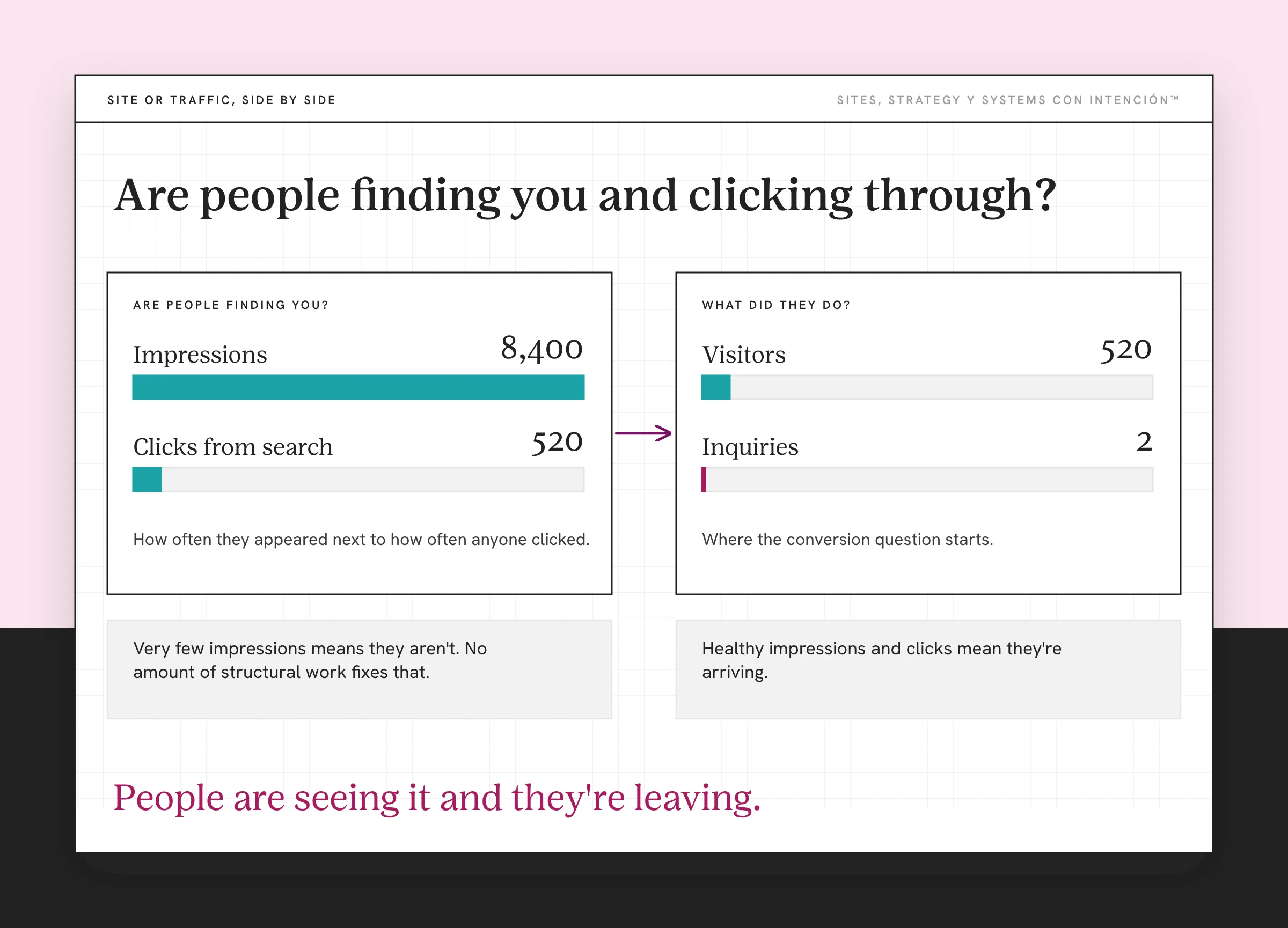
The default assumption is that not enough people are seeing the site. So the answer is to post more, run ads, find a better content strategy. On the sites I'm asked to look at, that's usually wrong. Es que people are seeing it and they're leaving. Sending more people to a site that doesn't convert sends more people to the same stall points. I've seen it from the other side too. A founder kept the same paid ads at the same spend before and after their site was fixed. Afterward those clicks started turning into inquiries from people who were a better fit.
And a caveat I'll give you honestly, because it cuts against my own argument: sometimes it really is traffic. If there's no SEO strategy at all and everything depends on social, traffic is inconsistent by design and that really might be the constraint. That's a different argument about what each channel is for: your website vs social media. It can be both. What I see most is founders assuming it's only traffic while the conversion problem is sitting right there on the page.
Settle it with data rather than instinct. Google Search Console's performance report shows impressions, meaning how often you appeared, next to clicks, meaning how often anyone clicked through from Google. It answers one narrow question: are people finding you and clicking through. Very few impressions means they aren't. No amount of structural work fixes that. Healthy impressions and clicks mean they're arriving, which is where the conversion question starts. What the report can't tell you is why they left.
What Is the Site Doing Instead of Converting?
A non-converting site is usually busy, doing a job competently. That job is just not this one.
It's introducing. Describing the founder, the philosophy, the approach. That order is whatever felt natural to write and it's rarely the order someone needs in order to decide.
It's listing. The services page names everything on offer. No indication of which is the right fit, where to start, what any of it involves. That's the gap a proper website audit is looking for before anyone talks about rebuilding. Website content organized as a list isn't a decision aid. A visitor who can't self-select has no information scent to follow. In my experience they leave rather than guess.
It's presenting. Blog posts, resources, episodes, all of it good, none of it connected to an actual offer. The visitor gets informed and entertained and leaves without doing anything, because nothing asked them to. Qué desperdicio.
None of that's bad work. It's work aimed at a different outcome, which is why a site that reflects your brand accurately can still fail at this. Aiming the site at one outcome is what website strategy adds to good work.
The Sixty-Second Self-Check
Do this on your own site now. It costs nothing and it's more honest than analytics.
Open the homepage as though you've never seen it, even if you're embarrassed by your website. Can you tell from the first screen who this is for and what problem it solves? Not what you do. What it's for, plus whether you're the person.
Then: what is the obvious next step? Not the available options. The one thing the page clearly wants you to do next.
If either answer took work, you've found something I would look at before touching the design. Así es, both is the usual result. The honest next question is whether that calls for a redesign or a rebuild. That's a smaller decision than it sounds once you know which of the two is broken.
What Changes First When You Fix It?
This is the part nobody prepares you for. It's why fixes get abandoned early.
The quality of the inquiry changes before the quantity does. People who reach out already get it. They reference the right things, ask better questions, arrive pre-sold. Discovery calls get shorter because the site already did the first twenty minutes of the conversation. Calls that start from zero are the first sign you need a redesign.

In what I've seen, when volume does change it comes later, often 60 to 90 days out. It isn't guaranteed. Search needs time to respond to a website restructure. Cleaner inquiries show up faster than that. So the signal to watch for is a change in who is coming through the door, not how many. De verdad, if you're only measuring the number in month one you'll conclude it didn't work, right at the point where it's starting to.
If nothing at all is landing, that's a different problem than an outdated website still holding a version of the business you've outgrown. Both are worth ruling out before a rebuild.
What This Post Is Not About
There's a version of this problem where the site was never built to convert in the first place. No sorting, no sequencing, a contact form doing the entire job alone. That's a different diagnosis with the same symptom: a website not generating leads. It's the more common one of the two.
There's also the version where the site is fine and the business has outgrown what it can carry. That shows up as a website hurting your business: growth capped by the site rather than the market. This post assumes the pages are right and the intent was there. Aquí el problema es otro: the parts are correct and nothing connects them. That's usually a smaller job than a full website redesign.
Either way there's a cost on your side. Every question the site doesn't answer lands on a call or in your DMs, which is the structural half of burnout most advice skips.
Key Takeaways
- When the pages are right and it still doesn't convert, it's usually unclear positioning together with no path through the site.
- Neither of those is a design problem, which is why a redesign so often changes nothing.
- Settle the traffic question first with Search Console. It tells you whether people are finding you and clicking through, which is where the conversion question starts.
- Sometimes it really is traffic. If everything depends on social and there's no SEO strategy, traffic is inconsistent by design. It can be both.
- Inquiry quality improves before volume does. In what I've seen volume follows 60 to 90 days later. Judging month one by the number is how good fixes get abandoned.
I can't read my own site cold. Where is it losing people?
La Digital Rueda is free and takes about two minutes. It asks a few questions about your site, your content and your backend and shows you where the pressure is.
And if you'd rather have this sort of thing arrive in your inbox: Off the Clock. It's where I write about building something that keeps working while you aren't at your desk.
Frequently Asked Questions
Why is my website not converting visitors into clients?
Usually two things at once. The site doesn't make clear who it's for and what problem it solves, then there's no obvious path from landing to acting. Visitors either can't tell whether they're the right person or can't tell what to do next. Neither is a design issue, which is why sites that look good often convert badly.
I have traffic but no leads. What is wrong?
Check Search Console first to confirm people really are arriving. If impressions and clicks are healthy, they are, which makes the page worth investigating before you buy more traffic, since more traffic multiplies whatever is already happening. If impressions are very low, you have a findability problem instead and structural work won't fix it.
Will a redesign fix a website that is not converting?
Often not. A redesign that only changes how the site looks misses the two causes I see most, positioning and path, which survive a visual refresh intact. Nobody decided who the site is for or what someone should do next. The new version presents the same confusion more attractively.
How long before I see a difference?
You'll usually notice the inquiries getting better first, within a few weeks. More of them takes longer, about 60 to 90 days in what I've seen, because Google needs time to catch up to what changed. So don't judge it by how many leads come in the first month. That's how people talk themselves out of a fix that was working.
What is the difference between traffic and conversion?
Traffic is whether people are showing up. Conversion is what they do once they're there. You can usually tell which one you've got pretty fast: if Search Console shows people arriving and nobody's reaching out, the problem's on the page. Buying more ads just sends more people to the same leak. Sometimes it's both, which is annoying but fixable.
Could it be my offer rather than my website?
Yes, though the site will show you. If visitors reach the services page and leave, that can be pricing, scope or positioning rather than layout. The site makes an offer problem visible, so it's worth ruling out before rebuilding pages that are describing the offer accurately.
About the Author