
You posted the Reels. Built the landing page. Showed up for months the way everybody said to, doing it well.
And some of it worked. That's the part nobody warns you about, porque a total flop would at least be information. Instead a post lands, a launch does okay, one week brings three inquiries and the next brings none. The effort and the results stopped tracking together somewhere around month four.
What I see most often across service-based businesses is marketing without a strategy, which sounds like an accusation about effort and almost never is one. It's a woman doing eleven things well, none of which know about each other.
"I'm doing everything and I can't tell what's working."
"I had a good month and I don't know why."
"I keep starting things and nothing compounds."
That last one. Ese es el problema. (That's the problem.)
The Short Answer
Marketing without a strategy is marketing where every move gets chosen on its own. Strategy is the decision about where you're going and what you'll leave out. Tactics are the moves you make once that decision exists. The tactics are rarely what is missing. What is missing is the thing they're supposed to add up to.
If You're Reading This Because It's Your Site
Reading more isn't the hard part. La Jugada is $47 and it tells you which layer this is actually sitting in.
Get it, $47What Is Marketing Without a Strategy?
In the businesses I see, it looks like a lot of activity. Each piece defensible on its own, with no decision sitting above any of it.
Strategy is the decision. Who you serve, what you're known for, what you're deliberately declining and what "working" would look like if it landed. It's upstream of everything and most of it is made of exclusions. Michael Porter's argument in Harvard Business Review is that strategy is defined as much by what you turn down as by what you chase.
Tactics are the moves. The post, the email, the ad, the page. Downstream, swappable and only meaningful once the decision above them exists.
If you grew up in a Puerto Rican kitchen you already understand this and nobody had to explain it. Nadie makes sofrito per dish. You make it once, in volume, then it carries everything you cook for the next two weeks. The recipes change, the base doesn't. Strategy is the sofrito. Chopping fresh garlic every single time you want dinner is how cooking ends up taking all day.
The Myth: A Tactic Becomes a Strategy If You Do It Consistently
This is the version circulating everywhere. It sounds responsible, which is what makes it stick. Post consistently, email weekly, show up daily. Do it long enough and supposedly it turns into a strategy.
Eso no es estrategia. (That's not strategy.) What that is, is a habit. A good one sometimes, sure, but consistency is a quality a tactic can have. It isn't a mechanism that produces a decision.
What Happens Without a Strategy?
Es que the tactics are working. That's the uncomfortable part. They're landing correctly, in a business with nothing built to catch them.

A tactic can hit every one of its own numbers and still cost you. A Reel that brings in the wrong client is a tactical win and a strategic loss. A page converting people you don't want to work with is performing exactly as built. When no decision sits above the moves, each move gets graded on its own metrics. Those metrics can't tell you whether the business moved.
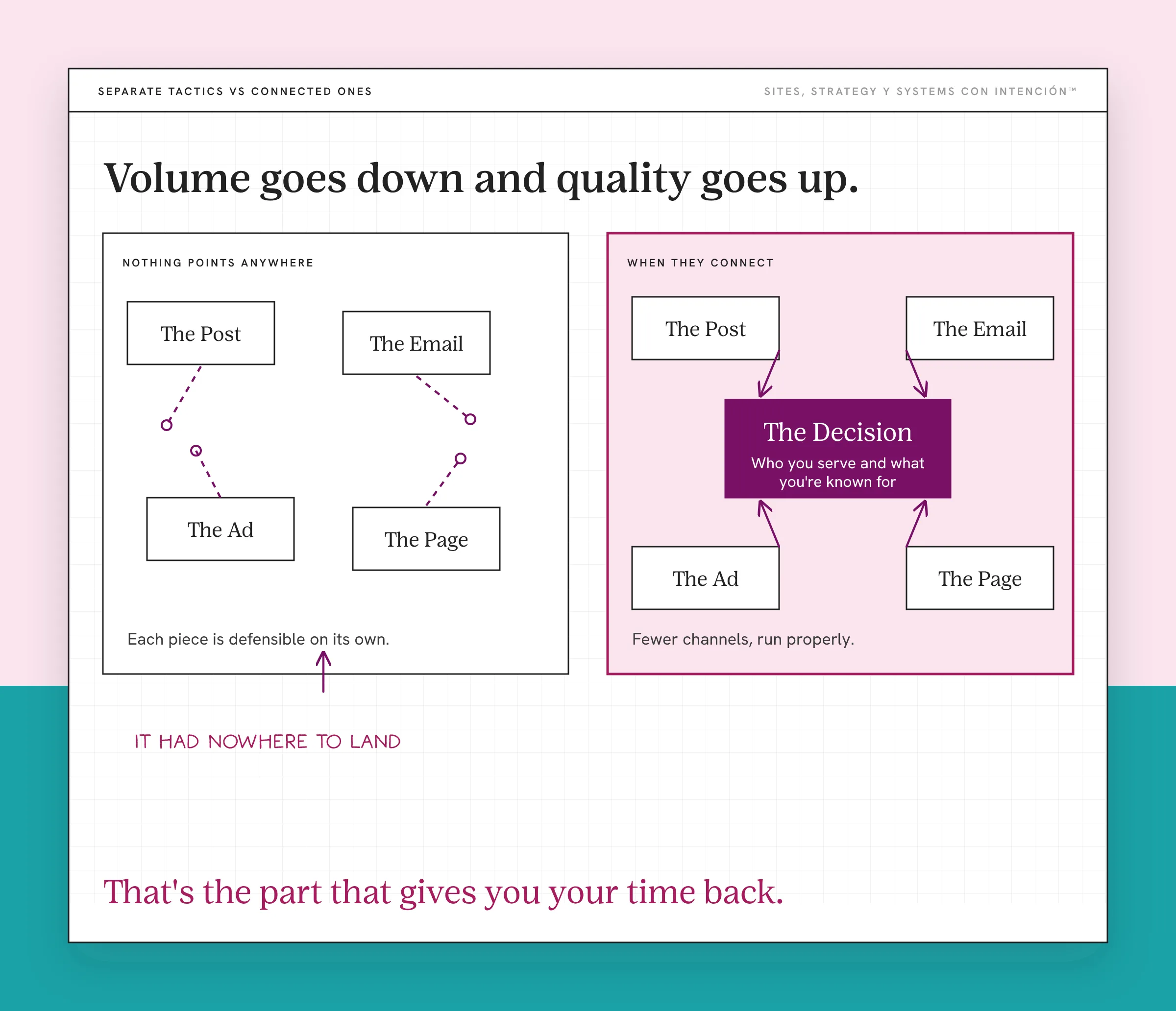
The clearest version of this runs through social. Strong engagement, an active audience, numbers that look healthy on-platform. And that attention wasn't connected to an owned system that could keep working without the platform. The engagement was real. It had nowhere to land.
Y ahí es donde it stops being a marketing problem. The front of the house is good: clear offer, consistent content, a founder who knows what they're doing. Underneath, nothing is connected. The outdated website was built for a version of the business that no longer exists. The inquiry path runs through your inbox. Every good tactic lands in a system that can't carry what it just sold.
That gap is the Strategy-to-System Split. Tactics expose it and widen it when the systems can't support them. Every tactic is a promise the backstage has to keep.
Which is why more feels like the answer and never is. Another channel, another offer, another weekly commitment. Sin darte cuenta, the split gets wider each time.
The Three Shapes This Takes
I see all three running at once more often than not, which is why it reads as overwhelm instead of a structural problem.
- Nothing points anywhere. Instagram sends people to a link tree. The link tree sends them to a homepage. The homepage lists services. Nobody is ever asked to do one specific thing, so nobody does.
- Everything points at you. Every path ends in a DM or a discovery call, which means growth is limited by your time, your attention and your availability.
- The channels disagree. What the content promises and what the site says are two different businesses, so they arrive already recalibrating who you are.
They don't cost you the same amount. It's worth knowing which one you're paying for.
Two and three are what cap a business. Two caps it because you can add more marketing, more tools or more people and none of it buys capacity while you're still the connective tissue. The work still routes through one person. Three caps it because a business that describes itself differently in three places gets harder to understand and harder to trust. The content attracts someone holding one expectation, then the site, the offer or the sales conversation hands them a different story. That creates friction even when each individual channel looks good on its own.
One is where the fix is clearest. Unless something on the site is broken, cutting a page down to one decision point is usually the highest-return change on the list. A link tree that points directly at the thing you're selling can close a surprising amount of that gap on its own.
None of the three gets fixed by better tactics. All three are decisions nobody made. A tactic can't make a decision on your behalf.
The Self-Check: Can You Say It Outloud?
Try it right now. Who you serve, what you're known for, what happens next when someone believes you. One sentence, outloud, no notes.

If what comes out is a list of activities, you have your answer.
If a real sentence comes out but your actual week doesn't reflect it, that's the other answer. It's also the more common one by a wide margin. The strategy exists. It's just not the thing making decisions.
Then the honest question. Skip "is my marketing working," which nothing can answer. Ask this one instead: when something works, can you say why? A business with strategy can. A business running on tactics can't, y ahí está la razón good months stay unrepeatable.
What Changes When They Connect
Volume goes down and quality goes up.
Fewer inquiries, more of them from people who already understand the scope and the price before they reach out. Fewer channels, run properly. Fewer decisions per week, porque the ones that matter were already made upstream and don't need remaking every Monday morning.
What you feel first is the business stopping asking you for a fresh decision every single day. That's the part that gives you your time back. It arrives before the revenue does.
"I'm doing everything and nothing compounds" has a cause. Effort isn't the cause. You already knew that or you wouldn't have read this far.
The next move is finding out where the connection breaks. That's almost always smaller and less dramatic than a whole new marketing plan. Sometimes it's one page. Sometimes it's one path dead-ending in your inbox.
Key Takeaways
- Marketing without a strategy comes down to one question: do your moves connect to anything or does each one start over?
- Strategy is the decision about where you're going. Tactics are the moves you make once that decision exists.
- You're probably not short on tactics. You're executing constantly and getting scattered results, which is a different problem.
- The tell is unrepeatable success. Something worked, you can't say why, so you can't do it again.
- A strategy you can say outloud in one sentence beats a strategy document nobody opens.
Okay, so where do I start if nothing's adding up?
La Digital Rueda is free and takes about two minutes. It asks a few questions about your site, your content and your backend and shows you where the pressure is across all of it.
Frequently Asked Questions
What is the difference between a marketing strategy and marketing tactics?
Strategy is the decision about direction: who you serve, what you're known for, what you're choosing not to do and what success would look like. Tactics are the specific moves that follow from that decision, like a post, an email, a landing page or an ad. Strategy is judged on whether the business moved. A tactic is judged on its own numbers, which is exactly why tactics can succeed while the business stays stuck.
Why is my marketing not working?
Start by checking whether it's actually not working. Often the pieces perform and the results are still scattered, which is a different problem from failure. Ask whether you can explain your last good month. If you can't, the moves aren't connected to a decision and more marketing won't fix that. If you can, ask whether that month moved the business where you wanted it to go. A yes points at capacity or execution. A no is still a strategy problem.
Can you have tactics without a strategy?
Yes. Most businesses do. It looks like constant activity producing results you can't explain or repeat. The giveaway is unrepeatable success: a good month arrives, you can't name what caused it, so you can't do it again. Tactics without strategy still produce outcomes. They produce outcomes you have no control over.
Is a marketing plan the same thing as a strategy?
No. A plan is a sequence of tactics with dates attached. A strategy is the set of decisions determining which tactics belong on that plan at all. You can have a very detailed plan and no strategy. That's a common and expensive place to be, because the plan gives you the feeling of direction without any of the filtering.
Can a small business have a marketing strategy without an agency?
Yes. Most should start there. A strategy is a decision rather than a deliverable, so it doesn't require a retainer to produce. What it requires is being able to say who you serve, what you're known for and what happens next when someone believes you. An agency can help you execute against that. It can't make the decision for you. Buying execution before the decision exists is how founders end up with a very expensive set of disconnected tactics.
How often should a marketing strategy be updated?
Less often than most people think. Always for a reason rather than for a date on the calendar. Strategy is the decision about who you serve and what you're known for. That doesn't change quarterly. Revisit it when the business itself changes: a new offer, a different client you want, a shift in capacity, a season that no longer fits. Tactics get reviewed constantly. The decision underneath them should be stable enough to filter those reviews.
Which should a small business fix first, strategy or tactics?
Strategy, though not the way it usually gets recommended. You don't need a document. You need to be able to say in one sentence who you serve, what you're known for and what happens next when someone believes you. If you can't, no tactic will hold. If you can, the work is checking whether your website and your systems reflect that sentence, because that's where the disconnect usually lives.
How do I know if my problem is strategy or execution?
There are two tests and you need both. Can you explain your last good result? If you can't, the moves aren't connected to a decision and more execution won't help. If you can, that clears one test only. Then: did that result move the business in the direction you wanted? A channel bringing in clients you don't want passes the first test and fails the second. That's a strategy problem however well it performs.
About the Author