You did the repurposing. The post became a carousel and a couple of captions and an email. Every one of them landed softer than the post did. So you assumed you picked the wrong formats and went looking for a better list.
That's the part that makes people quit. The work itself is manageable. What wears you down is producing something visibly weaker than what you started with, week after week, until repurposing feels like a tax you pay for having written something good.
Most advice on how to repurpose blog content is a list of formats. Turn it into an infographic, make it a video, put it on SlideShare. Every item on that list is possible and not one of them tells you what to put inside the infographic, which is exactly where it falls apart. I run a weekly content operation off my own blog posts. The thing that fixed this for me had nothing to do with formats.
Content repurposing means taking something you already made and adapting it for a different place and a different reader, which is a different job from posting the same thing in five places.
The Short Answer
To repurpose blog content, pull the two or three sharpest ideas out of the post and give each one its own full expression somewhere else. A newsletter section, a short text post, a carousel. The work is choosing which ideas carry. Reformatting is the easy part.
If You're Reading This Because It's Your Site
Reading more isn't the hard part. La Jugada is $47 and it tells you which layer this is actually sitting in.
Get it, $47What Does One Post Actually Become?
Here is the real shape of it, using my own two chains.
When an episode of the podcast drops, it moves in this order. The episode becomes a blog post. The blog post becomes a newsletter, the newsletter feeds social clips and the clips feed short text posts. Notice where the blog sits. The conversation is the source and the blog is the first thing built from it, which is backwards from how I usually see this taught.
The other chain starts at the blog. That one runs every week whether or not there's an episode. One post gets chunked into a newsletter, social content and text posts. Mira, chunking is the word I use for it. It's mise en place logic. You do the breaking-down once at the start. Everything after that is assembly. It's closer to what's happening than repurposing is. It's also borrowed from a real idea: in usability work, chunking means breaking content into small, distinct units. Same principle, applied across channels instead of down a page.
The honest volume, since a system nobody can see is easy to disbelieve: one blog post feeds roughly eight to ten short text posts, one longer LinkedIn post, a carousel, a set of stories, a couple of email sends and a photo caption. Episode weeks add a companion piece.
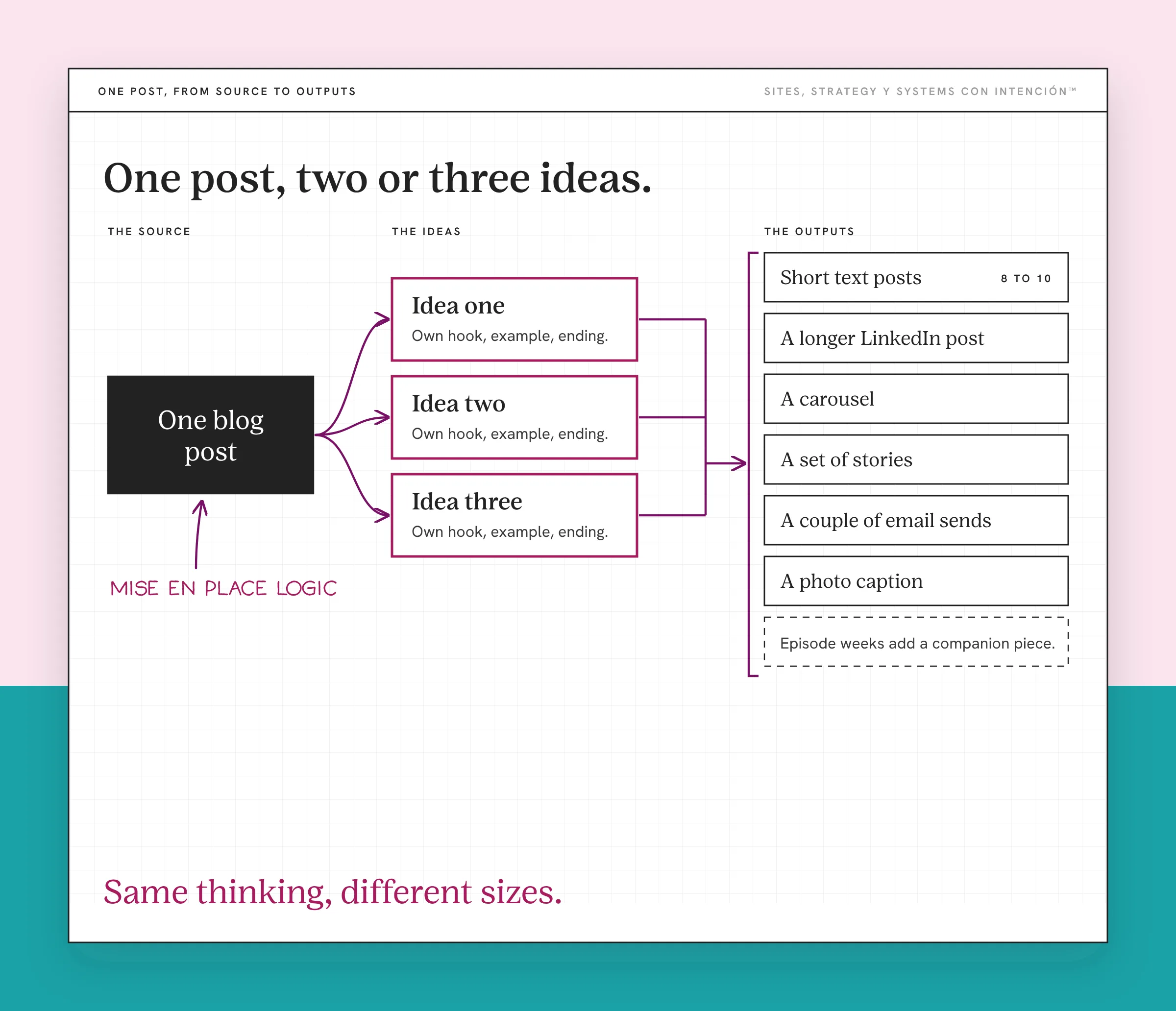
That looks like a lot coming out of one post. El detalle es que the count is two or three ideas, expressed eight to ten times, in places where each one gets to be the whole point rather than a supporting sentence.
The Rule That Makes It Work: Stop Summarizing
Every piece of repurposing advice teaches summarizing without saying so. Condense the post. Pull the highlights. Make a carousel of the main points. That instruction is why repurposed content reads like leftovers. It's the one thing I don't let happen in my own process.
The rule I run on: no summarizing. Take the sharpest insight and make it land on its own.
A summary of a good post is a worse post. It has the shape of the original with the specifics filed off. A reader who hasn't read the original gets the outline of an argument nobody is making.
It also fights how people read. Nobody is reading a post word by word, so a summary is already a scan, produced by you, of something they were going to scan anyway. So they scan your scan and get nothing solid to hold. One idea at full strength gives them something to catch on. They can tell. They don't know that what they're looking at is a compression, ya tú sabes, but they can feel that it's thin.
One idea given a full expression is a different object. Take one claim from the post, the sharpest one, then write it as though it's the only thing you have to say. It gets its own hook, its own example, its own ending. It's short because a single idea doesn't need eight hundred words.
That's the whole difference between repurposing and reposting the same thing everywhere.
Here is what it looks like on one sentence. Take a claim from this post: a summary of a good post is a worse post.
In a newsletter there's room, so it gets its reason attached.
Every repurposing guide tells you to condense the post. So you condense it. The short version reads thin, so you decide you're bad at condensing. A summary keeps the shape of the argument and drops the specifics that made it convincing. What arrives is the outline of a case nobody is making.
In a short text post there's no room, so it gets the sharpest version and nothing else.
Condensing your blog post is how you end up with a worse blog post. Pick one thing it said and say only that.
Same idea, twice. Neither one is a shrunken copy of the other. Neither one is the paragraph above them. That's the whole move. It's also the reason eight to ten outputs from two or three ideas isn't padding.
Two to Four Ideas, Not Eight Pieces
The number that surprises people: I get two to four core ideas out of a week. The distribution spreads those few ideas across many posts and formats.
The thinking is deep and few. The distribution is light and many.
That order is what protects the work. A blog post is where the thinking happens, at length, with room to be wrong and fix it. Everything downstream is distribution, which is lighter by design because the hard part already happened upstream. Trying to have a new idea for every platform every week is how people burn out on content and then blame the platforms.
It's also why this is a strategy question before it's a production question. Volume with nothing behind it is activity without a strategy driving it. You can feel that in a feed. Two ideas landing repeatedly in different shapes reads as a point of view. Eight unrelated pieces read as someone filling slots.
The Post You Just Published Is the One
You have forty blog posts and you want to know which one to chunk. This is the question I get asked most about repurposing and it's usually the wrong question.
I don't overthink the pick. Most weeks, whatever went up that week is what gets chunked. Some posts don't need it and that's fine. The post and the distribution happen in the same week, in that order.
What makes this week's post the right one is recency. Having the work already done is a side effect. I still reread it before chunking, because you don't remember all the details even on something you wrote four days ago. On a post from this week that reread is a quick pass. On something from March it means rebuilding the whole context from a page I barely remember writing.
So the honest answer to which post to repurpose first is this week's. If you're publishing on any kind of rhythm you never have to decide.
If you aren't publishing on a rhythm, that backlog question starts feeling urgent and it's standing in for a different problem. Tal cual, forty old posts chunked well won't produce a cadence on their own. Repurpose an old piece when it still earns it, then build chunking into the week you publish. A cadence produces things worth chunking, every week, without you having to shop the archive for them.
And if you do want to go back in there, make the post better before you make anything from it. Repurposing multiplies whatever is already there, which cuts in both directions.
How to Chunk One Post
The sequence I run:
- Reread it. Yes, even four days later. You'll have forgotten which parts were load-bearing and which were scaffolding that only works where it sits. That distinction is the entire output of this step.
- Go biggest to smallest. Newsletter first, since it has the most room and the fewest constraints, which means the ideas get tested at full length before anything gets cut down. Social next. The short text posts land last, by which point you already know which ideas survived.
- Keep the post open the whole time. This is the part that sounds wrong, since having the source in front of you is precisely where summarizing creeps in. The rule is what holds that line, not distance from the source. Look at the post for the details, then write the new thing as its own thing.
- Work by format or by idea, whichever you can sustain that day. Some weeks I write all the short posts in a row. Some weeks I take one idea through every format before touching the next. Both work. Try them and keep the one you finish.
- Expect one sitting, unless there's video. Text and email move fast once the reread is done. Video is the thing that turns a session into a project, so decide about it before you start rather than at nine at night.
Step 1 is where the judgment lives, which is worth knowing because it's also the step that gets skipped when you're rushing. Reformatting is quick. Working out which parts of a two thousand word post can stand up alone is the actual task.

Which Formats Are Yours to Pick?
I'm not going to tell you which formats to use, because it depends on what works best for you.
The sequence transfers. The format mix doesn't, no le des más vueltas. If video is where your people are, the clips matter and the carousel is optional. If nobody reads your newsletter, fixing that is a different project and chunking into it won't fix it. If short text posts are where you're good, dale con eso, run those and skip the rest without apologizing for it.
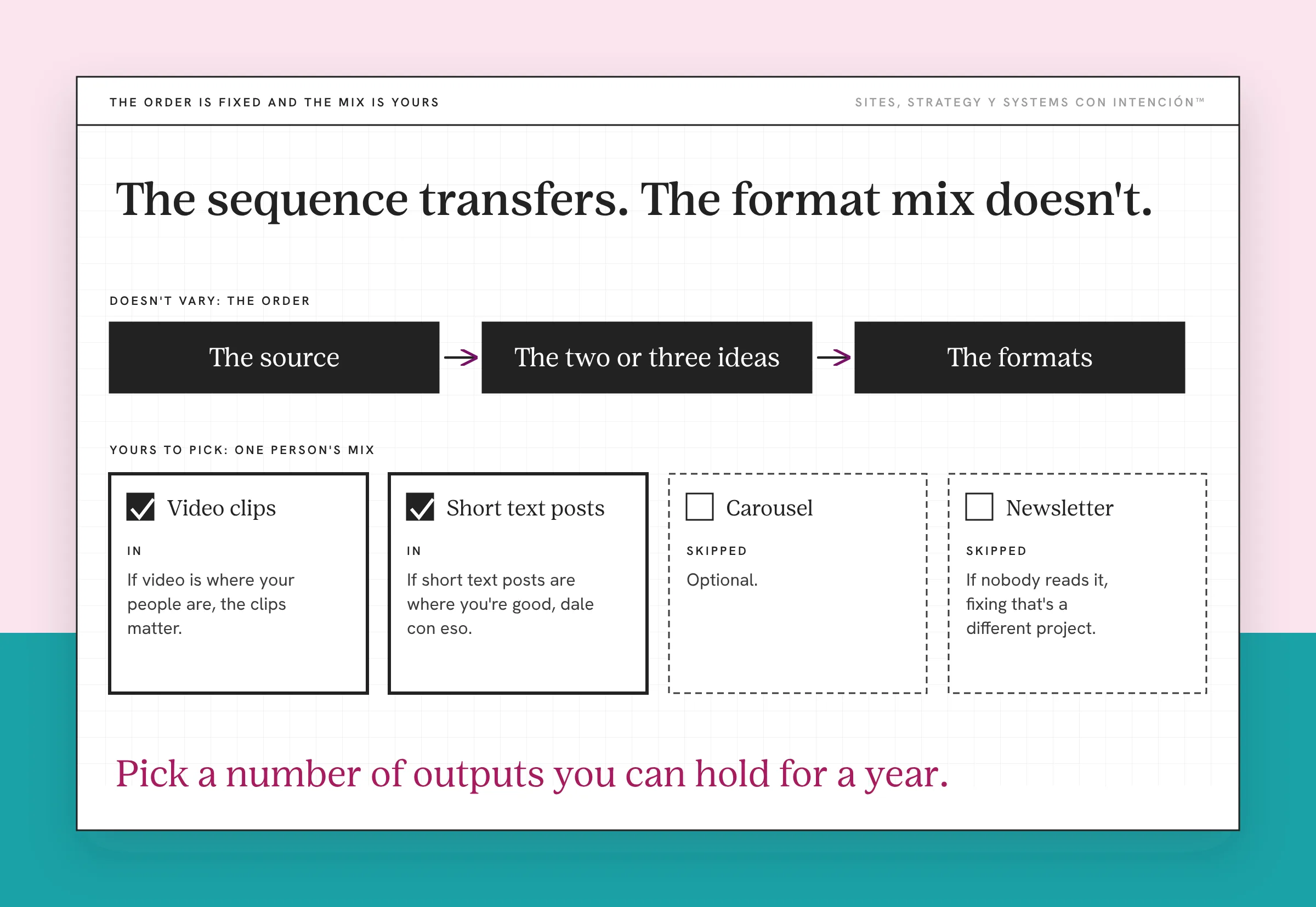
What doesn't vary is the order of operations. Source first, then the two or three ideas, then the formats. Picking formats first is how you end up making a carousel about nothing.
Pick a number of outputs you can hold for a year rather than a month. Content compounds on the long, unglamorous timeline that a long-term marketing strategy runs on. Three outputs a week forever beats eleven for six weeks.
What Does This Change?
Repurposing stops feeling like a tax when you stop asking one post to be eight posts. You aren't stretching a thing until it thins out. You're taking two ideas that were already worth saying and giving each of them a room of its own.
The post stays where it is, long and complete, for the person who wants the whole argument. Everything downstream is one idea at full strength, aimed at someone who has thirty seconds. Same thinking, different sizes. That's how repurposing fits inside a bigger content strategy without eating your week.
That's a week you can run. And it's a week where the smaller pieces stop apologizing for not being the post.
Key Takeaways
- How to repurpose blog content, in one line: pull the two or three sharpest ideas out of the post and give each one its own full expression, rather than summarizing the whole post into smaller formats.
- Summarizing is the thing that makes repurposed content feel weak. A summary of a good post is a worse post.
- Expect two to four core ideas from a week of thinking, then distribute those few across many posts. Deep and few upstream, light and many downstream.
- You mostly don't have to choose which post to repurpose. If you publish on a rhythm it's this week's, since the choosing already happened while you were writing it.
- The sequence transfers between businesses. The format mix doesn't, so pick the outputs that fit where your people already are.
Is my content really the problem? Where should I look first?
Take La Digital Rueda. It's free, takes about two minutes and asks a few questions about your site, your content and your backend. You'll see where the pressure is before you make another piece.
And if you want the version of this that shows up in your inbox instead, Off the Clock is where I write about the unglamorous half of building something that keeps working while you aren't at your desk. Pick one and start there.
Frequently Asked Questions
Why does my repurposed content feel worse than the original?
Because it's almost certainly a summary. Condensing a post keeps its shape and loses the specifics that made it good, so a reader who never saw the original gets the outline of an argument without the evidence. Pull one idea out instead and write it fresh, at full strength. One idea expressed completely reads better than five compressed.
How many pieces should one post turn into?
Fewer ideas than you think and more pieces than you think. Two to four core ideas is a realistic week. Each one can appear in several places without repeating itself, because a short text post and a newsletter section are doing different jobs for different attention spans. The failure mode is eight ideas, y eso agota.
How is repurposing different from crossposting or reposting?
Crossposting puts the same content in several places. Reposting puts it back in the same place later. Repurposing takes one idea and builds something new around it for a different reader, so the piece stands on its own even for someone who never saw the source. If you could delete the original and the new piece still works, you repurposed it.
Do I have to make video?
No. Video is one output among several and it's the most expensive one to produce badly. If your people are on video, it earns its place. If they aren't, a well-written short post and a newsletter that people open will do more for less. Pick the formats where you're already competent and where your audience already is.
How do I repurpose blog content for social media?
Take one claim from the post, write it in a single sentence without looking at the post, then build a short piece around that sentence alone. Give it a hook, one example and an ending. Skip the summary, skip the numbered recap of the article and skip the link-in-bio framing until the post has said something worth reading on its own.
Should I only repurpose evergreen content?
Evergreen posts are the easiest to justify, since they stay true and the pieces you build keep working. Timely posts can absolutely be chunked, they just have a shorter shelf life and you shouldn't spend your best production time on them. In practice the question rarely comes up, because if you're chunking the post you just published you're working with whatever you wrote about this week.
Does repurposing hurt my SEO?
Repurposing into email and social posts usually doesn't, since they aren't competing with your blog in search. The exception is a newsletter platform that publishes each issue as a public web page. If that issue repeats the post word for word, you've made a second page saying the same thing. The bigger risk sits in publishing several near-identical blog posts on the same topic, which is a separate problem worth understanding on its own. Chunking one post into non-search channels isn't that.
About the Author