At a Beyoncé concert, nothing is an accident. The lighting shifts on the beat, every costume change lands right on time and you never think about the team behind the scenes. You trust that you're in good hands, so you relax.
That's how website design builds trust. A site can lose it just as fast, like a restaurant too cool for signs where you're peeking into doors looking for the bathroom and wondering whether to leave. In 12+ years and 100+ sites worked on, I've seen people decide whether a business is legit long before they read a word about its services. Your design is making that first impression for you.
The Short Answer
Website design builds trust by showing people you're real, current and paying attention. A site that's consistent from page to page, shows the actual person behind the business and works on every device tells visitors you'll take care of them too. A site that looks abandoned, mismatched or broken tells them the opposite before they read a word.
If You're Reading This Because It's Your Site
Reading more isn't the hard part. La Jugada is $47 and it tells you which layer this is actually sitting in.
Get it, $47How Does Website Design Build Trust?
People use what they can see to guess what they can't. They can't see how you treat clients or how organized your process is. They can see your site, so they use it as evidence.
That isn't new. In a Consumer WebWatch study of how people evaluate a website's credibility, participants mentioned the "design look" of a site in 46.1% of their comments, more than any other feature. That was 2002 and 2,684 people. The internet has changed a lot since then and the habit hasn't. People still judge the business by the site.
For a service business, that matters even more. You're asking someone to trust you with their money, their time and a problem they might be a little embarrassed about. Before they'll do that, they need signs that you're the kind of business that has its act together. Your design is the first sign they get.
What Makes People Distrust a Website in Seconds?
Three things break trust faster than anything else I see.
It looks outdated or abandoned. The copyright in the footer says 2021. The last blog post is from two years ago. A link on the services page goes nowhere. Ay Dios, people notice. When a site looks like nobody's touched it in a while, visitors start wondering if the business is still open. If yours is getting there, an outdated website is worth a closer look.
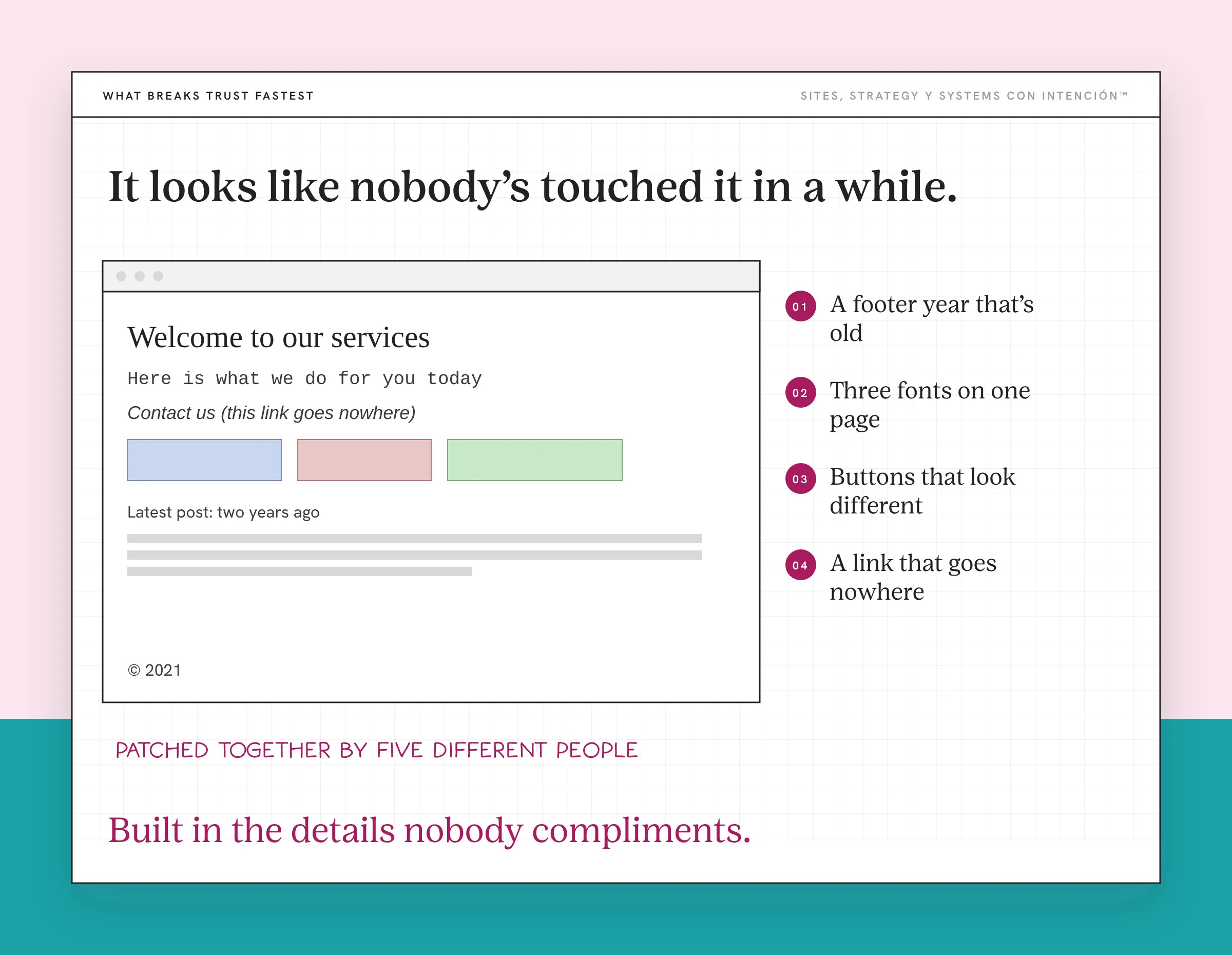
It's inconsistent. One page uses three fonts and the next uses two different ones. The colors shift, the buttons look different on every page and the voice changes from formal to casual and back. Diache, it feels like the site was patched together by five different people, which sometimes it was. Inconsistency makes a business look disorganized and people assume your work will feel the same way. When the site doesn't match who you are now, your website doesn't reflect your brand walks through what to fix.
It's slow or broken. This one I know from the other side of the screen. I was trying to buy something once. Wallet out, card ready, I was begging that site to take my money. The checkout kept freezing and loading forever. After refreshing over and over, I closed the tab. Qué vergüenza for them, because I really wanted it. In Baymard Institute's cart abandonment research, about 17% of US shoppers who abandoned an order for a reason other than just browsing said the site had errors or crashed. If your booking calendar won't load or your form won't submit, conversion friction costs you the people who were already sold.
None of these are about having a fancy design. A simple site that's current, consistent and working earns more trust than a gorgeous one that's falling apart.
Which Design Choices Build Trust?
The good news is that the choices that build trust come down to care and discipline more than budget. Three of them matter most for a service business.
Consistency Across Every Page
Use the same fonts, colors, button styles and tone everywhere. When every page feels like it belongs to the same business, visitors relax. That's the Beyoncé effect. The consistency tells them someone is paying attention to the details, so they assume someone will pay attention to them too. Mija, this is the cheapest trust you'll ever build. It just takes discipline.

Real Photos of You
People hire people. Stock photos of smiling strangers in a conference room tell visitors nothing about who they'll work with. Nielsen Norman Group's eyetracking research found users ignore generic stock photos of people as filler while they study photos of real staff. A real photo of you, your space or your work tells them there's a person behind the business. A phone photo in good light works as long as it's you. Ay bendito, a site where the owner never appears once feels like a business with nobody home. Your about page is the obvious place to start and your homepage benefits too.
Everything Works
Every button goes where it says and every form submits, so what happens after the click holds up. Pages load fast and look right on a phone. A working site doesn't get noticed and that's the point. Nobody trusts a business more because the contact form worked, but plenty of people stop trusting one when it doesn't. Test it on every device you can get your hands on. Nena, you'll find something. I always do. Since so many people find you on their phone first, start with what happens when your website isn't mobile friendly.
Proof like reviews, client results and credentials builds trust too. That's its own post on website trust signals. When the design looks cared for, it helps people believe the proof when they see it.
How Do You Check Your Own Site?
Pull out your phone and visit your own site as if it's the first time. Pretend you don't know the business. Then ask yourself:
- Does anything look old? Check the footer year, the newest blog post and any dates on the page.
- Does every page look like it belongs to the same business? Click through at least five pages and watch for fonts, colors and buttons that change.
- Can you see who's behind it? Is there a real photo of you somewhere a visitor would actually find it?
- Does everything work? Tap every button, fill out the form and try to book something.
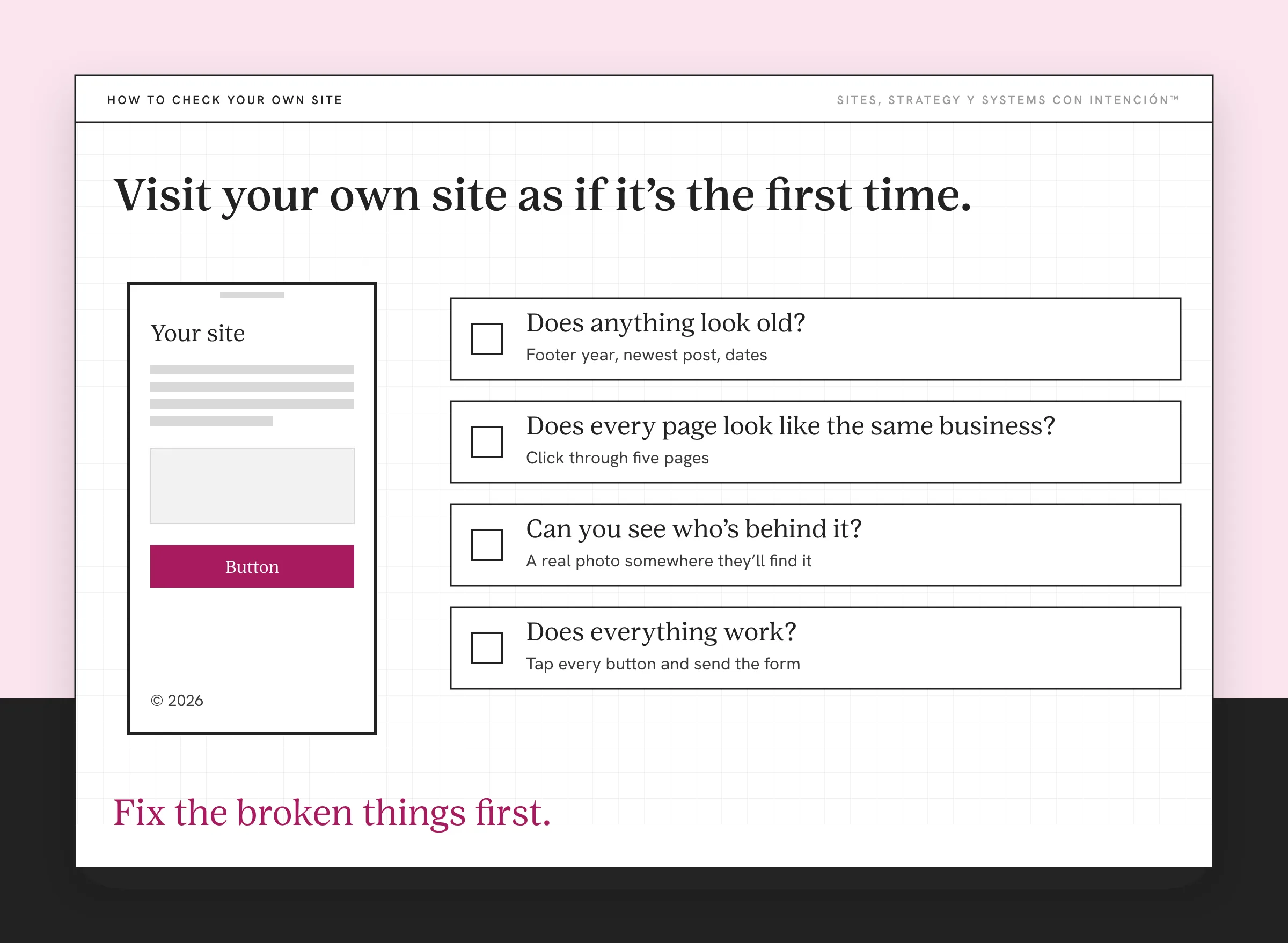
Write down every user experience problem that made you hesitate. Eso sí, be honest. If it made you hesitate, it's making your visitors hesitate too. Fix the broken things first, then the outdated ones, then the inconsistent ones.
If you've fixed the trust problems and people still aren't reaching out, why a site that looks great still doesn't generate leads covers the next layer. And if your pages feel crowded, cognitive load might be part of it. Trust is one layer of website strategy and it rarely works alone.
Trust on a website gets built in the details nobody compliments: the footer year, the real photo, the form that sends. Get those right and the rest of your site gets a fair read.
Key Takeaways
- People judge your business by your site. Design is the first evidence they see.
- Outdated, inconsistent or broken sites break trust in seconds, even when the business is great.
- Consistency, real photos of you and a site where everything works build trust without a big budget.
- Check your own site on your phone like a first-time visitor and fix what makes you hesitate.
So where is my site making people second-guess me?
In about two minutes La Digital Rueda asks a few questions about your site, your content and your backend and shows you where the pressure is. It's free.
Want more like this in your inbox? Off the Clock is my week-ish newsletter about websites, systems and burnout-free business.
Frequently Asked Questions
Why does website design affect trust?
Design is the first evidence people have about your business. A site that's consistent, current and working suggests you're organized and paying attention, so visitors assume you'll treat them the same way. A site that looks abandoned, mismatched or broken suggests the opposite. People use what they can see to judge what they can't.
What makes a website look trustworthy?
Consistent fonts, colors and buttons across every page, real photos of the person or team behind the business and a site where everything works. Current content helps too, like a recent blog post and the right year in the footer. Clear contact information and proof such as reviews add to it once the design has earned a second look.
Why don't people trust my website?
Check for three things first. Does anything look out of date? Do pages look inconsistent with each other? Is anything slow or broken, especially on a phone? Any one of these can make visitors doubt the business. Visit your own site on your phone like a stranger and write down every moment you hesitate.
Do I need a professional designer to build trust?
Not necessarily. Most of what builds trust is care: consistent styles, real photos, current content and testing that everything works. A designer can help you build a consistent system and a site you're proud of. A simple site that's kept up will still earn more trust than an expensive one that's been neglected.
Does a slow website hurt trust?
Yes. A slow or freezing page makes people wonder if the business is still running or if their information is safe. When a booking calendar or checkout won't load, even people who were ready to buy give up. Speed and reliability are part of how your design communicates that you're on top of things.
About the Author