People are reaching your services page and the booking button is there. From your side, the next step looks obvious because you already know what the offer means and what happens on the call.
The visitor has to figure both of those things out.
That's where I'd look at your website conversion funnel: can someone understand which offer fits, then do something about it without having to work so hard? When the explanation and the action don't connect, adding another button leaves the same questions sitting there.
In a multi-offer website redesign I directed, the work included content structure, navigation, mobile usability and ticketing access. We treated choosing an experience and booking it as connected parts of the site. That connection matters for service businesses, too.
The Short Answer
A website conversion funnel maps the steps people take toward a defined action, such as submitting an inquiry or booking a consultation. For a service business, it should help visitors understand the relevant offer, evaluate whether it fits and complete a suitable next step. Track the transitions to identify where to investigate friction.
If You're Reading This Because It's Your Site
Reading more isn't the hard part. La Jugada is $47 and it tells you which layer this is actually sitting in.
Get it, $47What Is a Website Conversion Funnel?
A conversion funnel is a way to examine progress toward an action you've defined. That action could be joining an email list, requesting a proposal, booking a call or paying for a service. This is the narrow version, the path on your site. A marketing funnel can mean the whole system around an offer, which is a different conversation.
Choose the action before deciding which steps to measure. A newsletter opt-in and a paid engagement represent different commitments. Treating them as interchangeable conversions can hide the website's actual ROI.
Your wider marketing funnel can include content, email marketing and other contact outside the website. A sales funnel may continue through qualification, proposals and closing. Here, we're examining the website's part in that process and where it hands someone onward.
How Can You Adapt Different Frameworks to Your Website?
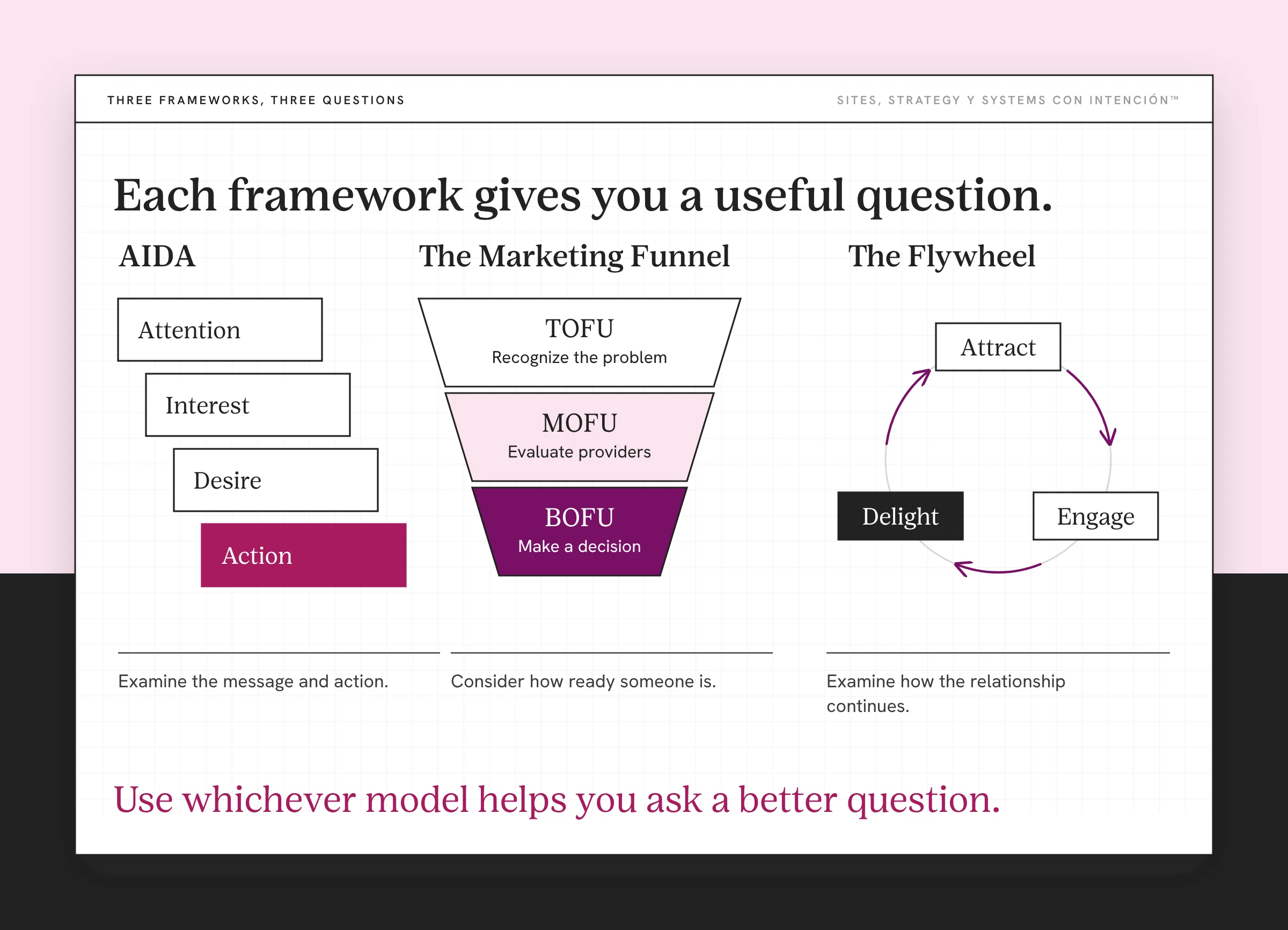
I like working with AIDA, the marketing funnel and the flywheel because each gives you a useful question to ask. Choose the framework around your business, your buyer and what you're trying to accomplish. You can use more than one while keeping each model's stages clear.
How Does AIDA Help You Connect Interest to Action?
The AIDA model uses Attention, Interest, Desire and Action. Apply it to what someone needs from your website:
- Attention: Help the right person recognize a relevant problem or opportunity.
- Interest: Explain how your service could help with that situation.
- Desire: Give them reasons to choose this offer, including useful details and relevant proof.
- Action: Make the appropriate next step clear and workable.
If someone understands the problem but can't see why your service fits, look at how you're developing interest and desire. If they're ready but the form is difficult to complete, look at the action you're asking them to take.
These are questions for reviewing the experience. You don't need a separate page for every AIDA stage.
How Does the Marketing Funnel Help You Match Readiness?
The top, middle and bottom of the marketing funnel help you consider how ready someone is:
- TOFU, top of the funnel: Help people recognize and understand a relevant problem.
- MOFU, middle of the funnel: Help them evaluate approaches and possible providers.
- BOFU, bottom of the funnel: Help them make a decision and take a suitable next step.
For example, an educational article might help someone understand their situation. A comparison could help them evaluate their options. An offer page could explain the scope and how to start.
The role depends on what the content helps someone decide. An article answering a specific buying question can support someone much closer to a decision.
How Does the Flywheel Keep the Experience Going?
HubSpot's flywheel model uses Attract, Engage and Delight. It asks you to consider how the customer experience supports continued growth, including after someone becomes a client.
Your website can attract through useful information, engage through clear offers and helpful interactions, then support delight through accessible onboarding details or resources clients need. The experience of working with you carries that further.
A completed inquiry is one moment in that relationship. Look at whether the promises on the page connect with what people experience after they click.
Use whichever model helps you ask a better question. AIDA can help you examine the message and action. TOFU, MOFU and BOFU can help you consider readiness. The flywheel can help you examine how the relationship continues. Adapt the application while being clear about which framework you're using.
What Does the Funnel Look Like for a Service Business?
Follow someone from the page they land on to a completed inquiry. What do they need to know along the way? Where are you adding friction that makes the next step harder than it needs to be?
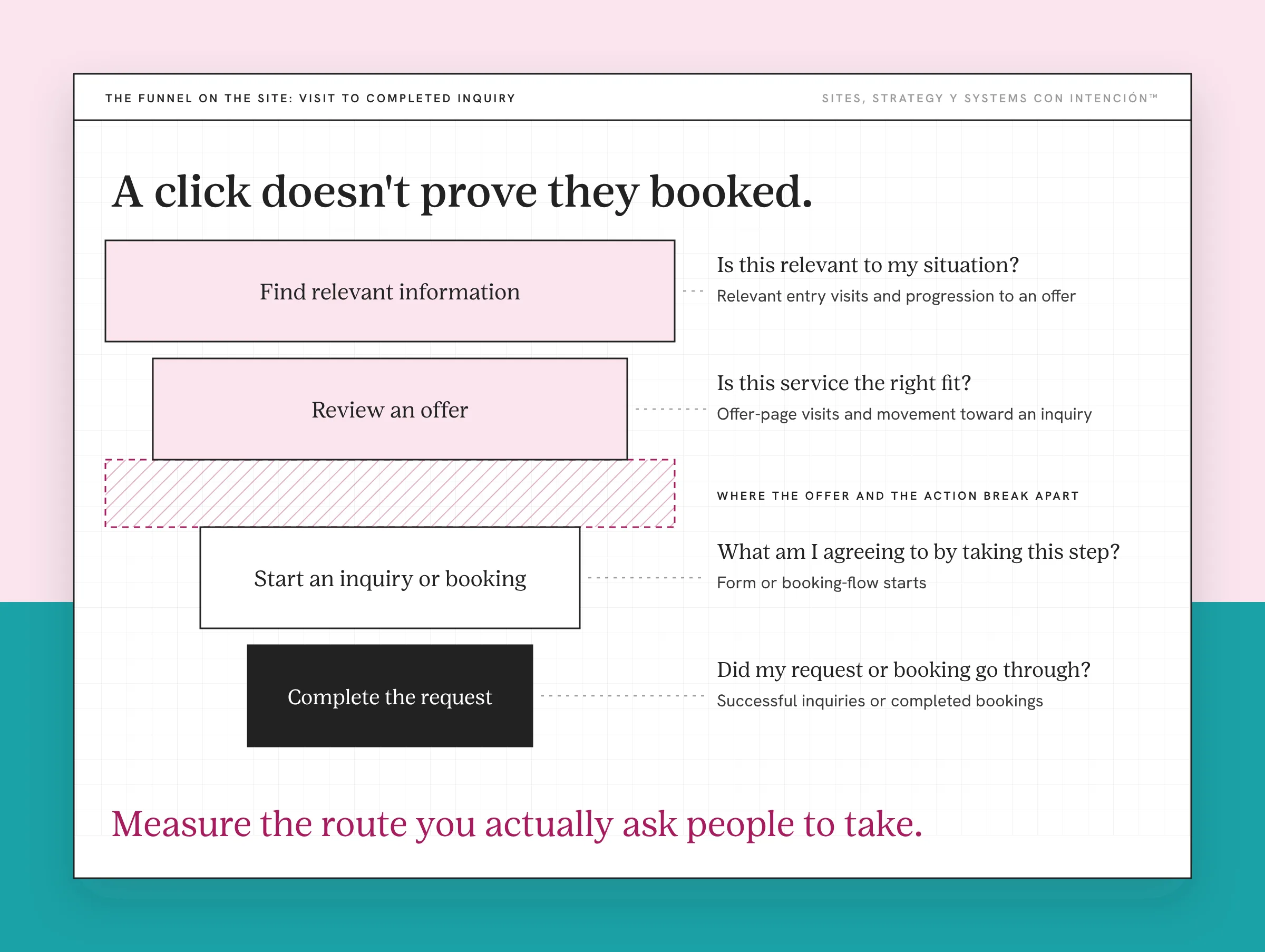
| Website Task | What the Visitor Needs to Understand | What Could Support That Decision | What You Might Measure |
|---|---|---|---|
| Find relevant information | Is this relevant to my situation? | An article, homepage or relevant landing page | Relevant entry visits and progression to an offer |
| Review an offer | Is this service the right fit? | Scope, outcomes, process, useful price guidance and proof | Offer-page visits and movement toward an inquiry |
| Start an inquiry or booking | What am I agreeing to by taking this step? | An explained call, proposal request or purchase process | Form or booking-flow starts |
| Complete the request | Did my request or booking go through? | A working submission flow and clear confirmation | Successful inquiries or completed bookings |
This is an illustrative map. It isn't a rule that a particular page must appear at every funnel stage.
An entry page can explain the offer and collect an inquiry in the same place. A returning visitor may skip the background. Someone comparing providers may leave and return later.
Keep those routes available. The customer journey can be messy even when your measurement plan uses a simple sequence.
Also distinguish an inquiry from a sale. For many service businesses, a completed form starts a conversation. The lead still needs to qualify and may need a proposal before becoming a paying client. For a defined package sold online, payment might happen on the site.
An ecommerce funnel might include product selection, cart and checkout. Your service business doesn't need to copy those steps if the buying process is different. Measure the route you actually ask people to take.
Where Do Understanding the Offer and Taking Action Break Apart?
The missing connection can sit on either side: people struggle to understand the offer or they struggle to act on their choice. When I look at service sites it's usually both, because they make it too hard for people to do either.
Whichever framework you use, look for the decision or action the site hasn't supported, because that's usually why the site isn't generating leads. The fix should address that specific gap.
Can Someone Tell Which Offer Fits?
At Blockbuster, a good cover could get you to pick up the box. You still needed to figure out whether you wanted to watch the movie, find an available copy and rent it.
Your website has to connect those decisions, too. Getting someone interested is one step. Helping them understand the offer and making it easy to act are part of the same experience.
Look at what happens when potential customers reach your offer. Can they tell who it's for, what it includes, how the work happens and why they would choose it?
If two services sound almost identical but have different commitments, explain the difference. If a visitor needs a consultation before getting a quote, say what that conversation helps you establish.
Several vague options with the same "Learn More" button can become a qué revolú before anyone reaches the calendar. More choices on the page won't help if the information doesn't support choosing between them.
You don't have to put every detail on every page. Give people the information relevant to the decision in front of them and a useful route to anything else they need.
Does the Next Step Match What They Know?
A visitor may understand the service but hesitate to click the call to action. They don't know whether the call is free, how long it takes or what happens afterward. Or they're interested but not ready to fill out an application that asks them to explain their whole business.
I've seen this on a client's site. People understood the offer and still didn't act, because the only next step was a big commitment.
Check the commitment behind your calls to action. Changing "Apply" to "Let's Chat" won't make the same long form feel shorter. Eso cansa. The process still asks for the same work.
Explain the action honestly. Then check whether the actual form, calendar or payment flow matches that explanation on a phone.
Use relevant answers and trust-building proof near the decision they support. If someone needs to understand the scope before booking, por favor, don't require the booking just to reveal it.
Does the Click Lead to Completion?
A click on a booking button shows someone tried to continue. It doesn't prove they booked.
Follow the flow through to confirmation. Does the calendar load? Can someone choose an appropriate slot? Does the form submit successfully? Do they know their request arrived?
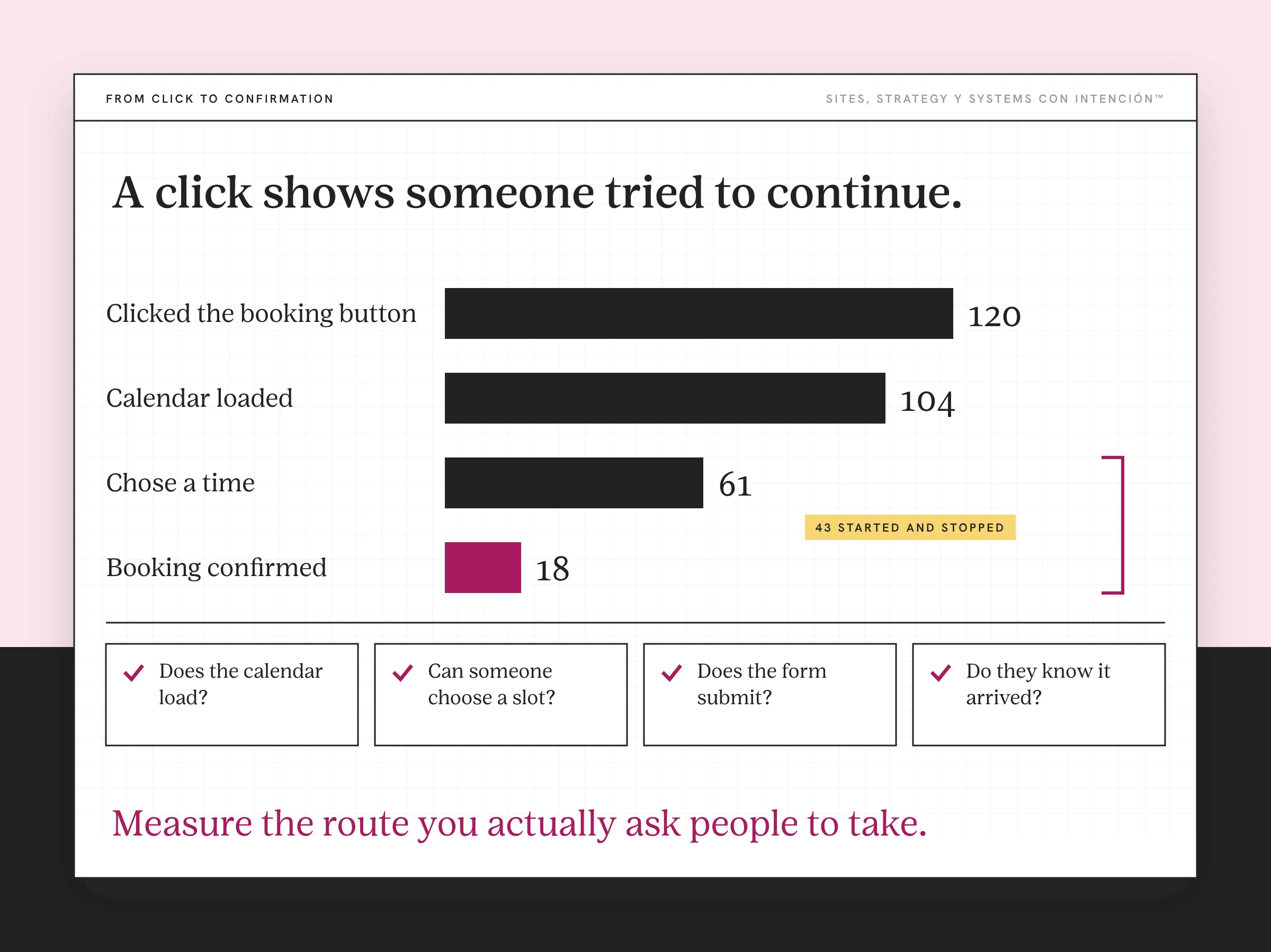
If the action happens in an external tool, check whether your measurement captures the actual completion. Counting outbound button clicks alone can make funnel performance look better than the resulting inquiries suggest.
What Changed in a Real Website Redesign?
I was Web Director on a full redesign and strategic rebuild for a multi-offer experience brand. The project included UX flow, content structure, page architecture, mobile optimization, SEO and integrated ticketing access.
The goal was to simplify navigation, improve search visibility and drive more bookings. We worked on how people found an experience and how they moved toward booking it.
In the first 90 days after the relaunch, bookings for a core experience increased 60%.
That's a result from the full project. It doesn't isolate a new button, a single page or one funnel-stage change as the cause. The work happened together with me as Web Director, supported by the team delivering it.
What makes the example relevant here is the scope of the thinking. The offer information, navigation and booking access were addressed as connected parts of the experience.
For a service business, the equivalent review follows someone from understanding what you provide through completing the intended inquiry or booking. You may discover that the offer needs a clearer explanation, the next step needs less friction or both. You may also find a problem that doesn't require a rebuild. That's the kind of thing a website strategy review tends to turn up.
How Do You Find the Next Gap in Your Funnel?
Start with one goal and one route worth examining. You can expand the analysis after you understand that path.
Define the Completion You Care About
Write down what counts as success: a successfully submitted inquiry, a confirmed consultation or a completed payment. Be specific enough that you can test whether tracking records it correctly.
Google Analytics uses key events for important actions you choose to measure. A button click and a successful inquiry are different events, so confirm what your current reports count before trusting a conversion rate.
Google's metric definitions define session key event rate as the percentage of sessions in which a key event occurred. Keep the denominator clear when you compare reports.
For example, if 20 of 1,000 measured sessions include a successful inquiry, the inquiry session conversion rate is 2%. This hypothetical calculation illustrates the denominator. Twenty event occurrences wouldn't necessarily mean 20 distinct sessions.
Map the Steps People Can Actually Complete
For a consultation offer, an illustrative tracked sequence might be:
Service page viewed → booking flow opened → booking confirmed.
You can use GA4 funnel explorations to examine defined steps and drop-off. The settings matter: an open funnel allows entry at later steps; a closed funnel requires entry at the first defined step.
Choose settings that match the question you're asking. A closed sequence won't represent every person who arrives through a direct booking link. Check device, source and tracking gaps before interpreting a drop as a failed experience.
Investigate the Gap Before Choosing the Fix
| What You Observe | What to Investigate |
|---|---|
| People arrive but rarely reach a relevant offer | Whether the traffic fits, the entry page explains the connection and the offer is easy to find |
| People view an offer but rarely start an inquiry | Fit, scope, proof, price expectations and the commitment requested |
| People start but don't complete the flow | Form burden, errors, mobile usability, availability and tracking completeness |
| Inquiries arrive but few become suitable opportunities | Targeting, expectations, qualification and the later sales process |
Investigate these possibilities before making a diagnosis. Feedback, a manual walkthrough and the actual inquiry records can help explain what analytics can't show.
Then choose a focused change and measure what happens. Avoid changing the offer, layout, traffic campaign and form all at once if you're trying to understand one change's effect.
Don't chase a higher conversion rate without checking what converted. A useful funnel helps appropriate people progress and lets poor-fit visitors recognize the mismatch. More submissions aren't automatically better opportunities, mija.
You can optimize the route once you can see what each step asks of someone. That's where conversion funnel optimization becomes useful work: a clear question, a reason for the change and a way to evaluate it.
Start with the route from understanding the offer to completing a suitable next step. Before adding more traffic, more CTAs or another automation tool, check what people need at that point. Then choose a change that helps them move forward.
Key Takeaways
- A website conversion funnel connects the visitor's decisions with a defined, measurable action.
- AIDA, TOFU/MOFU/BOFU and the flywheel provide different ways to plan the experience; measurable website actions need their own clear definitions.
- Clear offer information and a manageable next step need to work together.
- Button clicks, completed inquiries and paying customers are different outcomes.
- Investigate drop-off before choosing a fix, then measure both completion and lead quality.
I'd rather talk through my own funnel with someone.
Bring your site, your numbers and the step where people stop. We'll work through it in one private session and you'll get notes. Sessions start at $350. Full audits are available and get quoted first.
Frequently Asked Questions
Which framework should I use for my website funnel?
Use AIDA to review attention, interest, desire and action; TOFU, MOFU and BOFU to consider readiness; and the flywheel to examine attracting, engaging and delighting people across the relationship. You can apply more than one if it helps your business. Keep the models' stages distinct, then define the actual website actions you'll measure. A framework should help you decide what someone needs next.
Is a website conversion funnel different from a sales funnel?
The terms overlap, so define the scope you're examining. Here, the website conversion funnel focuses on steps toward an on-site action or a tracked handoff to another tool. A sales funnel may continue through qualification, proposals and closing. A service business can collect a successful inquiry on the website while still needing a separate sales conversation before that person becomes a client.
Do visitors have to follow every stage in order?
No. A warm referral can arrive ready to book while someone finding an article may need more information. People also return, compare providers and enter through different pages. Keep useful routes available instead of forcing everyone through a set reading order. For measurement, define which sequence you're analyzing and understand that it won't necessarily describe the entire customer journey.
Do I need special funnel software?
Start by identifying the action, the steps leading to it and what your current tools can reliably measure. You may already have the website, booking system and analytics needed to investigate a useful route. Additional software can help with specific requirements, but it won't establish the offer's fit or explain the next step for you. Choose tools around the problem you've identified.
What is a good conversion rate for a service-business funnel?
First define what converted, who was eligible and the period measured. An email signup, a consultation and a paid engagement involve different commitments. Traffic source and readiness also affect what a comparison means. Use a consistent definition to establish your own baseline, then evaluate changes alongside inquiry quality. A percentage without that context isn't enough to tell you whether the funnel is helping the business.
Can I improve the funnel without rebuilding my website?
Possibly. A clearer offer explanation, useful expectation-setting or a simpler working inquiry flow may address the problem on the existing site. Other issues can require more substantial work, as the full rebuild case in this article illustrates. Diagnose where people struggle and what the platform can support before deciding how much needs to change. The scope should follow the issue you identify.
About the Author