If you've ever bought concert tickets on a resale site, you know the banner. "Only 2 left at this price!" Then you refresh and there are still 2 left. You come back tomorrow and there are 2 left. By the third time, you've stopped believing anything on that page, including the parts that were true.
That's what fake urgency does to a service business site. It borrows trust you haven't earned yet and spends it all at once. Real website trust signals work the other way: they give someone a reason to believe you before they ever reach out. After 12+ years and 100+ sites, the ones that hold up are almost always the plain ones.
The Short Answer
Website trust signals are the proof on your site that makes a stranger comfortable enough to reach out: testimonials, results, your face, your process and clear pricing. The ones that increase conversions are real and specific. They also sit right where someone hesitates. Fake scarcity does the opposite and spends trust instead of building it.
If You're Reading This Because It's Your Site
Reading more isn't the hard part. La Jugada is $47 and it tells you which layer this is actually sitting in.
Get it, $47What Are Website Trust Signals?
A trust signal is anything on your site that answers the question a visitor won't ask outloud: can I trust this person with my money and my problem?
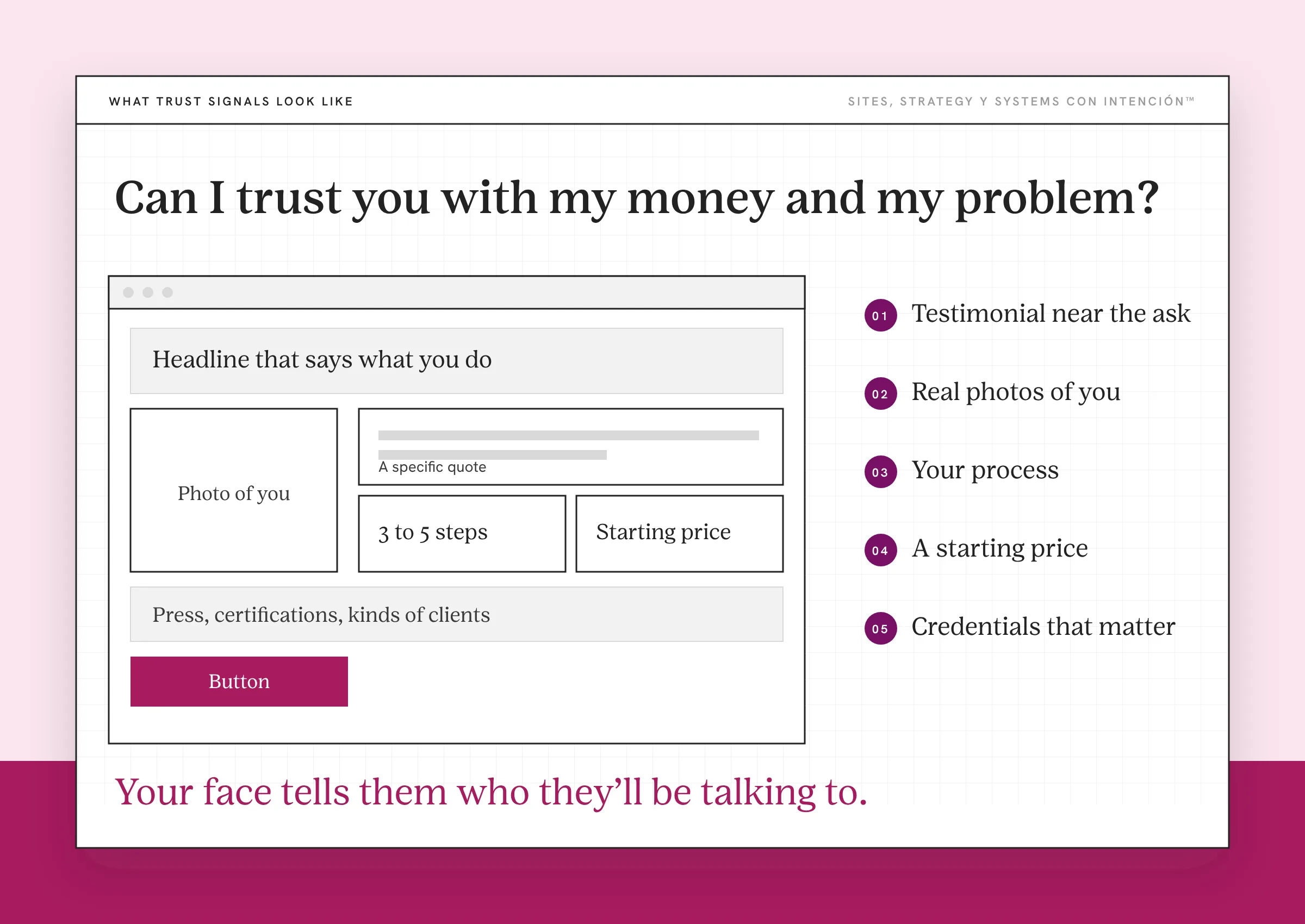
For a service business, that usually means:
- Testimonials and reviews from real clients, with names and enough detail to be believable. Ask before you publish anyone's name or words and only share results they actually got
- Results, even small ones, described the way the client would describe them
- Your face and your team, in real photos
- Your process, so people know what working together looks like
- Pricing or a starting point, so nobody has to guess whether they can afford you
- Credentials that matter to your buyer, like press, certifications or the kinds of clients you serve
Security badges and payment logos belong on a checkout page, where Baymard Institute found trust seals shape how secure the payment form feels. On a services page, they rarely move anyone. People hiring a service are buying you, so the signals that work are the ones that show you.
How your site looks plays a part too. How website design builds trust covers that side. This post is about the proof you put on the page.
Why Does Fake Scarcity Backfire?
Fake scarcity is the countdown timer that resets when you reload, the "only 3 spots left" that's been true since March and the "price goes up at midnight" that never does.
It can get a click. It also teaches your visitor that your site says things that aren't true. The FTC's dark patterns report called out countdown timers designed to make consumers believe they only have a limited time when the offer isn't actually time-limited. Ay, por favor, if a regulator has a name for your tactic, it's not a trust signal.
Real limits are fine, pa' que sepas. If you really take four clients a month, say so. If a price really changes on a date, say the date and keep it. The difference is whether it's still true when someone checks.
Where Should Trust Signals Go on Your Site?
Proof works best where doubt shows up. A lot of sites I see put every testimonial on one page that few people visit, qué desperdicio. Move them to the moments people hesitate:
- Next to the ask. A testimonial right beside your button or form answers "is this worth it?" at the exact second someone wonders. If people stall at the button, missing proof is usually among the reasons they don't click a CTA.
- On your services page. That's where people decide. Put a result or a quote under each offer and spell out what working together looks like. How to write a services page shows where they fit.
- Near your pricing. Proof right next to the number makes the number easier to say yes to.
- Above the form. One line about what happens after they submit takes away the "what am I signing up for?" worry.
- On your About page. Real photos and About page copy that tells the story of how you work, so the person reading feels like they've met you.

I did exactly this on a client site. We moved testimonials up next to the ask, swapped stock images for real photos of them and their team and added their process steps so people could see what working together looks like. Mija, you'd be surprised how many sites have all of that somewhere and none of it where someone's actually deciding.
Which Trust Signals Matter Most for a Service Business?
If you're starting from nothing, this is the order I'd start with, then adjust it to what your buyers question first:
- One specific testimonial near your main call to action. Specific beats glowing. A line like "we stopped answering the same three questions on every call" does more than "Amazing to work with!"
- Real photos of you. Stock photos of handshakes tell people nothing. In Nielsen Norman Group's eyetracking, users ignored generic stock photos as filler and looked closely at photos of real staff. Your face tells them who they'll be talking to.
- Your process in three to five steps. It answers "what happens next?" before anyone has to ask.
- A starting price or range. It filters out people who were never going to buy and reassures the ones who can.
- A result. Even one before and after, described in plain words.

Add them one at a time and keep them current. De verdad, an outdated testimonial from a service you don't offer anymore can do more harm than none at all. Keeping proof current is one of the easiest wins in website strategy.
How Do You Know If Your Trust Signals Are Working?
Watch your inquiries more than your clicks. When proof sits in the right places, you'll often notice it in the conversations before you see it in a report: people mention a testimonial, ask fewer basic questions or show up already knowing your process.
If your traffic still isn't converting, the gap might be somewhere else entirely. Conversion friction, too many options on one page or the missing step in your conversion funnel can all look like a trust problem from the outside. And if the site looks finished and the inquiries still aren't coming, start with why a good-looking site isn't generating leads. The proof should also match whatever brought people in, which is part of the post-click experience.
Trust is built the slow way, with true things placed where people need them. Take down anything on your site that you couldn't defend if a visitor checked, then put your best real proof next to your ask.
Key Takeaways
- Website trust signals are the real proof on your site: testimonials, results, your face, your process and pricing.
- Fake scarcity like resetting countdown timers spends trust and the FTC has called it out as a dark pattern.
- Proof works best where people hesitate: next to the ask, on your services page, near pricing and above the form.
- For a service business, specific testimonials and real photos beat security badges and generic logos.
- Keep every signal true and current, because an outdated one can cost more trust than it earns.
I'd like someone to tell me where my proof should go.
Bring your site and the proof you've got to one private session on your real question. Notes are included. Sessions start at $350 and anything bigger gets quoted before we start.
Frequently Asked Questions
What are trust signals on a website?
Trust signals are the parts of a site that help a stranger believe you're legitimate and good at what you do. For a service business that means testimonials, results, real photos of you and your team, a clear process, pricing or a starting point and credentials your buyers care about. Security badges matter mostly on checkout pages.
Where should trust signals go on a website?
Put them where people hesitate. A testimonial next to your main button or form, a result under each offer on your services page, proof near your pricing and a line above your form about what happens next. A testimonials page nobody visits doesn't help much on its own.
Do countdown timers and scarcity tactics work?
Fake ones can get a quick click, but they teach visitors not to believe your site. The FTC has flagged countdown timers that make people think an offer is time-limited when it isn't. Real limits are fine when they're true, like a set number of client spots per month or a price change on a date you keep.
What is the most important trust signal for a service business?
A specific testimonial from a real client placed next to your call to action. It answers the exact doubt someone has at the moment they decide. Real photos of you are a close second, because people hiring a service want to know who they'll work with.
How many testimonials should a website have?
Fewer than most people think, placed well. One or two specific testimonials on each page where someone decides will do more than twenty stacked on a page nobody visits. Choose ones that describe a result or a change in the client's own words.
About the Author