
Imagine using your yearbook photo as your professional headshot. It was accurate once. You looked exactly like that, MySpace angle and all. Anyone who meets you now is going to notice the gap.
Your website might be doing the same thing. What your website says about your business gets decided in the first second someone lands on it. Plenty of sites are still telling the story of a business that doesn't exist anymore. In 12+ years and 100+ sites worked on, one of the signs that tells me a site needs serious work is when it shows an older version of the business than the one I'm talking to.
The Short Answer
What your website says about your business is decided in seconds. Visitors read your design, your headline and how current everything looks, then decide whether you're legit and whether you're for them. If your site still describes the business you used to be, it's telling an old story and costing you the clients you serve now.
If You're Reading This Because It's Your Site
Reading more isn't the hard part. La Jugada is $47 and it tells you which layer this is actually sitting in.
Get it, $47What Does Your Website Say About Your Business in the First Second?
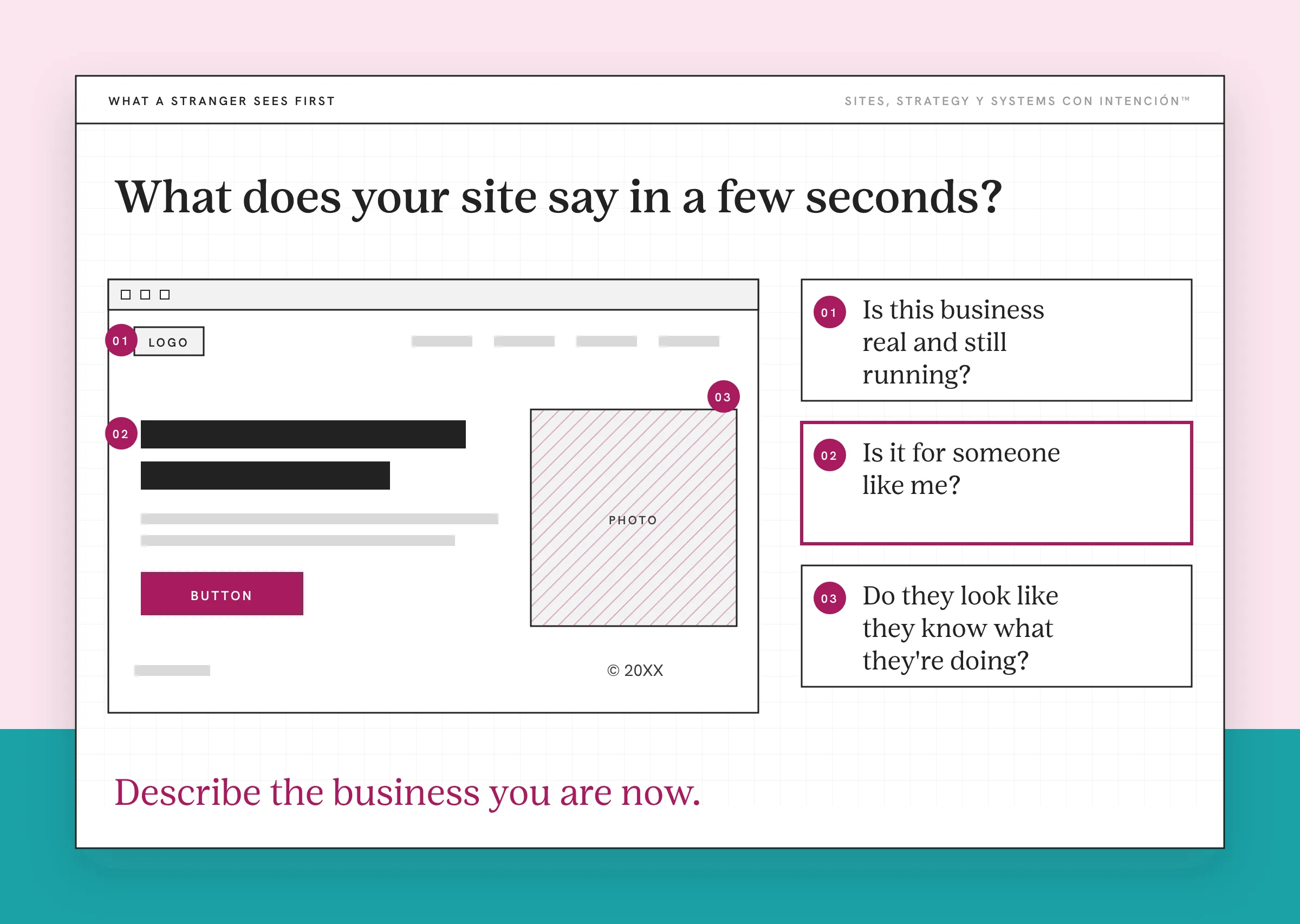
Before anyone reads a full sentence, they've already formed a first impression of the site. They notice whether the site looks current, whether it feels put together and whether the headline seems to be about someone like them.
That habit isn't new. In a 2002 Consumer WebWatch study of how people evaluate a site's credibility, the 2,684 participants mentioned a site's design look in 46.1% of their comments, more than anything else. The internet has changed since then and that habit hasn't.
So in those first few seconds, your site is answering three questions for you:
- Is this business real and still running?
- Is it for someone like me?
- Do they look like they know what they're doing?
If the answers come out wrong and they weren't already sold on you, the visitor bounces before your copy gets a chance. For how design shapes those answers, see how website design builds trust.
Is Your Site Telling an Old Story?
The yearbook photo problem shows up a lot in service businesses that have grown. The site was built for the business you were two or three offers ago. Since then, your prices changed, your process changed and maybe your ideal client changed too. The site didn't.
Look for these signs:
- Services you don't offer anymore, or new ones that never made it onto the site.
- Old prices or packages that don't match what you quote on calls.
- A look that matches your old brand, with colors, photos or fonts you've since moved past.
- Copy written for a different client, like beginners when you now work with established businesses.
- Dates that give it away, like a footer year or a newest blog post from years ago, the kind of small website problem that's easy to ignore.
Every one of those tells a visitor that the site isn't keeping up, ay, mija. Then they wonder whether the business is keeping up either. That's why Stanford's web credibility guidelines tell you to keep content current. If your site looks old more than it reads old, an outdated website covers that side.
What Happens When Your Site Shows an Older Version of Your Business?
You attract the clients you used to want. The site still speaks to your old audience, so that's who finds it and inquires. You'll see it in the site metrics that actually matter. Then you spend your calls explaining that you don't do that anymore.

You also confuse the clients you want now. They arrive from a referral or a post expecting the business they heard about and find something that feels a few years behind. Diache, that gap makes people hesitate right when they were ready to reach out.
When the brand itself feels off, your website doesn't reflect your brand goes deeper. When the site is so far behind that patching it won't help, when to stop optimizing and rebuild your website is the next read.
How Do You Find Out What Your Site Is Saying?
You can't see it the way a stranger does without a little effort, because you know the business too well. Eso sí, it's worth the effort.
- Open your homepage on your phone and give it a few seconds. Write down what you think the business does and who it's for. It won't replace a real usability test, but it shows you what a stranger walks away with.
- Compare that to what you'd say on a call. Every gap is something your site is getting wrong.
- Check every offer, price and date against what's true today.
- Ask someone who doesn't know your business to tell you what they think you do after a quick look.
If you want a fuller process, how to review your own website objectively walks through it step by step. That review is a good first look at your website strategy too.
What to Do This Week
- Do the five-second test on your homepage and write down what it says.
- List every outdated offer, price or date you find.
- Rewrite your homepage headline so it describes the business you are now.
- Swap one old photo for a current one of you or your work.

Small updates go a long way here, pues. The goal is a site that looks like the business you'd introduce yourself as today.
Key Takeaways
- What your website says about your business is decided in seconds, mostly by design and the headline.
- Plenty of sites tell an old story, with past offers, prices, looks or clients.
- An old story attracts the clients you used to want and confuses the ones you want now.
- Test your site as a stranger, fix what's out of date and make the homepage describe who you are today.
Can someone look at my site and tell me what it's saying?
Bring your site and whatever's bugging you about it to one private session on your real question. Notes are included. Sessions start at $350. Full audits are available and get quoted first.
Frequently Asked Questions
What does my website say about my business?
It tells visitors whether you're current, whether you're for them and whether you look like you know what you're doing. People read that from your design, your headline, your offers and how up to date everything looks. If any of those feel old or vague, visitors may decide you're not the right fit before they read further.
How fast do people judge a website?
Very fast. Visitors form a first impression within seconds, often before they read a full sentence. That impression comes mostly from how the site looks and what the headline says. A 2002 Consumer WebWatch study found design look was the feature people mentioned most when judging whether a site was credible.
How do I know if my website is out of date?
Check your services, prices and dates against what's true today. Look at whether the photos, colors and copy match your current brand and your current clients. If you'd describe your business differently on a call than your homepage does, the site is out of date even if it looks fine.
Should I redesign my website if my business has changed?
Not always. If the changes are in your offers, prices and copy, updating those pages may be enough. If the look, structure and audience all changed, a redesign or rebuild can make more sense. Start by listing what's out of date, then decide based on how much of the site it touches.
Can an old website hurt my business?
Yes. An out-of-date site can make visitors wonder whether your business is still running, attract clients you no longer want to work with and confuse the ones you do want. Keeping your offers, prices and homepage current is one of the simplest ways to protect your first impression.
About the Author