
When a dish tastes flat, the instinct is to add something. You reach for more garlic, more adobo or another pinch of whatever's closest. Sometimes that works. Other times the problem is that nobody made the sofrito first. No amount of extra ingredients will fix a base that was never there.
Your website works the same way. When inquiries for your services slow down, the instinct is to add more: another page, another blog post, another lead magnet. It's exhausting to keep writing and still hear nothing back. So does your website need more content or more clarity? In 12+ years and 100+ sites worked on, I've learned to check the base first, because extra content on top of an unclear message just gives people more to be confused by.
The Short Answer
Your website needs more clarity if visitors can't tell what you do, who it's for or what to do next. It needs more content if people understand you but can't find you or keep asking questions your site never covers. Check clarity first. Content only helps once the message underneath it is clear.
If You're Reading This Because It's Your Site
Reading more isn't the hard part. La Jugada is $47 and it tells you which layer this is actually sitting in.
Get it, $47How Do You Know If Your Website Needs More Clarity?
When I review a site, the first things I look at are load time, navigation, the hero and the homepage as a whole. Content comes later. That order exists for a reason: if the top of the homepage doesn't say what you do, a lot of people leave before they read further down, which Nielsen Norman Group's page-visit research backs up.
These are the signs the problem is clarity:
- You can't explain your offer in one sentence and neither can your site. Read the first screen of your homepage. If it takes a paragraph to figure out what you sell, the message isn't clear yet. Complex work can take more explaining further down the page. The first screen still has to say what it is.
- Visitors ask questions your site already answers. The answer is there, just buried or worded in a way they don't recognize.
- The wrong people inquire. When a page never says who it's for, everyone assumes it's for them.
- Traffic comes in and inquiries don't. People arrive, read a little and leave without a next step.
- Your pages describe the same thing in different words. The services page says one thing, the about page says another and the blog says a third.
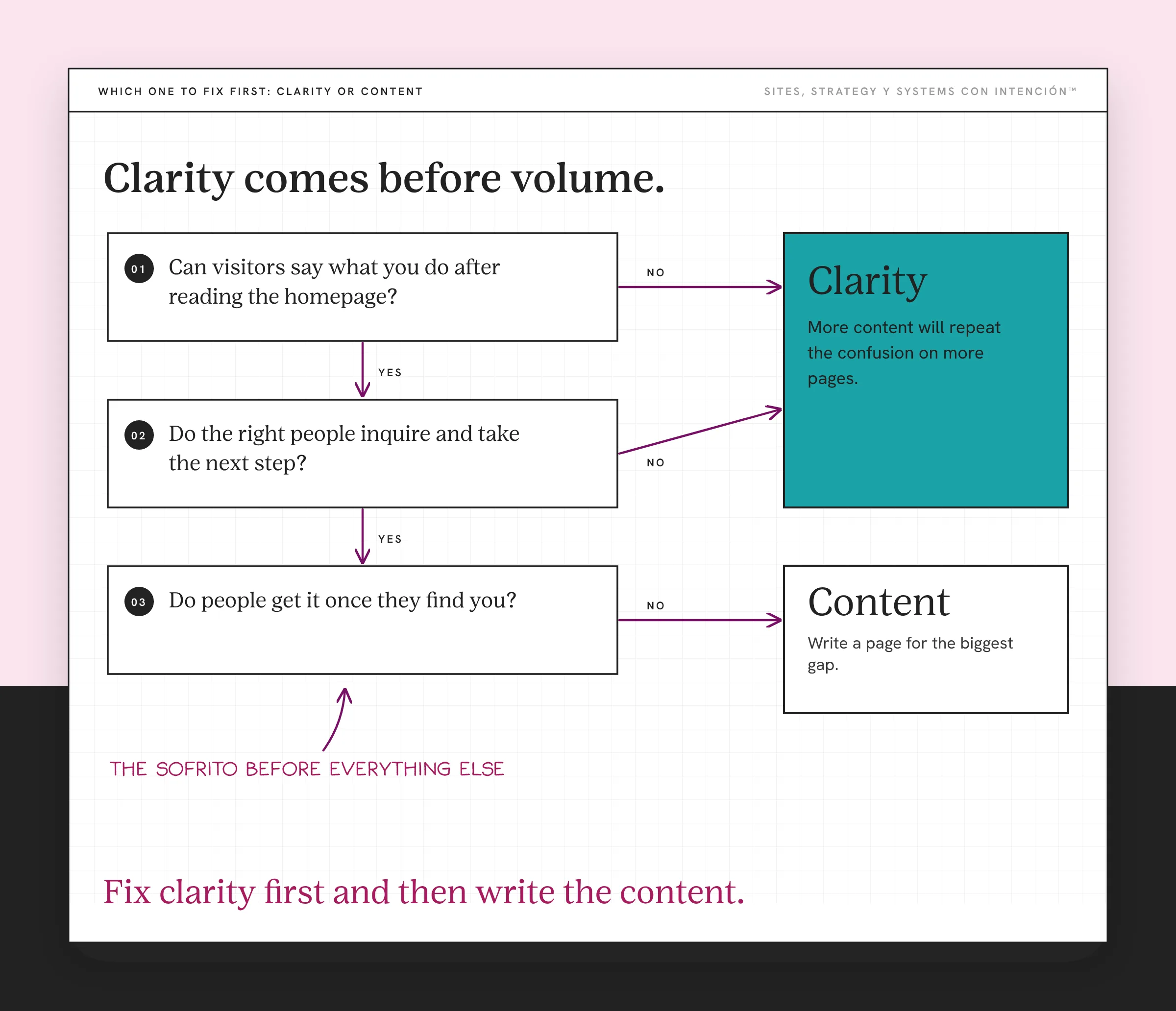
Ay, mija, if three or more of those sound familiar, more content won't help yet. It will repeat the confusion on more pages.
How Do You Know If Your Website Needs More Content?
Content is the right fix when the message is already clear and something is missing around it.
These are the signs the problem is content:
- People understand you once they find you, but they don't find you. Search Console shows few impressions for the questions your clients ask.
- You keep answering the same question in DMs and there's no page for it. The question exists. Your site just doesn't treat it as one of the questions your website should answer.
- An offer has no page of its own. If people have to email you to learn what a service includes, that service needs a page.
- There's nothing for people who aren't ready yet. No guide, no article, no smaller step, so they leave and don't come back.
- There's no proof. No case study, no client story, no examples of your work.
Eso sí, notice what these have in common. The visitor already gets what you do. They just need more to find you, trust you or take the next step.
Why Does Clarity Come First?
Content multiplies whatever message is already there. If the message is clear, every new page reinforces it. If it isn't, every new page adds another version of the confusion.

I've had a client come to me asking for more pages. What the site needed was clarity, so we fixed the message first. Adding pages to a message nobody could follow would've just given visitors more to be confused by.
That's also the website audit mistake a free scan can't catch. Ask me what an audit finds that a scan misses and my answer is "if they don't have a true content strategy." A crawler can tell you a page loads. It can't tell you there was never a plan behind the pages.
So the order is the same every time. Get the base right, then build on it. Skip the base and small website changes won't make a difference. Diache, it's the sofrito before everything else.
Which One Should You Fix First?
| If this sounds like your site | Start with |
|---|---|
| Visitors can't say what you do after reading the homepage | Clarity |
| The wrong people inquire | Clarity |
| Traffic comes in and nobody takes the next step | Clarity |
| People get it once they find you, but few find you | Content |
| You answer the same question in DMs every week | Content |
| An offer has no page of its own | Content |
If your site lands in both columns, fix clarity first and then write the content. The new pages will work harder on a clear base. Clarity before volume is about as close to a rule as website strategy gets.
How Do You Fix Clarity Before Adding Content?
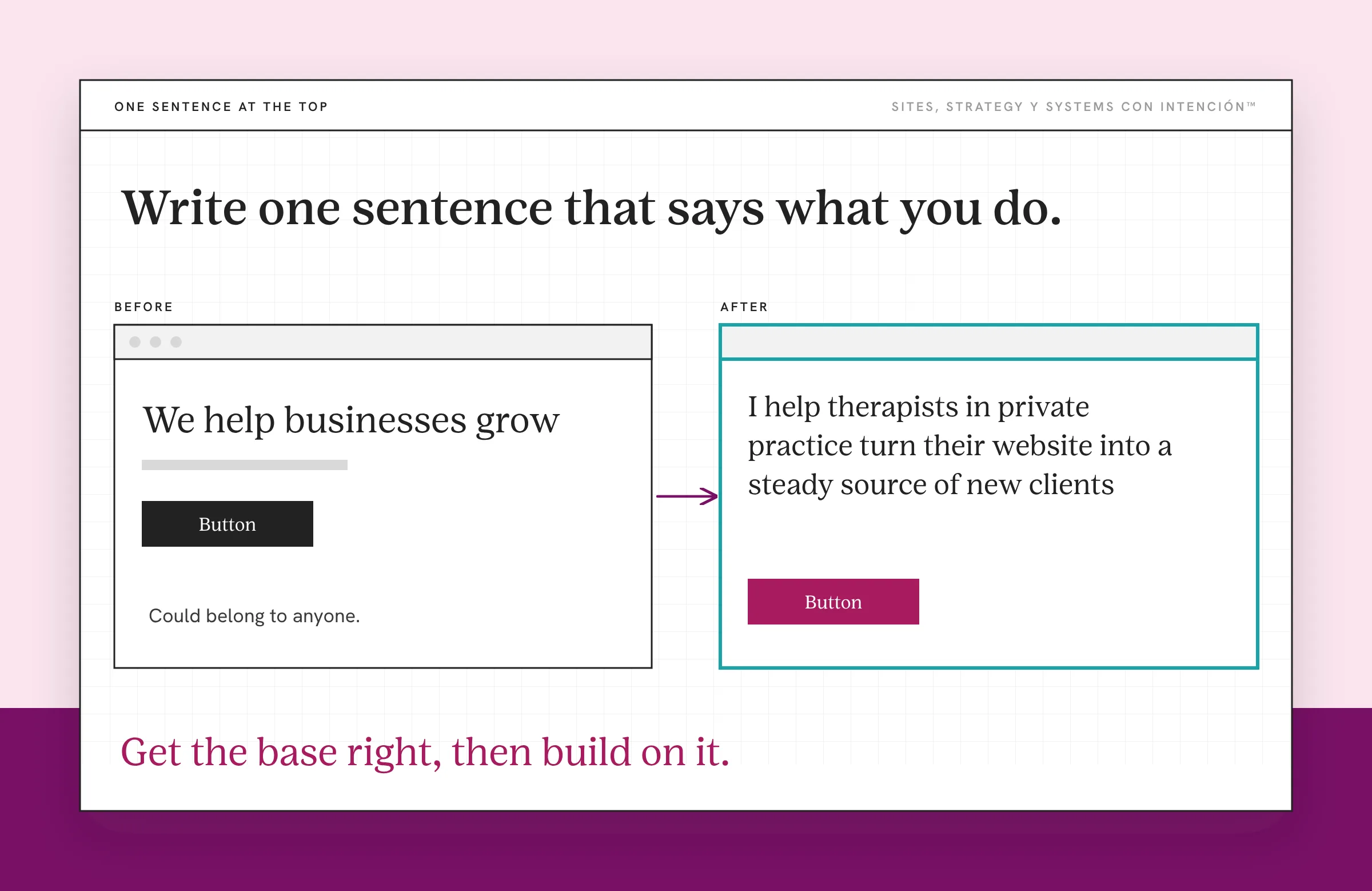
- Write one sentence that says what you do and who it's for. Put it at the top of your homepage, shaped however fits your brand. "We help businesses grow" could belong to anyone. "I help therapists in private practice turn their website into a steady source of new clients" tells the right person they're in the right place. That second line is an example, so write yours about your actual offer and your actual client.
- Use the same words everywhere. Your services page, about page and posts should describe the problem and the offer the same way.
- Give every page one clear next step. A page without one is a dead end.
- Cut what doesn't support the message. Pages that repeat or contradict each other can be merged or removed.
If you're not sure how many pages you need once the message is clear, how many pages a website should have walks through it. The copy side is covered in the most common website copy mistakes.
When Is It Time to Add More Content?
Add content when the message is clear and you can point to a gap in the website metrics that matter. A question clients keep asking, an offer without a page, a search people make that you don't show up for or a reader who isn't ready to book yet. Each of those is a reason to write something new.
Write it for the person asking. Google's guidance on helpful, people-first content makes the same point: content should serve the reader before it serves a search engine.
Then connect every new piece to the offer it supports. Content that doesn't lead anywhere builds traffic without building business, which is the difference covered in why some blog posts bring clients and others just traffic.
Once a post brings people in, your website has to close the sale. For how all the pieces work together, see a content ecosystem.
What to Do This Week
- Read the top of your homepage as a stranger. Review your own site objectively and ask: can you tell what you do, who it's for and what to do next?
- List the questions you answered in DMs or emails this month. Mark which ones have no page.
- Pick one. If the homepage failed the stranger test, fix clarity first. If it passed, write a page for the most common unanswered question.
Key Takeaways
- Your website needs clarity if visitors can't tell what you do, who it's for or what to do next.
- It needs content if people understand you but can't find you or keep asking questions your site never covers.
- Fix clarity first. Content multiplies whatever message is already there.
- Add content to fill a specific gap and connect every new piece to an offer.
So does my site need more pages or a clearer message?
For $47, answer five questions and share your link. In about 10 minutes you get a read on your site, your marketing and your backend with the first move worth making. There's no call.
Want more like this in your inbox? Off the Clock is my week-ish newsletter about websites, systems and burnout-free business.
Frequently Asked Questions
Does my website need more content?
It does if your message is already clear and something is missing around it, like a page for a question clients keep asking, a page for an offer or something for readers who aren't ready to book. If visitors can't tell what you do or who it's for, fix that first. More pages on an unclear message spread the confusion.
How do I know if my website message is clear?
Read the top of your homepage as someone who has never heard of you. Within a few seconds you should be able to say what you do, who it's for and what to do next. Then compare your services page, about page and blog. If they describe your work differently, the message needs tightening.
Should I add more pages to my website?
Add a page when it fills a specific gap: an offer without its own page, a common question without an answer or a topic your clients search for. Don't add pages to look bigger. Each new page should support the main message and point to a next step.
Can too much content hurt my website?
It can. Pages that repeat each other, contradict each other or don't lead anywhere make it harder for visitors to find what matters and harder to tell what you're about. Fewer, clearer pages that each have a job can do more than a long list of pages that overlap.
Is website clarity a design problem or a copy problem?
It's mostly copy and structure. Design helps people find the message, but the message itself comes from what the page says and the order it says it in. A beautiful layout can't fix copy that never says who you help. Start with the words, then make sure the design puts them where people look first.
About the Author