
Making your own cafecito takes two minutes. You know how strong you like it, how much sugar and which cup. Now picture making it for the whole office. Twenty people, twenty orders, one stovetop and nobody wrote anything down. Same recipe, total chaos.
Your business works the same way when it grows. So is your website ready to scale? The quickest way to find out is a gut check you can call the tomorrow test: imagine twice the leads showed up tomorrow and watch what breaks first. In 12+ years and 100+ sites worked on, the first cracks I look for are in intake, scheduling and onboarding, because those are the backend gaps I name most often.
The Short Answer
Your website is ready to scale when twice the inquiries wouldn't double your workload. Run the tomorrow test: if your leads doubled overnight, would intake, booking and follow-up keep working without you? Anything that only works because you personally handle it is where you'll break first. Fix those pieces before you push for growth.
If You're Reading This Because It's Your Site
Reading more isn't the hard part. La Jugada is $47 and it tells you which layer this is actually sitting in.
Get it, $47What Is the Tomorrow Test?
The tomorrow test is one question. If twice as many people inquired tomorrow, what would happen?
Walk through it step by step. Twice as many contact forms land in your inbox. Twice as many people want a call. Twice as many new clients need a welcome email, a contract and a first appointment. Every step that depends on you reading, replying or copying something by hand now takes twice the time.
That's the test. Ojo, you're not asking whether your site looks ready for a bigger business. You're asking whether the work behind it can handle more people without everything running through you. Looking ready was never one of the metrics that matter.
Score it with three yes-or-no questions:
- Could twice the inquiries sort themselves into fits and not-fits before they reach you?
- Could twice the people book a call without a single email from you?
- Could twice the new clients get welcomed and onboarded if you were out for the day?
Three yeses and the work behind your site is ready for more people. One or two and you know exactly what to fix first. Zero means growth would land on you, so fix the systems before you chase more leads.
What Breaks First When Leads Double?
Three things crack first.
Intake. If every inquiry comes in as a free-form email, you have to read each one, figure out what they need and decide whether they're a fit. At ten a month that's fine. At twenty, it's a part-time job. A short intake form with a few real questions sorts people before they ever reach your inbox. That sorting is part of what website success actually looks like.
Scheduling. If booking a call means emailing back and forth to find a time, doubling your leads doubles the emails. Mija, that's how a good month turns into a week of "does Tuesday work?" A booking tool connected to your calendar takes that off your plate.
Follow-up and onboarding. New clients need the same things every time: a welcome message, next steps, paperwork, a first meeting. When you send those by hand, they're the first things to slip when you're busy. People start to wait. Some of them stop waiting.
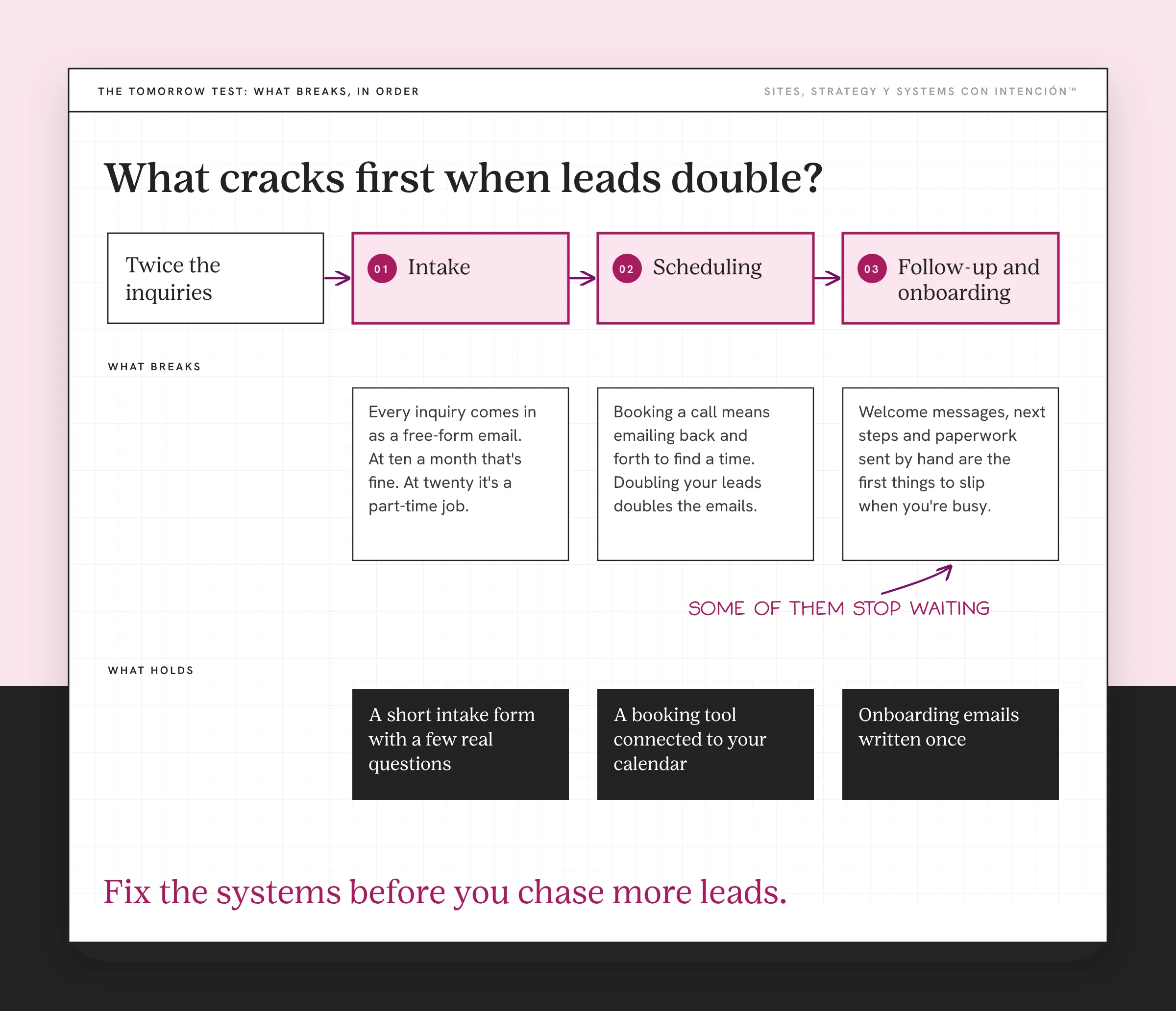
This lines up with what I see most often when I look at a business's backend. Manual intake, scheduling and onboarding are the gaps that cost founders hours every week. They also make it harder for new clients to get started.
Why Does Doing It All Yourself Become the Ceiling?
When I've been asked whether burnout and a growth ceiling are the same problem, my answer is "Same mechanism, different symptom." The person is absorbing what the system should absorb.
Burnout is what that does to you. The ceiling is what it does to your revenue. If every lead runs through your hands, your site is hurting your business because you can only grow as fast as you can personally reply, schedule and onboard. Ay, bendito, you end up turning work away or doing it at midnight.

Speed matters too. Research published in Harvard Business Review on how quickly companies respond to online leads found that most aren't responding nearly fast enough. When your leads double and your process stays manual, response times are the first thing to stretch.
For how your site can carry more of the selling on its own, see why your website is your best salesperson.
How Do You Get Your Website Ready to Scale?
Start with whatever would break first in your tomorrow test.
- Add a real intake form. Ask the handful of questions that tell you whether someone is a fit and what they need. GOV.UK's guidance on form structure is a good model to follow. Send the answers somewhere organized.
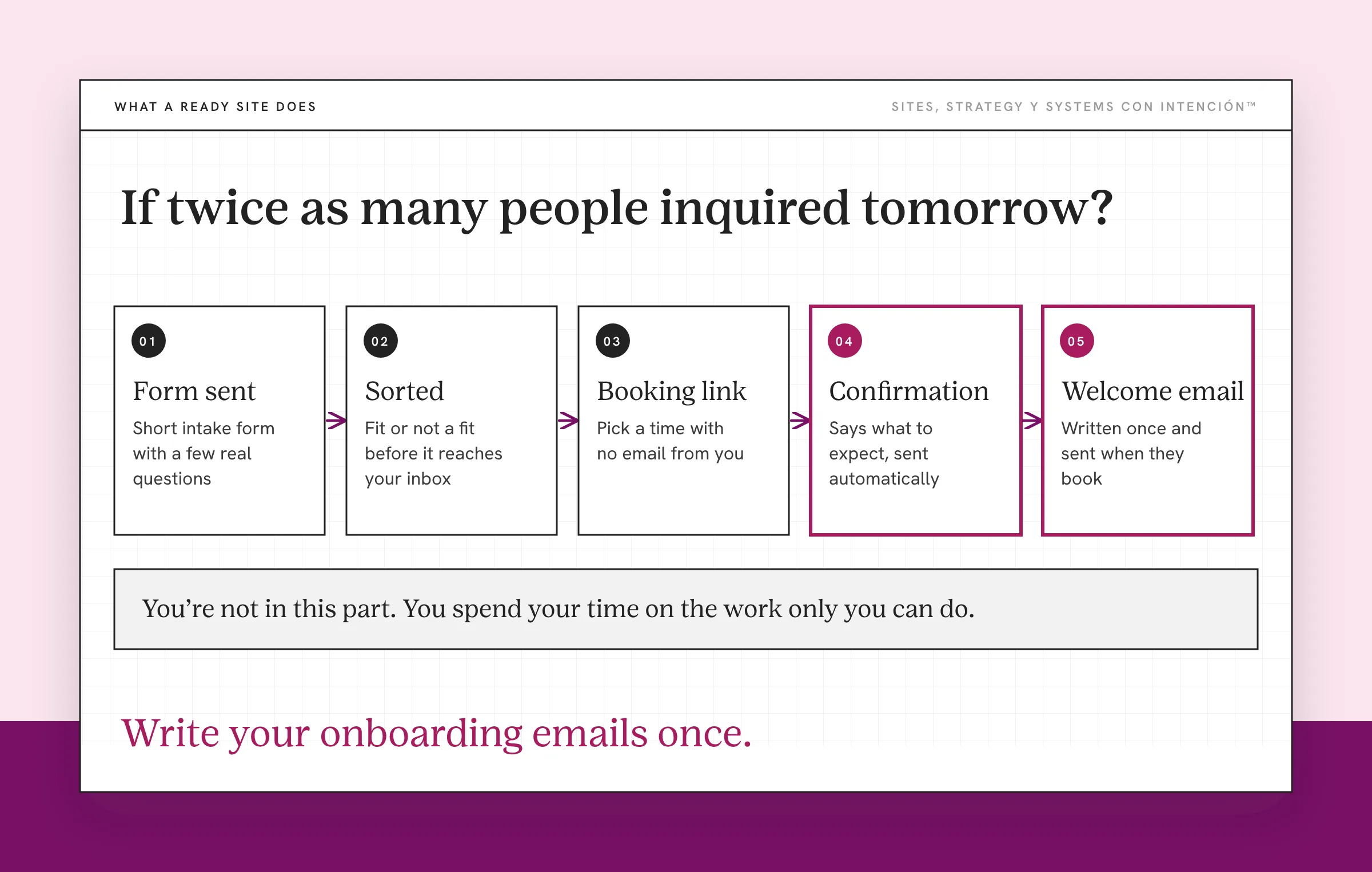
- Connect a booking tool. Let people pick a time that works without emailing you first. Add an automatic confirmation that tells them what to expect, so they're not left with questions your site should have answered.
- Automate the welcome. Write your onboarding emails once and have them send when someone books or signs. Keep them in your voice.
- Write down the process. Even if you're the only one doing it, a written step-by-step makes it possible to hand off later. That's how small business systems start.
- Check whether the site can keep up. If every update needs a developer or the platform can't support the tools you need, that's a sign you're outgrowing your website. A website that needs constant updates won't scale with you.
If the site itself was built for a smaller version of your business, read when to stop optimizing and rebuild your website before you start patching. Scaling is one of the moments where website strategy matters most.
What Does Ready Look Like?
A site that's ready to scale feels the same at twenty inquiries a month as it does at ten. People fill out a form that sorts them. They book a time without waiting on you. They get a welcome that tells them what happens next. You see who's coming and spend your time on the work only you can do.
I've seen what that looks like at volume. I was part of the team on a multilingual lead generation site with a quiz that sorted people by what they needed and sent each one personalized results. Integrated follow-up sequences handled the next steps. In its first campaign window, more than 1,500 leads went into segmented email workflows without anyone answering them one by one. That result belongs to the whole team and the whole system. The point for you is the shape of it: sorting, follow-up and next steps that run on their own.
Eso sí, being ready is ongoing. It means the next jump in growth won't land on your shoulders all at once. Run the tomorrow test again every time your offers or your volume change.
Key Takeaways
- Your website is ready to scale when doubling your inquiries wouldn't double your workload.
- The tomorrow test asks what breaks first if twice the leads showed up tomorrow.
- Intake, scheduling and onboarding are where the cracks show first.
- Burnout and the growth ceiling come from the same mechanism: you absorbing what the system should.
- Fix the piece that would break first, then the next one, before you push for more growth.
I ran the tomorrow test and I'd rather talk it through.
Bring your site, your numbers and whatever broke first when you ran the test. One private session on your real question starts at $350 and notes are included.
Frequently Asked Questions
How do I know if my website can handle more clients?
Run the tomorrow test. Imagine twice as many inquiries arrived tomorrow and walk through what happens to each one. If intake, booking and follow-up all depend on you doing something by hand, your site isn't ready yet. If those steps run on their own and you only step in for the work itself, it's ready for more.
What breaks first when a service business grows?
The manual steps between an inquiry and a first meeting break first. Reading and sorting inquiries, scheduling calls by email and sending onboarding materials by hand all take more time as volume grows. Those are the steps where people start waiting and some of them leave before they ever become clients.
What should I automate before I scale?
Start with whatever would break first in your tomorrow test. For many service businesses that's scheduling, followed by intake and onboarding emails. A booking tool, a short intake form and a few automated welcome emails cover most of it. Keep the messages in your own voice so the experience still feels personal.
Do I need a new website to scale?
Not always. A lot of sites can scale by adding a better intake form, a booking tool and automated follow-up. If your platform can't support those tools or every change needs a developer, a rebuild may be the better move. Check what's holding you back before you decide.
How does scaling affect burnout?
When growth adds more manual work, it lands on the person doing that work. If that's you, more clients can mean more hours and more stress. Moving intake, scheduling and follow-up into systems lets you take on more clients without taking on every extra task yourself.
About the Author