Anyone who watches The Challenge on MTV knows nobody walks into a vote blind. Players spend the whole week watching who's strong, who's struggling and who's running the house behind the scenes. By the time they vote someone into elimination, they know exactly why. The ones who vote on a hunch tend to end up packing their own bags.
Choosing between a website audit vs redesign works the same way. A redesign is the big move. An audit is the scouting that tells you whether the big move is the right one. In 12+ years and 100+ sites worked on, my answer to "audit or redesign?" has stayed the same: audit first, always.
The Short Answer
Start with an audit. A website audit tells you what's broken, what's working and why people aren't taking the next step. Sometimes the answer is a redesign. Sometimes it's a handful of fixes to copy, navigation or the inquiry path. Redesigning without an audit means paying to change things you haven't diagnosed.
If You're Reading This Because It's Your Site
Reading more isn't the hard part. La Jugada is $47 and it tells you which layer this is actually sitting in.
Get it, $47What's the Difference Between a Website Audit and a Redesign?
An audit is a diagnosis. Someone goes through your site and finds out what's working, what's broken and what's missing. It ends with a list of problems in order of how much they cost you.
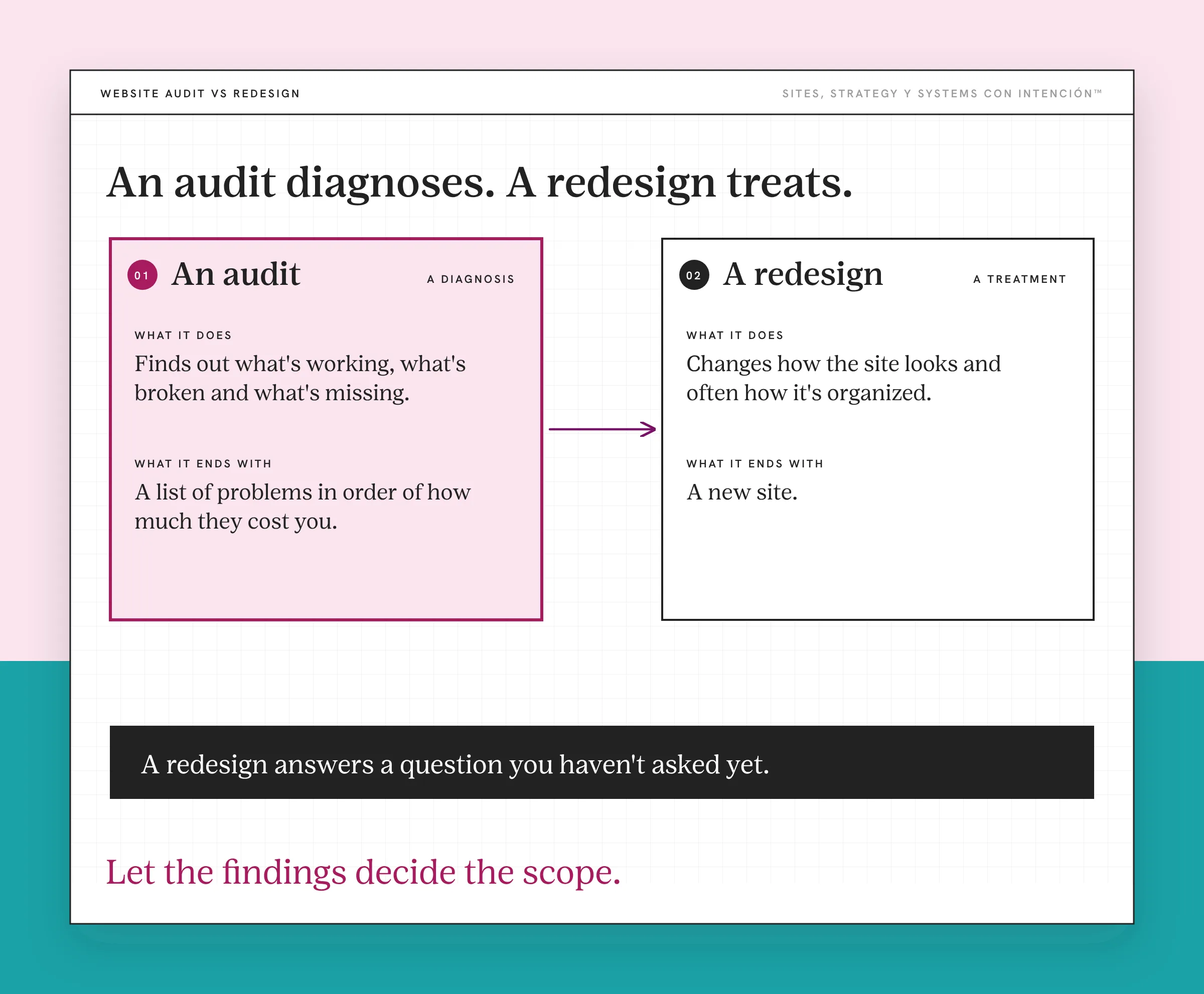
A redesign is a treatment. It changes how the site looks and often how it's organized. It ends with a new site.
If you want the full definition of what goes into an audit, what a website audit is covers it. This post is about the order: which one comes first and why.
Why Should You Audit Before You Redesign?
Because a redesign answers a question you haven't asked yet. When a site isn't bringing in clients, it's tempting to assume the look is the problem. Ojo, sometimes the problem is something a new design won't touch.
A lot of what an audit finds lives under the surface, which is why small website changes often don't make a difference. A form that doesn't send. Copy that never says who it's for. Pages that don't connect to anything. When I'm asked whether an automated scan ever comes back clean while the real problem goes untouched, my answer is "yeah, if they don't have a true content strategy." No scan reports that a plan is missing. Diache, a new design won't add one either.
That's the risk of skipping the audit, créeme. You pay for a beautiful new site and carry the same problems into it. Ay, Dios, it's the most expensive way to find out the design was never the issue.
What Does an Audit Look At Before Anyone Talks About Design?
My usual order goes like this: load time, navigation, the hero, the homepage as a whole and SEO, technical and on-page. Then the individual pages, the UX and whether it works functionally at all. Last, whether any of it is connected to anything else.
That order matters because it checks whether the site works before it checks whether it's good, which avoids a common website audit mistake. I usually look at the website first, the UX and UI along with the backend, then strategy, then systems. Design shows up in the middle of that list. It's one question among many.
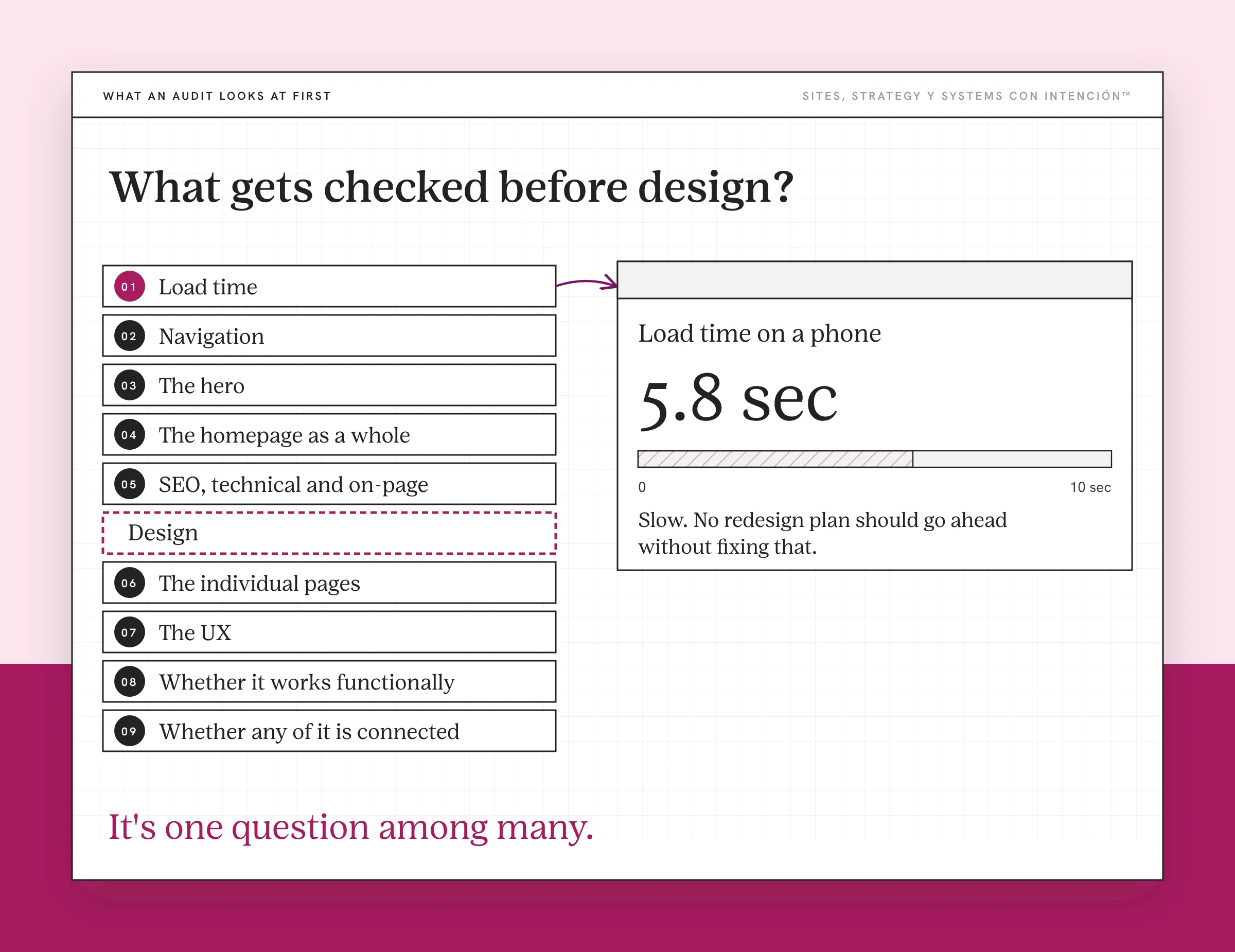
You can start the first step of reviewing your own site objectively today. Run your homepage through Google's free PageSpeed Insights and see how it loads on a phone. If it's slow, no redesign plan should go ahead without fixing that.
When Does an Audit Say You Need a Redesign?
Sometimes the audit points straight to a redesign or a rebuild. My rule is about whether the problems can be separated. When the backend is broken, the theme won't update, the architecture is wrong and the site shows an older version of your business, I'd change most of it anyway. It's not siloed fixes at that point.
It can go the other way too. I've reviewed sites where the structure was solid but the design still reflected the business from two years ago. In that case the audit tells you the structure can stay and the look is what needs the work.
When the problems can be fixed one at a time, they should be. Nielsen Norman Group calls that incremental change. When they're tangled together, it's time to stop optimizing and rebuild. Website redesign vs rebuild explains which of the two you need. The signs you need a website redesign covers what to look for.
The audit is also what makes a redesign work, mija. It hands the designer a list of what to fix, what to keep and what the site needs to do. Without it, the new site is built on the same guesses as the old one. The audit is the first step in any website strategy I do for exactly this reason.
It also maps what a new site can't break. Early in my career, I moved a client's domain too early and their email stopped working. I caught it right away and had it fixed within a day. I learned 301 redirects the hard way on that one too. Early career probs. An audit lists the pages, redirects and connections the new site has to carry over, so nobody learns that lesson on your site.

What Should You Do Next?
- Write down your goal. What should the site do for your business? An issue for one business is nothing for another, so the goal decides what counts as a problem and what website success looks like for you.
- Check the basics yourself. Load time on a phone, the menu, the top of your homepage and your contact form.
- Look at your numbers. Inquiries, where they come from and where people drop off. The website metrics that matter shows where to start.
- Get an audit before you price out a redesign. Pues, let the findings decide the scope.
If you want a quick gut check before a full audit, would you fire your website walks you through a simple review.
The audit is your week of watching before the vote. It tells you whether the big move is the right one before you pay for it. Skip it and you're voting on a hunch with your own budget on the line.
Key Takeaways
- An audit is a diagnosis and a redesign is a treatment, so audit first, always.
- Some of the biggest problems, like a missing content strategy or a broken form, won't be fixed by a new design.
- Check load time, navigation, the hero, the homepage, SEO, the pages, function and whether everything connects.
- When the problems can't be fixed one at a time, the audit will point you to a redesign or rebuild.
Okay, before I spend anything, where's my site losing people?
La Digital Rueda is free. It asks a few questions about your site, your content and your backend and in about two minutes it shows you where the pressure is, before anyone quotes you a redesign.
Want more like this in your inbox? Off the Clock is my week-ish newsletter about websites, systems and burnout-free business.
Frequently Asked Questions
Should I audit my website before a redesign?
Yes. An audit tells you what's broken, what's working and why visitors aren't taking the next step. That information decides whether you need a redesign at all and, if you do, what the new site has to fix. Skipping it means paying for a new design based on guesses.
Do I need a website audit or a redesign?
Start with the audit. If it finds a few separate problems, like slow pages, unclear copy or a broken form, fixing those may be all you need. If it finds problems tangled together, like an outdated theme, a broken backend and a structure that doesn't fit your business, a redesign or rebuild makes sense.
What does a website audit tell you?
A good audit checks speed, navigation, the top of your homepage, SEO, individual pages, usability, whether everything works and whether the site connects to the rest of your business. It ends with a prioritized list of problems so you know what's costing you the most and what to fix first.
Can a free website scan replace an audit?
A free scan is a useful start for technical issues like speed and broken links. It can't tell you whether your copy speaks to the right people, whether your pages lead anywhere or whether there's a strategy behind the content. Those take a person reviewing the site with your goals in mind.
How long should a website last before a redesign?
There's no fixed timeline. A site should be redesigned when it no longer fits your business or when its problems can't be fixed one at a time. An audit is the best way to tell whether you've reached that point or whether targeted fixes will keep it working.
About the Author