
Hamilton ends on "Who Lives, Who Dies, Who Tells Your Story." Who tells your story when you're not in the room? For your business, a lot of the time, it's your website.
So would you fire your website if it were an employee? It's on the clock every day, talking to people you'll never meet. In 12+ years and 100+ sites worked on, I've reviewed plenty of sites that would've been let go years ago if they were people. Owners keep them around because nobody ever sat them down for a review. This post gives you that review: four questions, a simple score and what to do with the result.
The Short Answer
To decide whether you'd fire your website, review it like an employee. Does it show up and work? Does it know the job and explain your offer to the right people? Does it bring in business you can count? Can it work without you babysitting it? Four yeses mean promote it. Two or three mean probation. One or zero mean it's time to replace it.
If You're Reading This Because It's Your Site
Reading more isn't the hard part. La Jugada is $47 and it tells you which layer this is actually sitting in.
Get it, $47Why Does Your Website Get a Pass?
You wouldn't keep an employee who showed up late, couldn't explain what the company does and never brought in a sale. Ay, por favor, you'd have had that conversation months ago. So why keep a site that isn't generating leads?
Websites get a pass because they don't ask for a raise. They sit there costing hosting fees and your time while nobody checks what return they're producing. Website effectiveness is just a fancy way of asking the same thing you'd ask about anyone on your team: are they doing the job?
Grab a notebook and answer the next four questions honestly. Mark each one yes or no.
Does It Show Up?
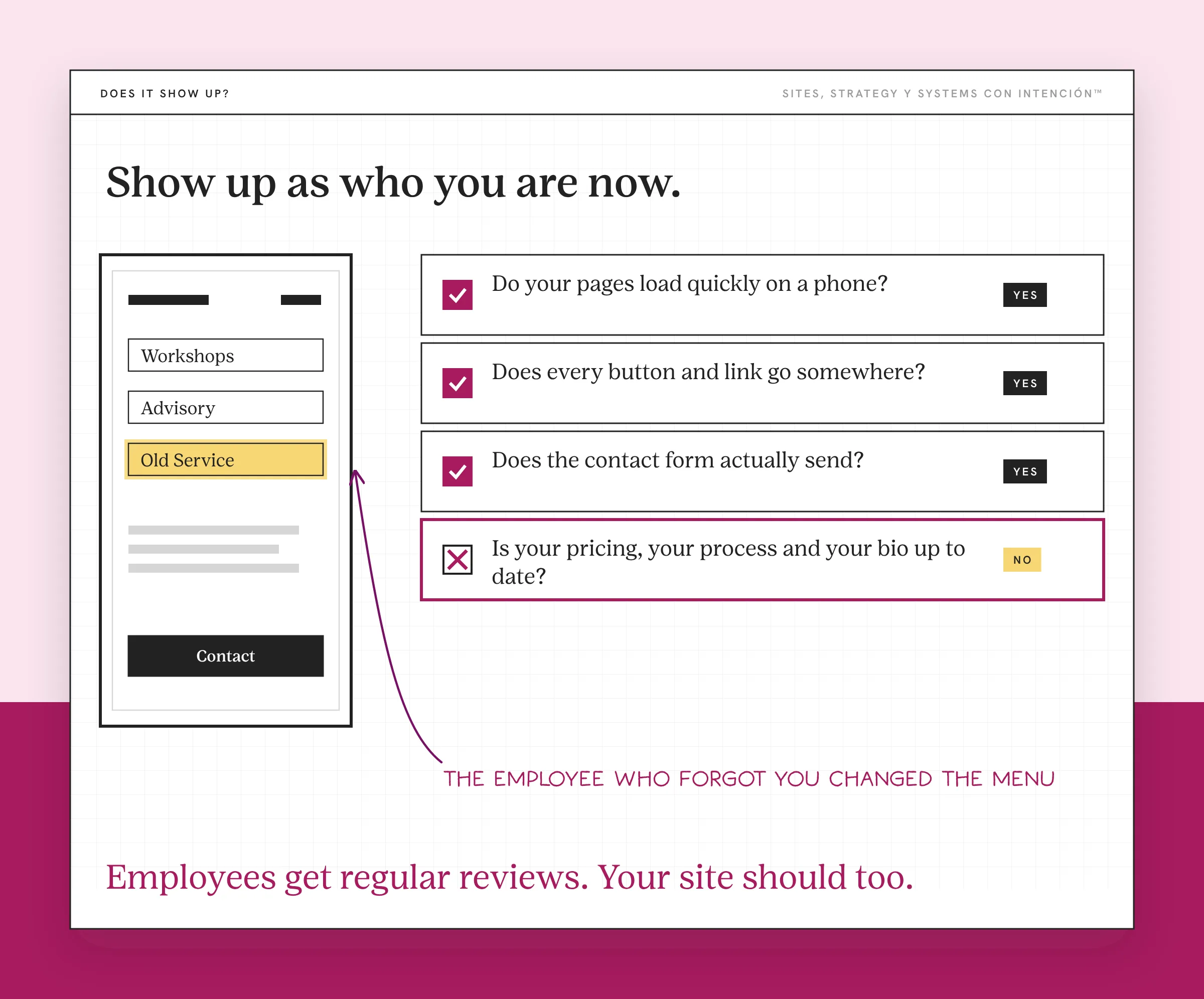
An employee who shows up is on time and ready to work. For a website, that means it loads fast by Google's Core Web Vitals standards, every page works and the information is current.
Check the basics. Do your pages load quickly on a phone? Google's free PageSpeed Insights will tell you. Does every button and link go somewhere? Does the contact form actually send? Is your pricing, your process and your bio up to date? Diache, a site that still lists a service you stopped offering is the employee who forgot you changed the menu. Showing up means showing up as who you are now, which is how website design builds trust.
If your site looks old or isn't built for phones, start with an outdated website and a website that isn't mobile friendly.
Score: yes if it works and it's current. No if anything is broken, slow or out of date.
Does It Know the Job?
A good employee can explain what the company does to a stranger in one breath. Your site should too.
Read the top of your homepage as if you've never heard of you. Can you tell what you offer, who it's for and what to do next? Does your services page explain each offer in plain words? Mija, if a visitor has to guess, that's a user experience problem and your site doesn't know the job yet.
The most common version of this problem is copy that talks about you instead of the person reading. Is your website losing you clients walks through how to spot it.
Score: yes if a stranger can tell what you do, who it's for and the next step within seconds, since Nielsen Norman Group found in 2011 that visitors often leave web pages within 10 to 20 seconds. No if they'd have to dig.
Does It Bring In Business?
You'd fire a salesperson who never closed anything. Your site's results are inquiries, bookings and sign-ups.
Look at the numbers. How many inquiries came through the site last month? Where did those people come from? Where do visitors drop off? Ojo, if you can't answer, that's its own red flag because nobody's watching. The four numbers to start with are in the website metrics that matter. Knowing those answers is the baseline for any website strategy.
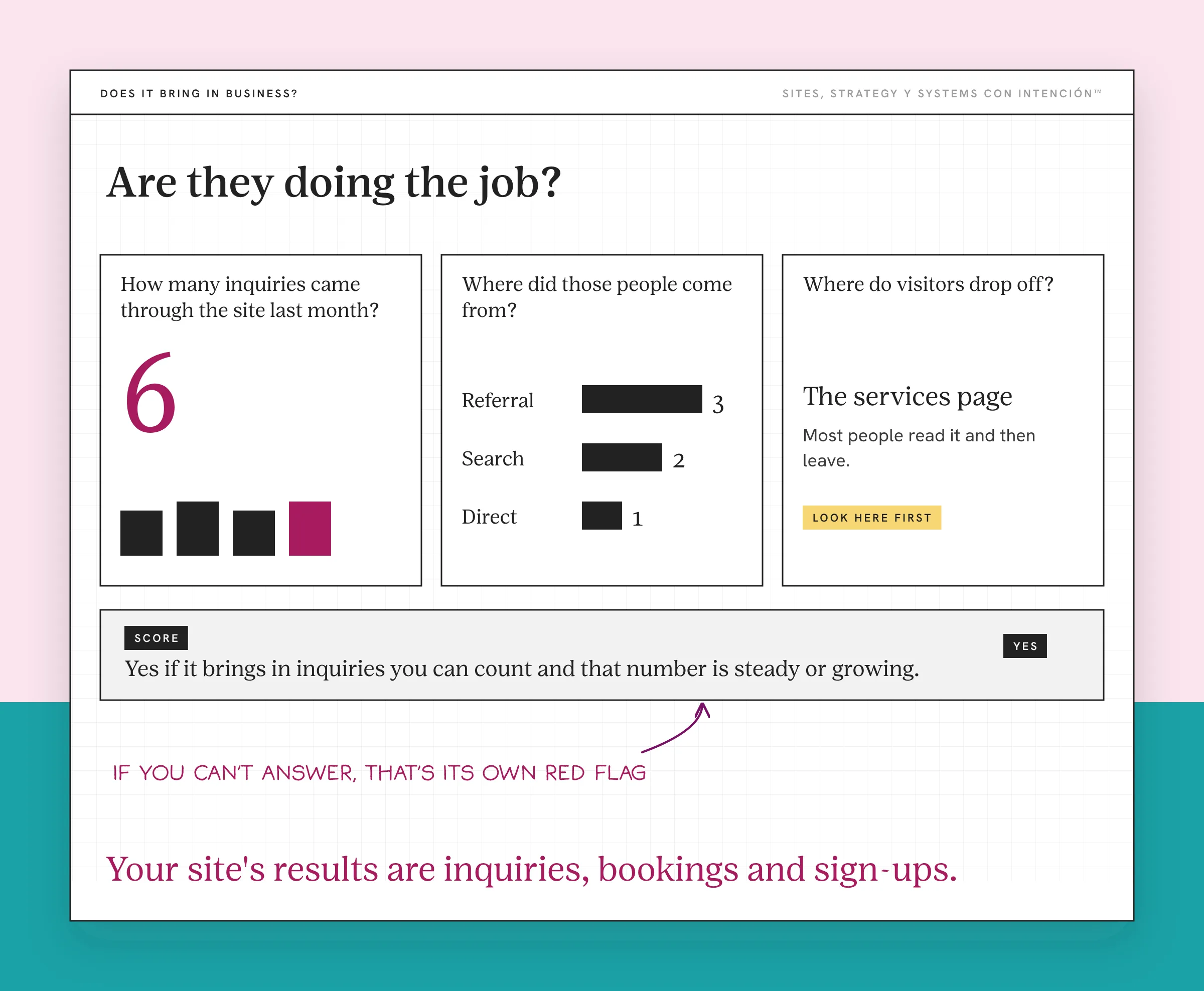
Score: yes if it brings in inquiries you can count and that number is steady or growing. No if it doesn't or if you can't tell.
Does It Need You to Babysit It?
The best employees don't need you hovering. They answer questions, handle the routine stuff and come to you only when it matters.
Does your site answer the questions you keep repeating in DMs? Can people book a call without emailing you first? Does anyone get a follow-up if you're busy? Ay bendito, if every lead still runs through your inbox, the site is just a receptionist who forwards everything to you. A site that sells without you is your best salesperson.
Score: yes if it handles questions, booking and follow-up on its own. No if everything waits for you.
Promote, Probation or Fire?
Count your yeses.
Four yeses: promote it. Your site is pulling its weight. Give it more to do: add content, sell a smaller offer through it or send more traffic its way. Wepa, that's a good employee.
Two or three yeses: probation. It has potential and specific problems. Write down the no's and fix them one at a time, starting with whichever one costs you the most. Probation is where small fixes pay off, ya tú sabes.
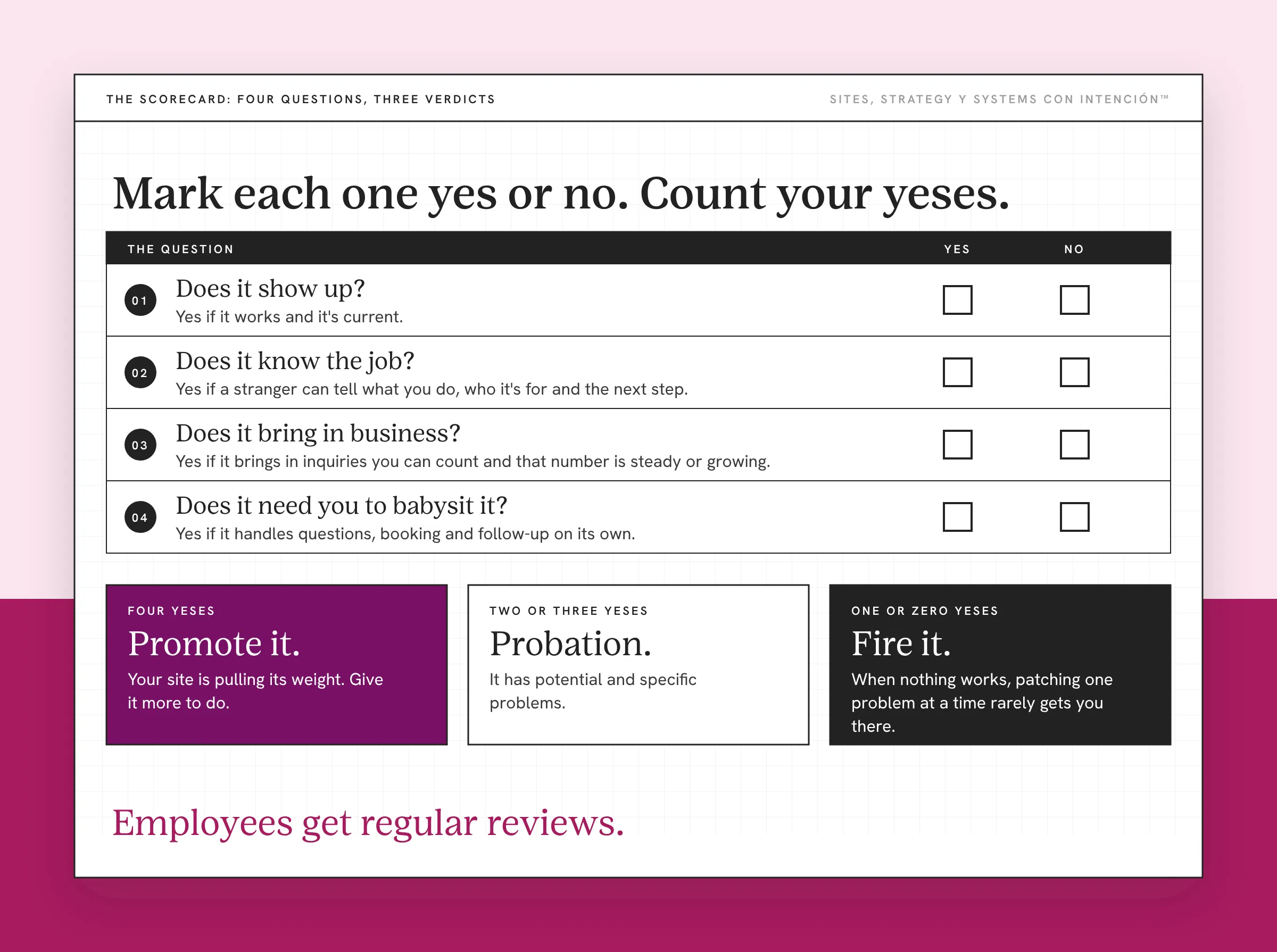
One or zero yeses: fire it. Créeme, when nothing works, patching one problem at a time rarely gets you there. My rule for this is simple. When the backend is broken, the theme won't update and the whole architecture is wrong, I'd end up changing most of it anyway. That's not siloed fixes, that's a rebuild. Pues, sometimes the kindest thing you can do for your business is let the old site go. Before you do, read website redesign vs rebuild so you know which one you need.
Whatever the verdict, put a date on your calendar to review it again in a few months. Employees get regular reviews. Your site should too.
Key Takeaways
- Review your site like an employee: does it show up, know the job, bring in business and work without babysitting?
- Website effectiveness comes down to whether it does its job, not whether it looks nice.
- Four yeses means promote it, two or three means probation and fix the no's, one or zero means it's time to replace it.
- Review it again on a schedule so a good site stays good.
Okay, so would I fire my site? What do I fix first?
Answer five questions and share your link. It takes about 10 minutes and you get a personalized read on your site, your marketing and your backend, plus the first move worth making. It's $47 with results on a private page and no call.
Want more like this in your inbox? Off the Clock is my week-ish newsletter about websites, systems and burnout-free business.
Frequently Asked Questions
How do I know if my website is effective?
Ask whether it does its job. An effective site loads and works, explains your offer clearly to the right people, brings in inquiries you can count and handles routine questions and booking without you. If it misses more than one of those, it isn't pulling its weight.
How do I evaluate my website's performance?
Start with results: how many inquiries, bookings or sign-ups the site produced last month and where they came from. Then check the basics, like speed, broken links and outdated information. Finally, read your main pages as a stranger to see if the offer and next step are clear.
When should I replace my website?
Consider replacing it when several core problems can't be fixed separately, like a broken backend, a theme that won't update and a structure that doesn't fit your business anymore. If the issues are specific and separate, fixing them one at a time can be faster and cheaper than a rebuild.
How often should I review my website?
A quick check every month on inquiries and broken pages keeps small problems from piling up. A fuller review, like the four questions in this post, works well every few months. Save the full audit for once a year. If your offers, prices or audience change, don't wait for the next one. Put all three on your calendar so they happen even when you're busy.
Can a website that looks good still be ineffective?
Yes. A polished design can sit on top of copy that never says who it's for, a form that doesn't send or a site that needs you to answer every question. The review only counts what the site does for your business.
About the Author