
You looked up topic clusters, decided to try one and hit the part where every guide says you need a pillar page first. Then you read the examples. Forty-five minutes of scrolling, a table of contents with thirty links, a downloadable PDF at the bottom. And you've got a business to run.
So the pillar page goes on the someday list and the blog keeps going the way it was.
After 12+ years and 100+ sites worked on, I'd rather you build a smaller pillar this month than a perfect one never. For most service businesses, the pillar that works is a lot closer to a table of contents than a textbook.
The Short Answer
A pillar page is the main page in a topic cluster. It frames one broad subject and links to every post that covers a piece of it, while those posts link back. For a service business, it can be a short hub page or a strong regular post. It doesn't need to be a 10,000-word guide.
If You're Reading This Because It's Your Site
Reading more isn't the hard part. La Jugada is $47 and it tells you which layer this is actually sitting in.
Get it, $47What Is a Pillar Page?
A pillar page is the main page in a topic cluster. It takes the broad subject, frames it in plain terms and links out to every smaller post that answers one piece of it. Those smaller posts link back to it. It's the page that holds the cluster together.
Hamilton's cast album opens with a number that introduces almost everyone you're about to meet. It doesn't tell you their whole stories. It tells you who matters, how they connect and that there's a lot more coming. Every song after it lands harder because the opening already set it up.
A pillar page does the same job for a cluster. Someone who lands on it learns what the subject covers and where each piece of it lives. Someone who lands on a smaller post sees the pillar link and knows there's a bigger picture to step back into.
How Is a Pillar Page Different From a Blog Post?
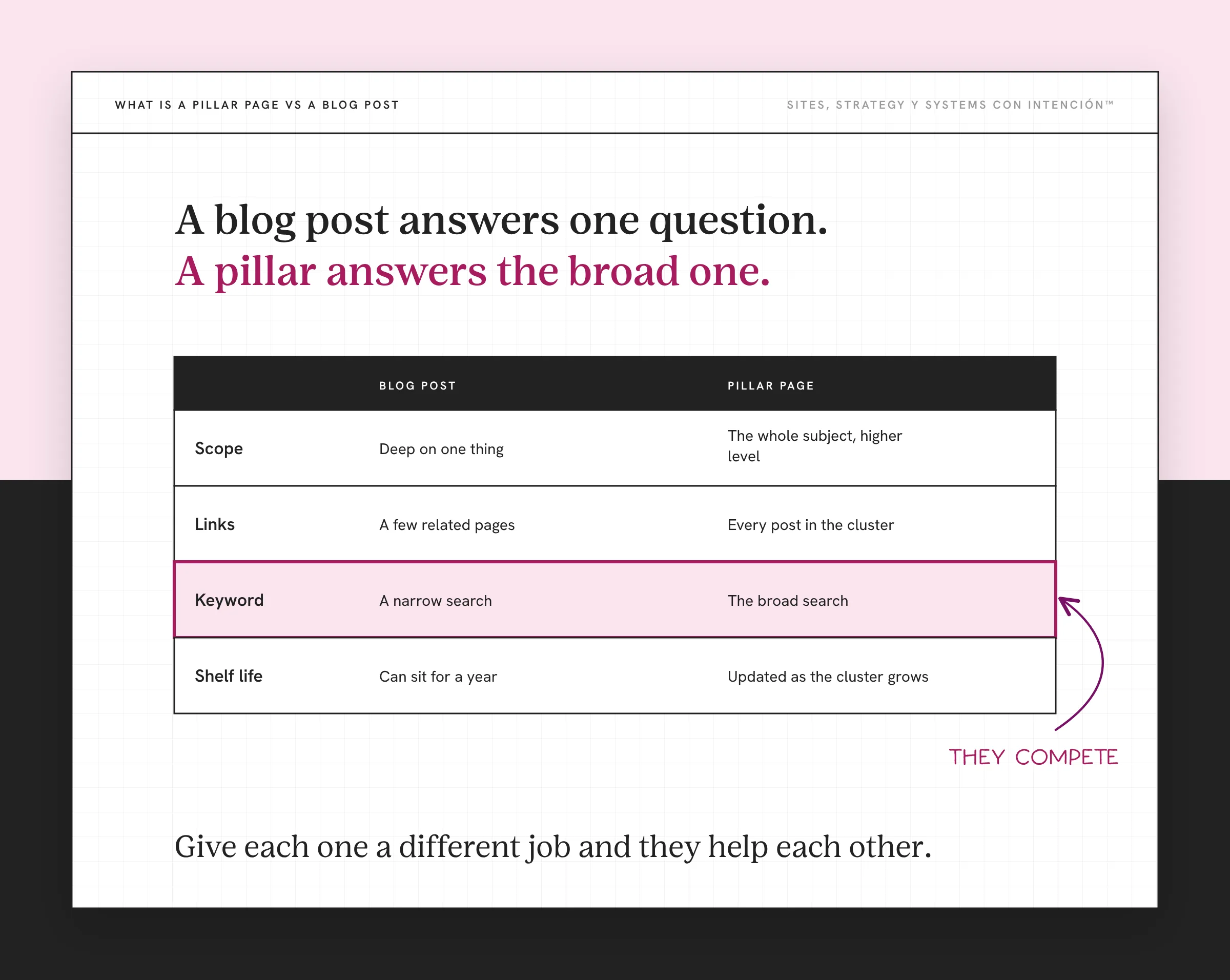
A blog post answers one question. A pillar page answers the broad question and points to the posts that answer everything underneath it.
Scope. A blog post goes deep on one thing, like how often to post. A pillar covers the whole subject, like content strategy, at a higher level.
Links. A blog post links to a few related pages where it helps. A pillar links to every post in its cluster on purpose and those posts all link back to it.
Keyword. A blog post targets a narrow search. A pillar targets the broad one. That split matters more than anything else on this list. When a regular post and the pillar chase the same keyword, they compete and neither ranks the way it should. That's the same problem that keeps weekly posts from building authority.
Shelf life. A pillar gets updated every time the cluster grows, the same way evergreen content only stays useful when someone comes back to it. A blog post can sit untouched for a year if the answer hasn't changed.
Does a Pillar Page Have to Be 10,000 Words?
No. That idea comes from software companies with content teams of twenty. It got copied onto every site that has a blog.
HubSpot's own definition says pillar pages are longer than typical blog posts and it also says they aren't as in-depth as the cluster content they link to. So even the company that popularized pillar pages describes them as wide and shallow. Somewhere along the way that turned into "write the longest page on the internet," qué sé yo.
For a service business, a giant pillar causes two problems. It tries to answer the questions the smaller posts were supposed to answer, so it ends up competing with its own cluster. And it takes so long to build that it never gets built. O sea, the cluster waits forever on a page nobody needed to be that long.
What Does a Pillar Look Like on a Service Business Site?
On a service business site, it tends to look like one of two things.
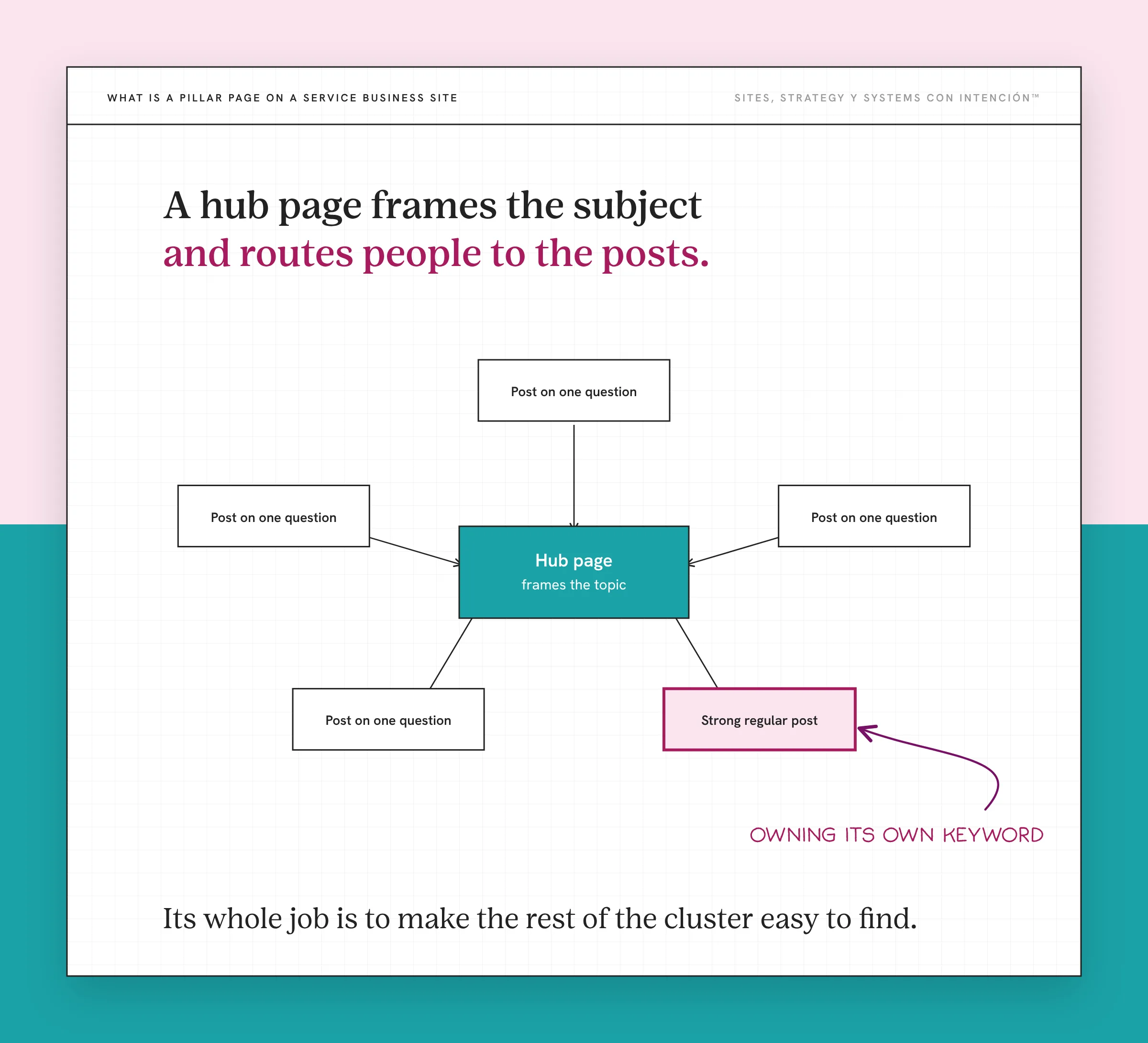
A hub page. A page that frames the subject in a few paragraphs, then lists the posts in the cluster with a line on what each one answers. It's built to route people, a lot like the navigation on a well-planned site. On my own site, every topic cluster has one of these. Someone interested in content strategy lands on the hub, sees the questions it covers and picks the one they came for. The hub doesn't pretend to be the deepest page in the cluster. Its whole job is to make the rest of the cluster easy to find.

A strong regular post. A post that owns the broad question and links down to every smaller post. My content strategy cluster has one of these too: a post on building a content ecosystem from what you already have. It's normal length. It answers the big question and sends people into the cluster for the details.
Fíjate that those can work together. A hub page frames the topic and a strong regular post sits under it as one of the spokes, owning its own keyword. What breaks things is when the hub and that post fight for the same search. Give each one a different job and they help each other.
Can a Blog Post Be Your Pillar?
Yes, if it does the pillar's job. That means three things.
- It answers the broadest question in the cluster. That's the question someone asks before they know which smaller questions to ask.
- It links to every post in the cluster. Each link sits where that smaller question comes up, with anchor text that says what's on the other side. Your internal linking strategy is what holds that together.
- Every post in the cluster links back to it. One link, in the body, where it fits. That's how readers and search engines both find their way to the bigger picture.
If you've already got a post that covers the broad question, you probably already have a pillar. It just needs its links. Go through the cluster, add the links in both directions and update anything in the post that's gone stale. Wepa, that's a pillar page.
If you don't have one yet, write it after you've sorted your existing posts, so you know exactly what it needs to point to. Then fill the gaps with posts drawn from the questions your buyers actually ask.
Key Takeaways
- A pillar page is the main page in a topic cluster. It frames the broad subject and links to every post in the cluster.
- A blog post answers one narrow question. A pillar answers the broad one and routes people to the rest.
- The pillar and the posts under it need different keywords or they compete with each other.
- A service business doesn't need a 10,000-word pillar. A hub page or a strong regular post can do the job.
- If you already have a post on the broad question, it can become your pillar once it links in both directions.
Do I already have a pillar hiding in my old posts?
A few questions about your site, your content and your backend. In about two minutes it shows you where the pressure is, so you know where to start looking.
Off the Clock is where I send posts like this one, along with notes on what I'm building behind the scenes.
Frequently Asked Questions
What is a pillar page example?
On a service business site, a pillar might be a hub page called something like "Content Strategy" that explains the subject in a few paragraphs and links to posts on topic clusters, posting frequency and repurposing. Each of those posts links back to the hub. A strong regular post on the broad question can play the same role, as long as it links to every post in the cluster.
What's the difference between a pillar page and a landing page?
A pillar page is built to inform and route people to more content on one subject. A landing page is built to get one action, like a booking or a sign-up, usually from a specific campaign. A pillar links out to many pages. A landing page usually keeps people focused on one button. They do different jobs, so most sites need both.
What's the difference between a pillar page and a blog post?
Scope and links. A blog post answers one narrow question and links to a few related pages. A pillar page covers the broad subject and links to every post in its cluster, which all link back to it. They also target different keywords, so they don't compete with each other in search results.
How long should a pillar page be?
As long as it takes to frame the subject and route people to every post in the cluster. For a service business, that's often far shorter than the 10,000-word examples you see online. If your pillar is answering the smaller questions in full, it's probably doing the cluster posts' job and competing with them.
How many pillar pages should a site have?
One per topic cluster. Most service businesses have three to six subjects they're really known for, so that's three to six pillars. Start with the subject closest to what you sell. A second pillar goes faster once you've seen how the first cluster fits together.
Do pillar pages still help SEO?
Yes. A pillar gives search engines one clear page for the broad subject and a set of links showing how every related post fits underneath it. It also keeps your posts from splitting the same search. The pillar won't rank on its own just because it exists. The cluster around it is what gives it weight.
Save This One for Later
Pin it to your own board so you can find it when you're ready to fix it.
Save to PinterestAbout the Author