You've published a blog post every week for months, maybe a full year. You kept the streak going through busy client weeks and holidays because you'd heard consistency is what builds authority. Then you open Search Console and it's a flat line. There's no traffic worth mentioning, no inquiry that mentions a post and nothing ranking for what you sell.
The schedule was never the problem and the posts probably aren't bad either. They were each written to stand alone. That stings when you did everything you were told, but it's also one of the most fixable problems a blog can have.
After 12+ years and 100+ sites worked on, my first move with a blog like this is to read the last ten posts in a row.
The Short Answer
In the content quality vs quantity debate, quantity only builds authority when the posts connect. A year of weekly posts that each stand alone, chase topics nobody searches and lead nowhere gives Google a pile of pages and gives readers no reason to stay. Fewer connected posts beat more scattered ones.
If You're Reading This Because It's Your Site
Reading more isn't the hard part. La Jugada is $47 and it tells you which layer this is actually sitting in.
Get it, $47Why Isn't Posting Every Week Building My Authority?
Each post was written to stand on its own. It picks a topic, makes its point and ends. Nothing in it points to the post before it or the one that comes next.
Put five guys at five mics and have all of them sing the melody. You don't get *NSYNC. You get a karaoke night where everyone picked the same song. A boyband sounds like a boyband because each voice knows where it sits. One's on the melody, one's under it and one's climbing over it on the bridge. Any one of them sung alone sounds fine. Together they make something none of them could.
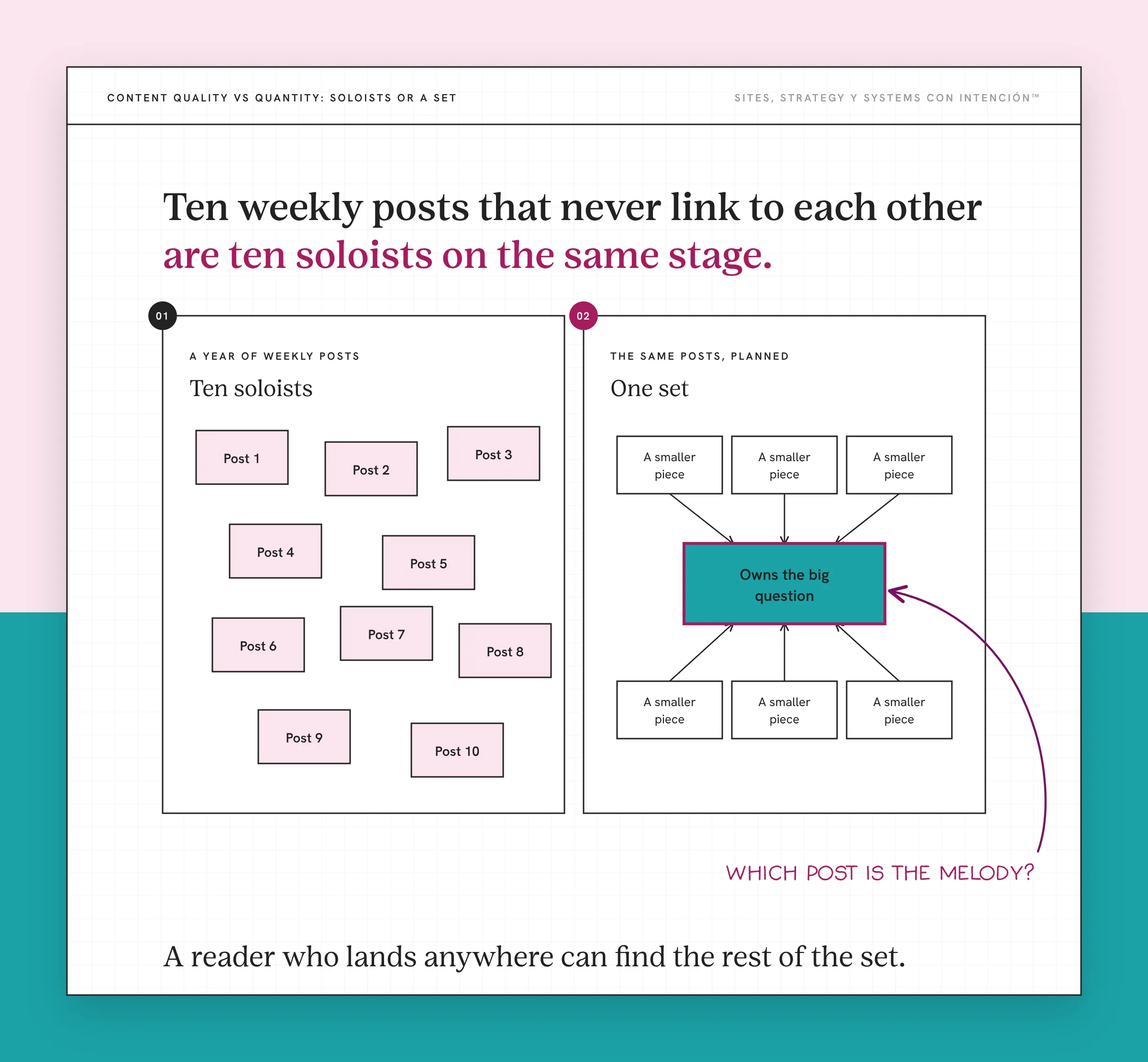
A blog builds authority the same way. One post owns the big question. The posts around it each take a smaller piece and link back to it. That way a reader who lands anywhere can find the rest of the set. Google sees the same thing: a site that's got the whole subject covered from more than one angle. That's what a content ecosystem built around one pillar does.
Ten weekly posts that never link to each other are ten soloists on the same stage. Each one might be good and the audience still can't tell what the song is. That's a lot of work to end up sounding like noise, ay bendito. Most of that's fixed with an internal linking strategy that ties posts together. It only works once you know which post is the melody.
What Else Keeps a Weekly Blog From Working?
Connection is the one I see first. Three more sit right behind it.
Topics nobody is searching for. A lot of weekly topics get picked because they're easy to write that week. It's a reflection, a recap or whatever came up on a client call. Those can be good reads. They just don't match anything a buyer types into Google, so they never reach anyone who isn't already following you. Google's guidance on creating helpful, people-first content asks a pointed question: are you publishing on "many different topics in hopes that some of it might perform well"? A weekly schedule with no plan behind it does exactly that. The "just stay consistent" advice skips that part entirely, ay fo. Start from the SEO basics a small business needs and pull your blog ideas from real buyer questions instead.
Posts that lead nowhere. A reader who finishes a post and finds no next step leaves. The post did its job, the reader liked it and nothing happened after. That gap is a big part of why some blog posts bring clients while others only bring traffic.
Nobody goes back. On a weekly schedule there's always a new post due, so the old ones never get touched. Eventually your best posts are sitting on old information. Meanwhile the newest one gets all the attention. Evergreen content only stays evergreen if someone comes back to it. Optimizing a blog post you already have often moves more than writing the next one.
What Happens When Your Posts Compete With Each Other?
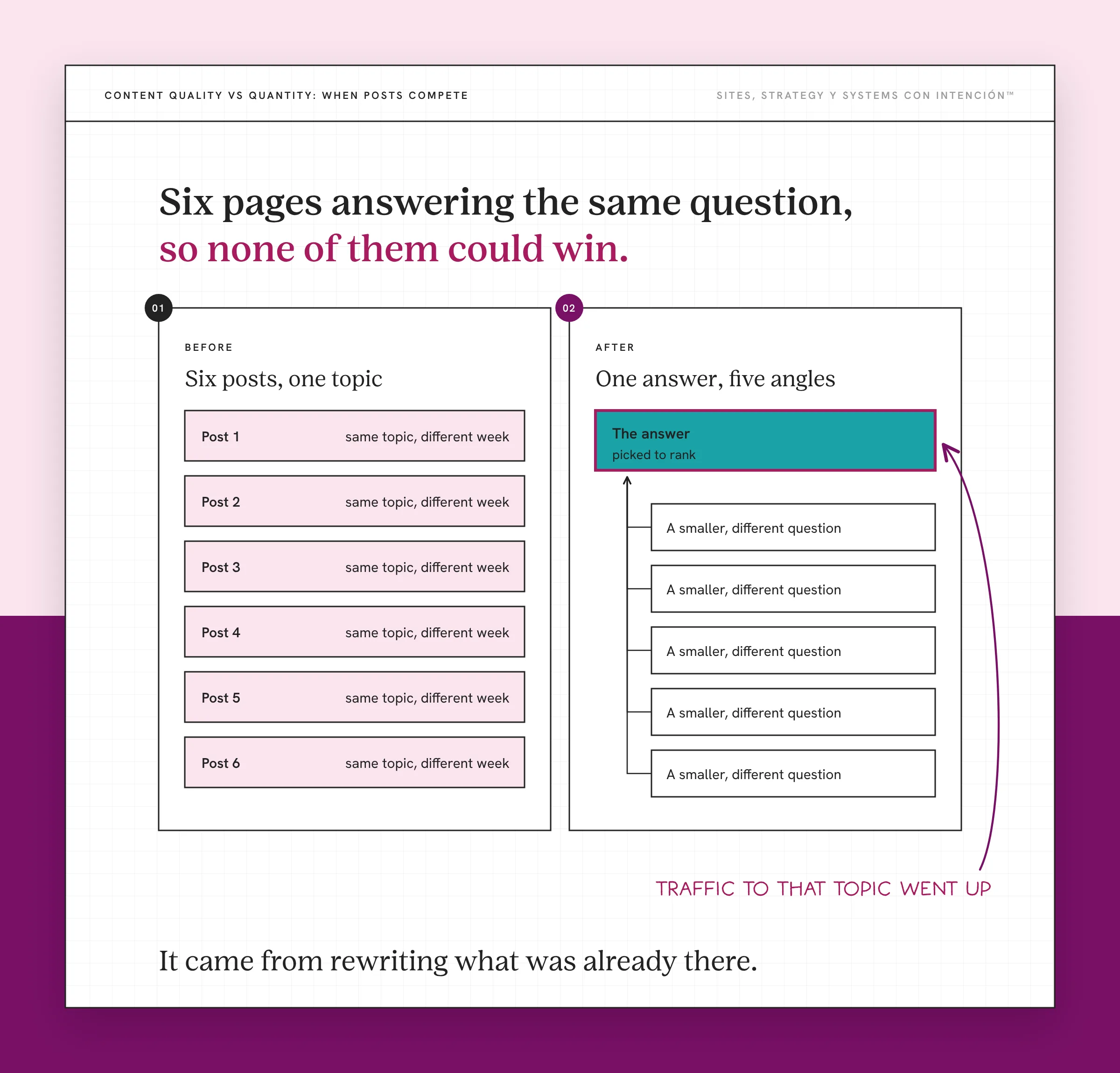
One service business I worked with had six or more posts going after the same topic. They weren't copies. Each one went up on a different week with a slightly different headline. That's exactly how it happens on a weekly schedule. Google saw six pages answering the same question, so none of them could win, diache.
We picked the one post with the best shot at ranking and made it the answer. The rest got re-angled: each one was rewritten to own a smaller, different question and link back to the main post. Traffic to that topic went up. I don't have a clean before-and-after number from that project and I won't invent one. The direction was clear, though. It came from rewriting what was already there.
It's the same reason repurposing content builds authority when every version owns its own angle and splits it when they all chase the same one.
Is Content Quality Just Word Count?
Adding length feels like the obvious next move when a blog isn't working. It hardly ever does what you'd hope.
Content quality is whether a post solves the problem the searcher came with. A short post that answers the question early and then shows how will outperform a long one that circles it. Format matters too. A question someone types deserves a direct answer near the top. A three-paragraph warm-up loses them before they get there.
When I measure content quality on a client blog, I check two things. Does the post get found for the question it's built around? Does the reader keep going to another page afterward? A post that does both is high-quality content at any length. Sometimes the honest answer is that the site needs more clarity before it needs more content.
Should You Prioritize Content Quality or Quantity?
You don't have to pick one. Weekly is fine if it's planned.
Planned means the topics come from a map before they land on a calendar. You decide the big question, then the smaller questions around it, then the order you'll publish them in. Built that way, a weekly schedule stacks every post on the last one. The work compounds instead of piling up.
If that sounds like starting over, it isn't, de verdad. The first thing I ask a founder in this spot is "Show me your last ten posts." Line them up. For each one, check whether it answers something a buyer actually types and whether it links to anything else. Then check where it sends the reader after the last paragraph. The posts that pass become the core of your map. The rest get updated, merged or re-angled before you write anything new.
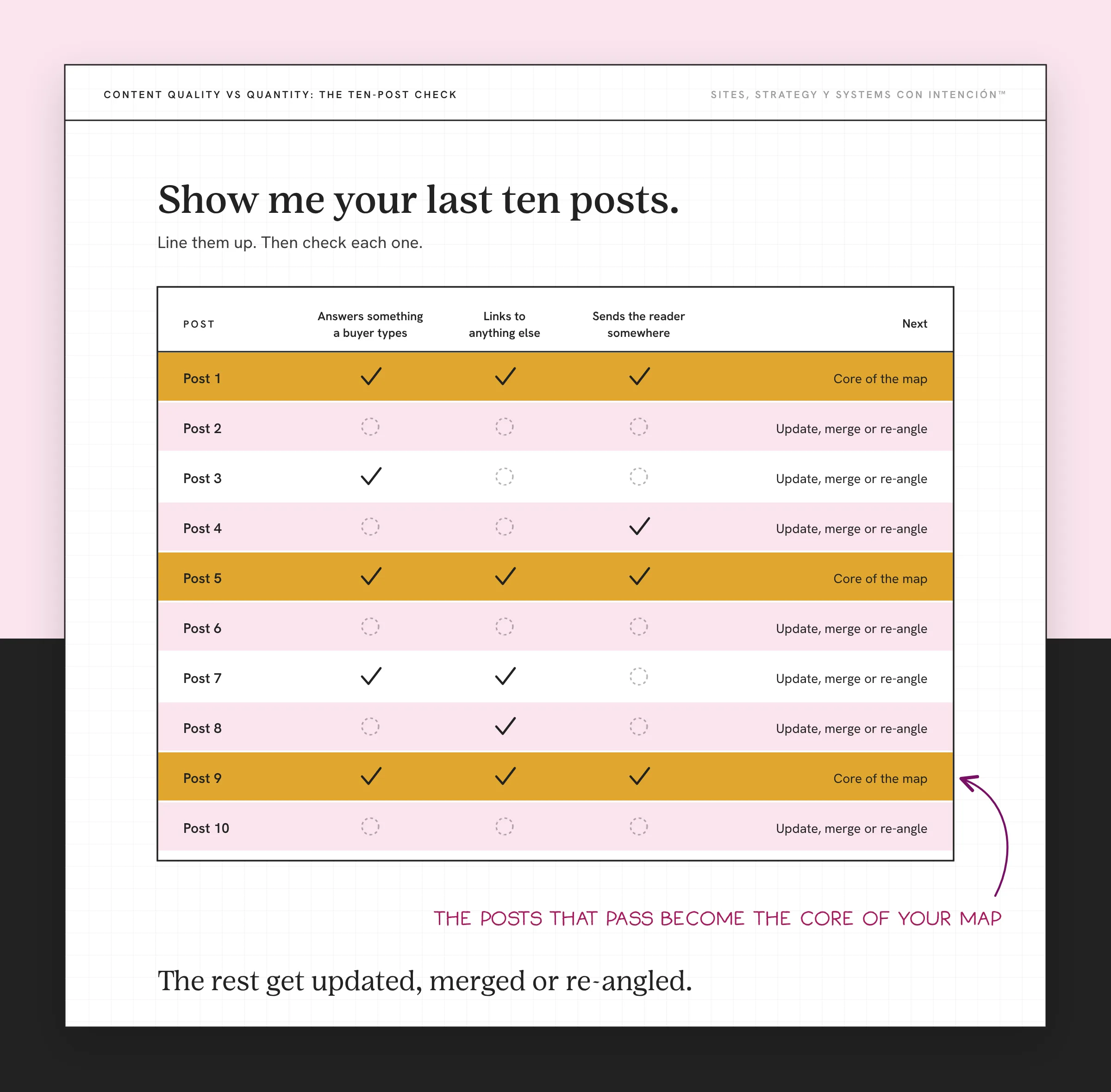
And if mapping topics feels like one more system to learn, that's worth noticing too. A stack of marketing frameworks can stall a content plan just as fast as no plan at all.
Key Takeaways
- In content quality vs quantity, quantity only builds authority when the posts connect to each other.
- Weekly posts stall for four reasons: they don't connect, they chase topics nobody searches, they lead nowhere and nobody goes back to them.
- Posts that compete for the same topic can keep every one of them from ranking.
- Content quality is whether a post solves the searcher's problem. Length is a separate question.
- Weekly publishing works when the topics come from a plan.
I've been posting for a year. Where do I even start?
A few questions about your site, your content and your backend. In about two minutes it shows you where the pressure is. Then you'll know whether to start with your posts or with what's underneath them.
If you'd rather get posts like this in your inbox, Off the Clock is my week-ish newsletter on sites, strategy y systems.
Frequently Asked Questions
Is quality more important than quantity in content?
For a service business blog, yes. That's assuming quality means the post answers a real search and connects to your other posts. Quantity helps only when each new post adds a piece the set was missing. Scattered posts do less than a smaller set that covers one subject from different angles and links together.
Can posting frequently hurt my SEO?
It can, when frequent posting leaves you with several posts on the same topic competing with each other. Thin posts written to hit a deadline don't help either. Neither do older posts that never get updated. If every post has its own question and links into the rest, a weekly or even faster pace is fine.
How do you measure content quality?
Start with two checks. Does the post get found for the question it was built around? Does the reader go on to another page after reading it? Search Console answers the first and your analytics answers the second. If a post passes both, it's doing its job. If it fails both, it needs a rewrite before you publish anything new.
How do you balance content quality and quantity?
Plan the topics before you set the schedule. Pick one big question your buyers have and list the smaller questions around it. Then publish them in an order where each post builds on the last. Then keep a standing slot for updating older posts. That way your weekly pace adds to a set instead of starting from zero every time.
Does publishing every week build authority?
It does when the posts work together. It's working when each post covers part of a subject you want to be known for and links to the others. A weekly schedule of unrelated topics mostly builds a long archive. What matters more than frequency is whether someone landing on one post can see the whole subject.
What does content quality mean?
Content quality means a post solves the problem the reader searched for, clearly and early. It answers the question, shows how and points you somewhere that's useful next. Length, polish and posting frequency don't decide it. A plain post that gets someone unstuck beats a long, beautiful one that never quite answers what they asked.
About the Author