You've bought the course, saved the template and tried to follow the method. Then another marketer shows up with a different approach and a convincing explanation of why this one works. Now you're wondering whether to start again.
There are plenty of useful marketing frameworks out there. I blame the internet, a pile of tactics and shiny object syndrome for how easy it is to keep looking for the magic answer. You can spend a lot of time learning other people's marketing strategies without deciding how to apply what you already know to your own business.
When someone is stuck here, I hear "Which framework is the right one?" "I bought the course and it's not working." "Do I need to use all of these?" "I just need the one thing that works."
A conversation with someone buying courses and trying different approaches is what prompted me to write about this. They were collecting things that had worked for other people. I wanted to talk about the underlying models and how to make them useful for the business in front of you.
I use frameworks in client marketing work. What matters is understanding the structure, choosing tactics that fit your buyer and having goals you can measure. Following someone's instructions perfectly won't tell you whether the work is helping.
The Short Answer
Marketing frameworks give you a structured way to organize decisions about buyers, messaging and the work you do. Use them to inform a strategy around your business goals, then adapt the tactics to your audience and resources. Review relevant results monthly so you can make informed decisions about what to continue or change.
If You're Reading This Because It's Your Site
Reading more isn't the hard part. La Jugada is $47 and it tells you which layer this is actually sitting in.
Get it, $47What Is a Marketing Framework Supposed to Help You Do?
A marketing framework gives you a structured approach to part of your marketing thinking. It might help you understand customer needs, plan a message or see how an experience continues after someone purchases.
Your strategy makes choices about who you're trying to reach, what you want to accomplish and how you'll approach that work. Tactics are the activities you choose to carry it out, such as publishing a useful article, running marketing campaigns or improving a follow-up email.
That distinction matters when you're evaluating another course. A model can help you ask better questions. A rigid prescription tells you exactly what to post without giving you enough context to adjust it.
The person in that conversation was trying approaches that had worked for someone else. That's the part I slow down and examine. Were the buyers similar? Were the goals the same? Could they explain why a particular activity belonged in their marketing plan?
It's a lot to sort through, bendito, when every new offer seems to promise the answer you've been missing. Before purchasing another one, look at what you already understand and where you're getting stuck applying it.
The basic models below help me think through marketing. You can learn from more than one without turning each into a separate set of tasks you have to complete.
Which Marketing Frameworks Can Help You Understand the Work?
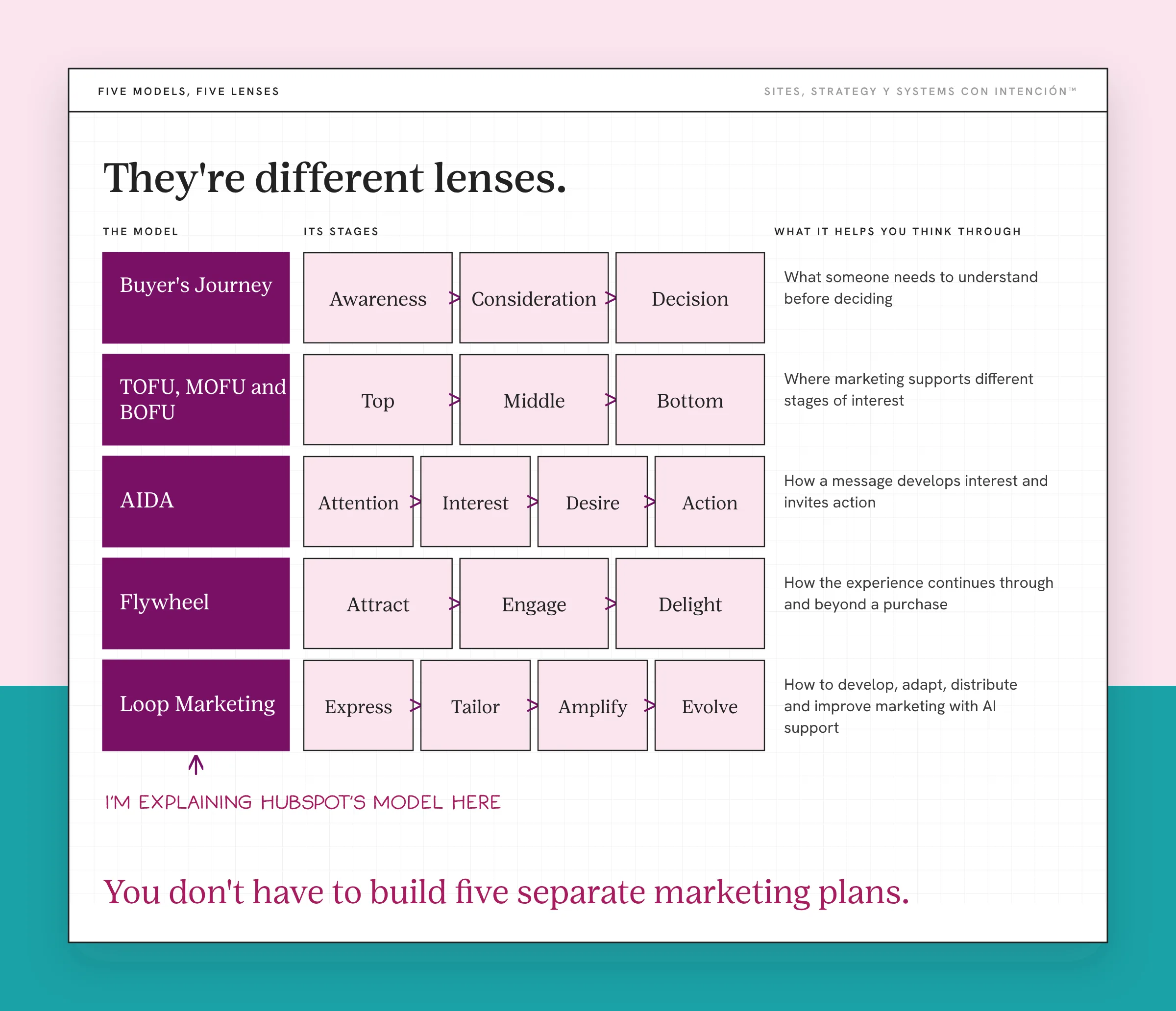
These five models help with related decisions, but they put the emphasis in different places. The buyer's journey helps explain the buyer's questions. A funnel helps organize marketing around those questions. AIDA helps with persuasion, while the flywheel brings the ongoing customer experience into view. Loop Marketing addresses how a team develops, distributes and improves its marketing with AI support.
What Does the Buyer's Journey Help You Understand?
The buyer's journey describes how someone moves from recognizing a problem to considering approaches and making a decision. HubSpot's buyer's journey guide explains these as awareness, consideration and decision.
For a service business, the questions might look like this:
- Awareness: Why does my website no longer reflect the work I do?
- Consideration: Would revising the copy help or do I need to rethink the structure?
- Decision: What does working with this provider involve?
Those are illustrative questions. Your market research and actual conversations will help you identify what your buyers need to understand.
A person who's still naming the problem needs a different explanation from someone comparing providers. That distinction gives you a reason to create different material instead of repeating the same sales message everywhere.
How Can TOFU, MOFU and BOFU Organize Your Marketing?
TOFU, MOFU and BOFU stand for top, middle and bottom of the funnel. People who've heard me talk about marketing have also heard me say these slightly ridiculous-sounding abbreviations. They give us a way to organize work around different stages of interest.
At the top, you're helping people find you and understand a relevant problem. In the middle, you're helping them explore approaches and evaluate fit. Near the bottom, you're answering the questions that help them decide whether to work with you.
An educational article, a comparison and a clear service page could support those different jobs. The medium alone doesn't determine the stage. A video could introduce a problem or explain what happens after booking.
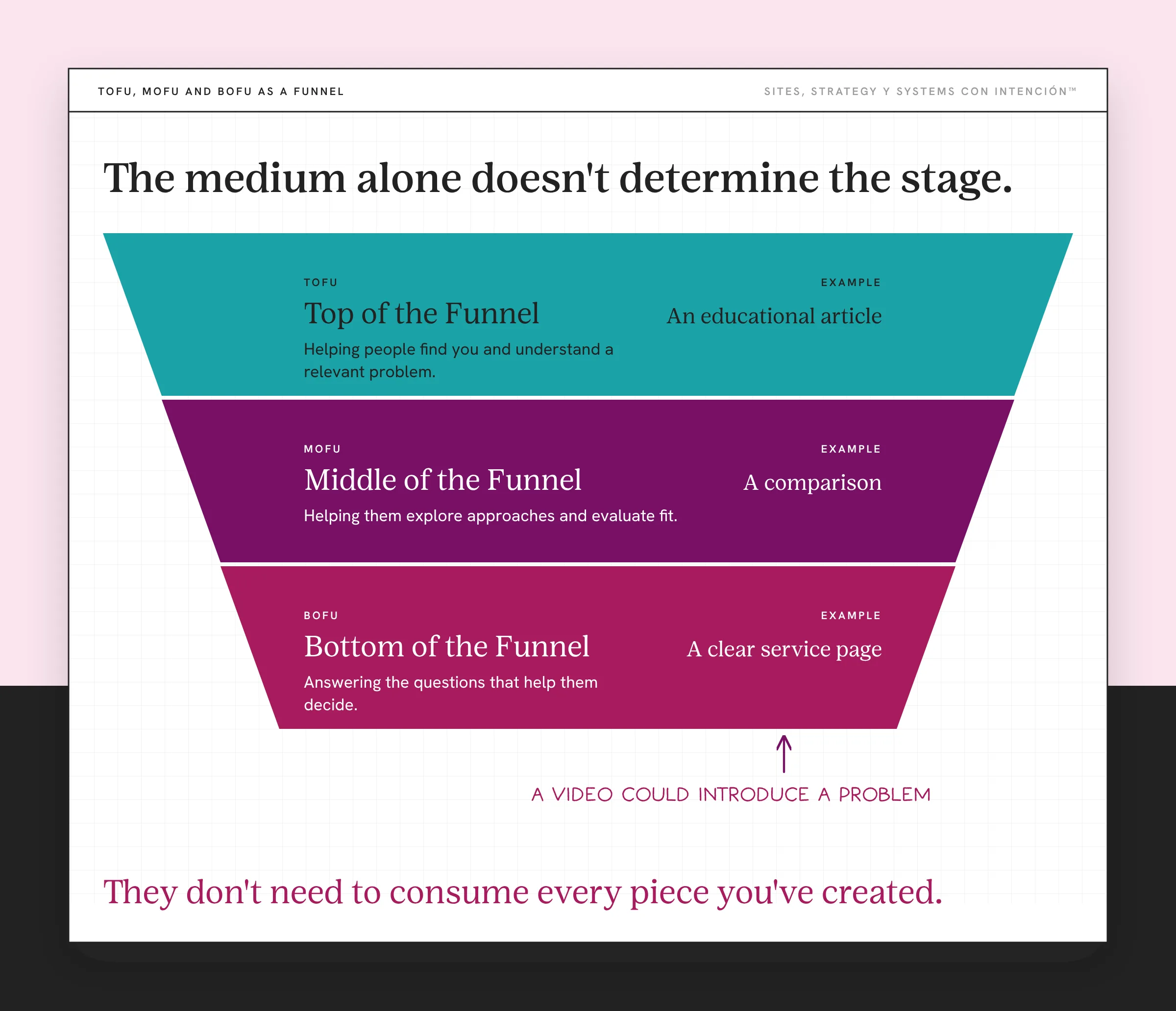
Use the funnel alongside what you know about the customer journey. Someone might arrive through a referral already familiar with the problem. They don't need to consume every piece you've created before they can inquire.
How Does AIDA Help You Shape a Message?
AIDA stands for Attention, Interest, Desire and Action. It gives you a way to think through how a message earns attention, develops relevance, makes an offer appealing and invites a next step.
For example, an illustrative email about a website review could begin with a problem the reader recognizes. It could explain why that problem matters, describe what the review helps them understand and invite them to read the details.
You'd still need to understand your target audience and how you position the product or service. AIDA won't supply your value proposition or tell you which claim you can support.
It can also help you look at where your call to action sits on your website. Getting someone interested and leaving them unsure what to do next gives them extra work.
What Does the Flywheel Add After the Purchase?
When I first learned about HubSpot's flywheel, my reaction was basically "duh." It made sense to keep the customer at the center and think beyond the purchase. I still used the other models, but this helped me consider more of the experience.
HubSpot's flywheel uses Attract, Engage and Delight. It asks you to consider how helpful experiences build momentum and how friction slows that down.
For a service business, onboarding, communication and support belong in that view. So do returning customers and referrals. Look at these touchpoints when you review the experience. Someone who's bought from you still has questions and expectations.
It can feel obvious once you see it, de verdad. Then you notice how much planning stopped at getting the inquiry or making the sale.
How Does HubSpot's Loop Marketing Work?
HubSpot's Loop Marketing is a framework for human and AI collaboration with four stages: Express, Tailor, Amplify and Evolve. In plain language, they cover defining your story, adapting your messaging, distributing it and improving the work through feedback.
HubSpot places brand and customer context at the start. Its approach uses AI to help adapt content, support distribution and analyze performance. That makes it a broader operating approach than a model for shaping a single message.
You can understand those principles before deciding which tools or processes belong in your business. The existence of a newer framework doesn't automatically give you a reason to replace everything you're already doing.
I'm explaining HubSpot's model here. The practical question for your own work is what you'd improve by applying it and whether you have the information and capacity to do that well.
How Do These Models Fit Together?
| Model | What It Helps You Think Through | A Service-Business Application |
|---|---|---|
| Buyer's journey | What someone needs to understand before deciding | Research questions that come up before an inquiry |
| TOFU/MOFU/BOFU | Where marketing supports different stages of interest | Organize educational, comparison and decision content |
| AIDA | How a message develops interest and invites action | Review the flow of a service-page message |
| Flywheel | How the experience continues through and beyond a purchase | Improve onboarding, follow-up and support |
| Loop Marketing | How to develop, adapt, distribute and improve marketing with AI support | Assess a campaign process and its feedback cycle |
These are applications to consider. You don't have to build five separate marketing plans. Understanding the differences between these marketing models helps you choose one that addresses the question you're working on.
How Do You Adapt Tactics to a Strategy That Works for You?
You have to remix tactics to create a strategy that works for you. That starts with your buyer, your offer and your business goals. Your choices also need to fit the wider business strategy: what you sell, whom you serve and how you deliver it. Then you can decide what activities belong together and what you can leave out.
If we're talking through this over cafecito, I want to know what you're trying to accomplish before I recommend another channel. A B2B consultant with a long buying process may need to answer different questions from a provider whose buyers already know the service they want.
One project I supported involved a multilingual lead-generation website. The work included quiz branching, personalized results, a searchable directory and segmented email follow-up. We aligned the design and follow-up with user behavior and conversion goals across the team.
Those tactics had jobs within the experience. Quiz answers informed what someone saw next. Content helped them explore their options. Email segmentation supported more relevant follow-up. Marketing automation helped connect that work.
That project illustrates how activities can connect around a buyer's needs. It doesn't tell you that your business needs a quiz, a directory or the same technology.
Before borrowing a tactic, work through these questions:
- What result are we working toward? Define the outcome you want the marketing to support.
- What does this buyer need? Use questions, behavior and research to identify what would help them.
- Why does this activity belong? Explain how it supports the outcome and what happens afterward.
- Can we maintain it? Account for your time, marketing budget and the work required to follow through.
You might combine content marketing with a useful email follow-up and a clearer service page. Another business might need different marketing channels because its buyers find information differently.
This is where it can get frustrating, mija. You're trying to follow the instructions and the business in front of you keeps needing decisions the instructions haven't addressed. Understanding the model gives you more room to make those decisions deliberately.
When you assess how your existing content builds authority, look at what it helps people understand and where it leads them. Adding another activity should serve a purpose you can explain.
What Should You Measure Each Month?
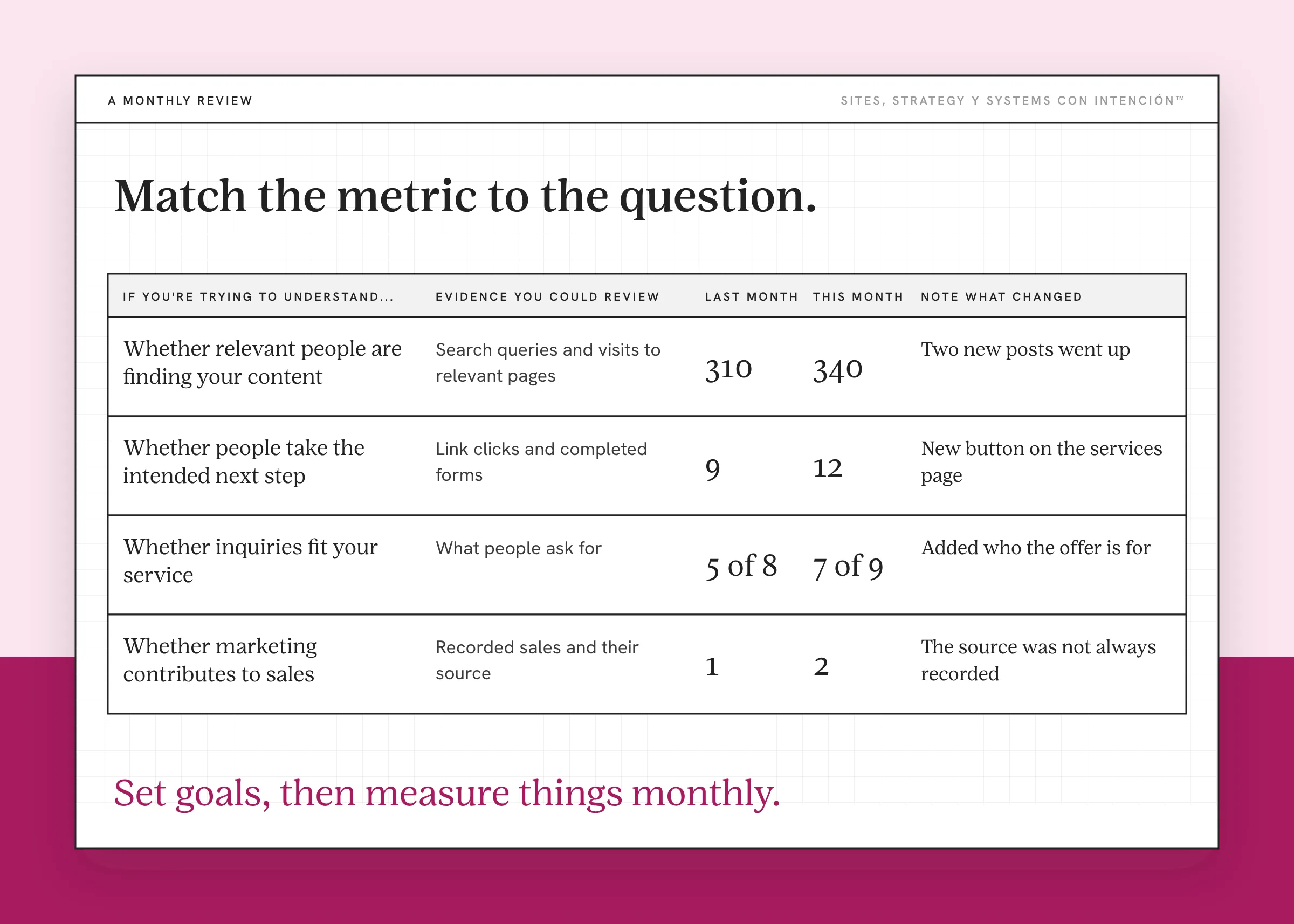
Set goals, then measure things monthly. What you track depends on what you're trying to do and which marketing activities you're using.
For a regional tourism business, the goal was 20% revenue growth. I led ongoing web and SEO strategy, oversaw monthly performance audits and keyword research and worked on aligning paid search, content and organic activity.
The wider team effort included $95,000 in revenue attributed to blog content. That figure describes reported revenue from the program; it isn't a one-month result. It shows why I want to connect content activity to the business outcome we're working toward.
The goal, the marketing efforts and the review belonged together. A list of posts published wouldn't have told us enough about progress toward a revenue objective.
For your monthly review, match the metric to the question:
| If You're Trying To Understand... | Evidence You Could Review |
|---|---|
| Whether relevant people are finding your content | Search queries, visits to relevant pages and traffic sources |
| Whether people are taking the intended next step | Relevant link clicks, completed forms or bookings |
| Whether inquiries fit your service | What people ask for and whether their needs match the offer |
| Whether marketing contributes to sales | Recorded sales and source information, with attribution limits stated |
These are examples of key performance indicators and supporting evidence. Choose the ones that relate to your marketing goals. More activity or more attention can be useful information without being the outcome you wanted.
Review the numbers alongside what you're hearing from people. Note what changed, what you're still unsure about and what you'll investigate next.
A promising response can be exciting, wepa, especially after you've been putting in the work. Keep enough context to understand what produced it before changing several more things.
Measuring monthly gives you a regular opportunity to learn. It doesn't mean every activity will produce a reliable answer within a month. You may need more time, better tracking or a smaller question before deciding what to change.
Before buying another framework, look at your existing marketing strategies and the work you've built around them. Can you explain the goal? Do the tactics support it? Can you see enough of what happened to make the next decision? A framework only earns its place inside a content strategy when you can answer those.
Those questions give you somewhere useful to begin. Pick a part of the marketing you can evaluate, understand what it's doing for your buyer and adjust the work based on what you learn.
Key Takeaways
- Marketing frameworks help organize decisions; applying them still requires knowledge of your buyer and goals.
- The buyer's journey, funnel, AIDA, flywheel and Loop Marketing emphasize different parts of the work.
- Remix tactics around the strategy your business needs and skip adopting every activity in a purchased method.
- Review relevant results monthly, with measures tied to your goals and enough time to interpret them responsibly.
I've tried the frameworks. Where do I even start with mine?
La Digital Rueda takes about two minutes and it's free. Answer a few questions about your site, your content and your backend and it shows you where the pressure is.
Frequently Asked Questions
What's the difference between a marketing framework and a strategy?
A framework organizes your thinking about a marketing problem or decision. Your strategy makes choices about the audience, goals and approach for your particular business. Tactics put those choices into practice. A framework can help you develop or examine the strategy, but you'll still need information about your buyers, your offer and the resources available to carry it out.
Can you use more than one marketing framework?
Yes. Different models can help with different questions. The buyer's journey can inform what someone needs to understand, while AIDA helps you consider how a message develops interest and invites action. Use them where they clarify the work. Adding another model should help you make a decision and not create a duplicate set of activities to manage.
Does every business need to use all five models?
You don't need to apply all five as separate processes. Start with the decision you're trying to make and consider which model helps you examine it. Understanding several can be useful, but the work should stay proportionate to your business. A small team can draw on the principles without adopting every tool or process described by a framework's publisher.
How do you choose which marketing metrics to track?
Begin with the outcome you're working toward and the activities intended to support it. Then choose measures that help you evaluate those activities and their connection to the outcome. Review the numbers alongside inquiries, sales information and buyer feedback where relevant. Be clear about what the evidence can establish and what remains uncertain, particularly when attributing a sale to a particular activity.
Should you switch frameworks when results are disappointing?
First examine the goal, the application and the information you're reviewing. Check whether the tactics fit your buyer, whether the next step is clear and whether you've had enough relevant activity to assess. You may need to adjust an execution choice or improve measurement. Changing the model before understanding what happened can leave you with the same unanswered questions.
About the Author