
You've got one main offer. The one that pays the bills, the one you'd sell all day if people would just book it. You also have a blog, maybe a podcast, definitely an Instagram. And somehow almost none of it sends anyone to the offer.
It's not because you aren't creating. You're creating constantly. The posts are good and people even tell you they're good. Then they go back to scrolling and the offer page sits there with its same four visitors a week.
After 12+ years and 100+ sites worked on, I see the same three mistakes in this spot over and over. Every one of them has a fix that doesn't involve making more content.
The Short Answer
A content strategy for one offer treats every post, episode and caption as a different angle on the same thing you sell. Each piece answers a question a buyer asks on the way to that offer, names it and links to it. The offer stays the same. The angles keep changing.
If You're Reading This Because It's Your Site
Reading more isn't the hard part. La Jugada is $47 and it tells you which layer this is actually sitting in.
Get it, $47Why Doesn't Your Content Sell Your One Offer?
Three mistakes do most of the damage and in my experience, founders in this spot are usually making at least two of them.
You write about everything. Productivity tips one week, a client win the next, then something about mindset because it was on your mind. Each one is fine. Together they tell a reader you're interesting and say nothing about what you sell, qué cosa. Your content wanders away from the offer one reasonable topic at a time.
Your content never names the offer. This one's the most common and the most painful, ay, Dios mío. A post explains a problem your offer solves, explains it well and then ends. No mention of the offer, no link, no next step. The reader understood the problem perfectly and had no idea you sell the fix.
Every post hits the offer from the same angle. The founders who do mention their offer often mention it the same way every time. Same pain point, same promise, same call to action. By the fourth post, readers have seen it and they scroll past it the way you scroll past an ad you've seen twelve times.
Content Marketing Institute's Robert Rose put it plainly years ago: content strategy and content marketing are two very different practices. The founders I talk to with one offer are usually doing plenty of content marketing. What's missing is the strategy that decides what all that content is for.
What Are the Angles Around One Offer?
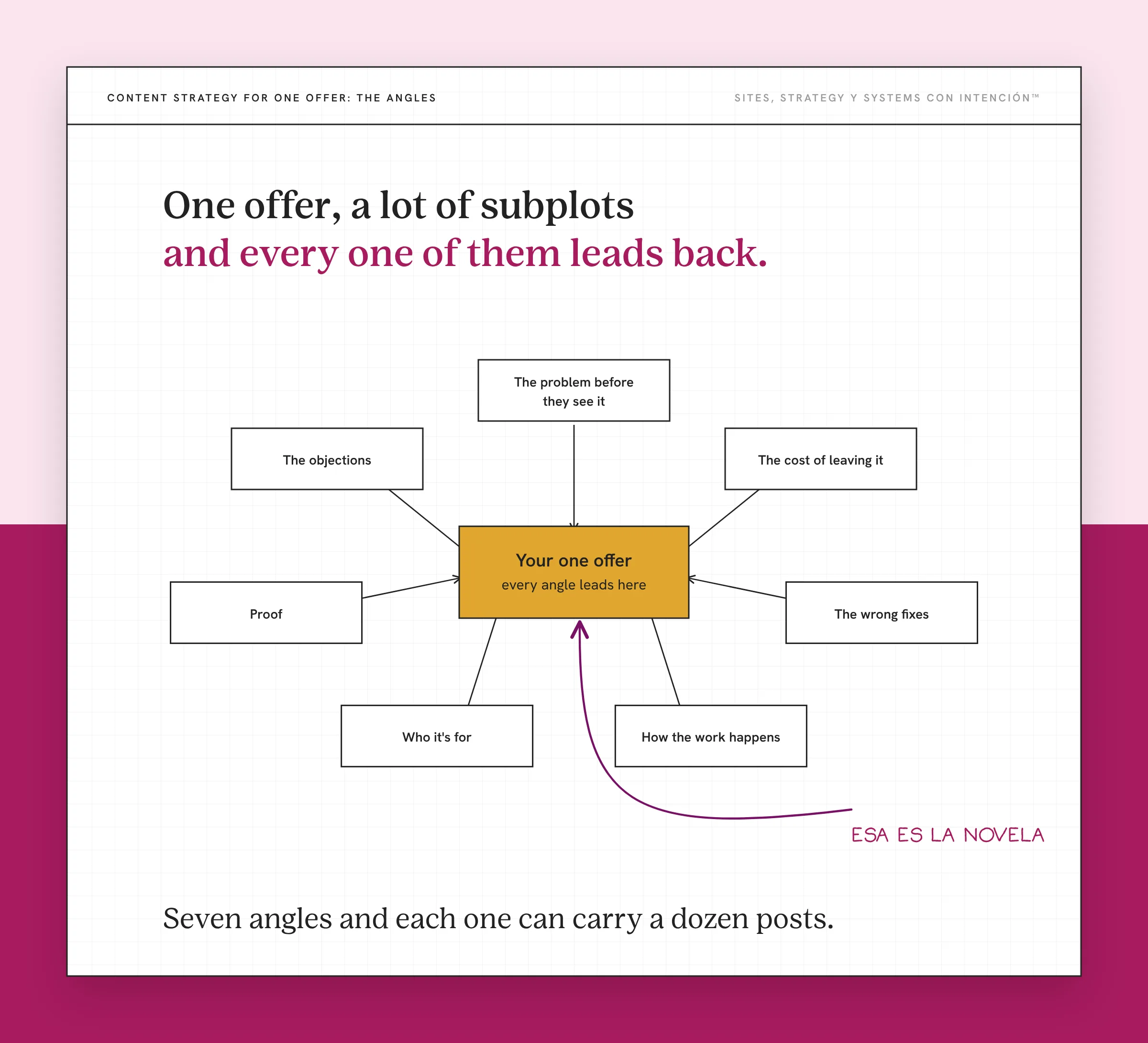
Jane the Virgin ran for five seasons on a premise you could explain in one sentence. It still had an evil twin, a crime lord, a telenovela star's entire career arc and more love triangles than anyone could count. Every single subplot fed back into Jane's story. Esa es la novela. The narrator made sure you never forgot whose story it was.
That's the move, mija. One offer, a lot of subplots and every one of them leads back.
Here are the angles that work around almost any service offer:
- The problem before they know it's a problem. What's happening in their business that they've normalized?
- The cost of leaving it. What does it cost them in time, money or clients to keep going the way they are?
- The wrong fixes. What have they already tried that didn't hold? Why didn't it?
- How the work happens. What does working with you look like, step by step?
- Who it's for and who it isn't for. Who should book and who should wait?
- Proof. What changed for someone who already did it?
- The objections. Price, timing, "I can do it myself." Each one gets its own piece.
Seven angles and each one can carry a dozen posts. That's a year of content about one offer that never repeats itself. If you've already got a content ecosystem built from what you already have, this is the list that tells you which pieces of it belong to the offer.
How Do You Map Content to What Buyers Ask Before They Buy?
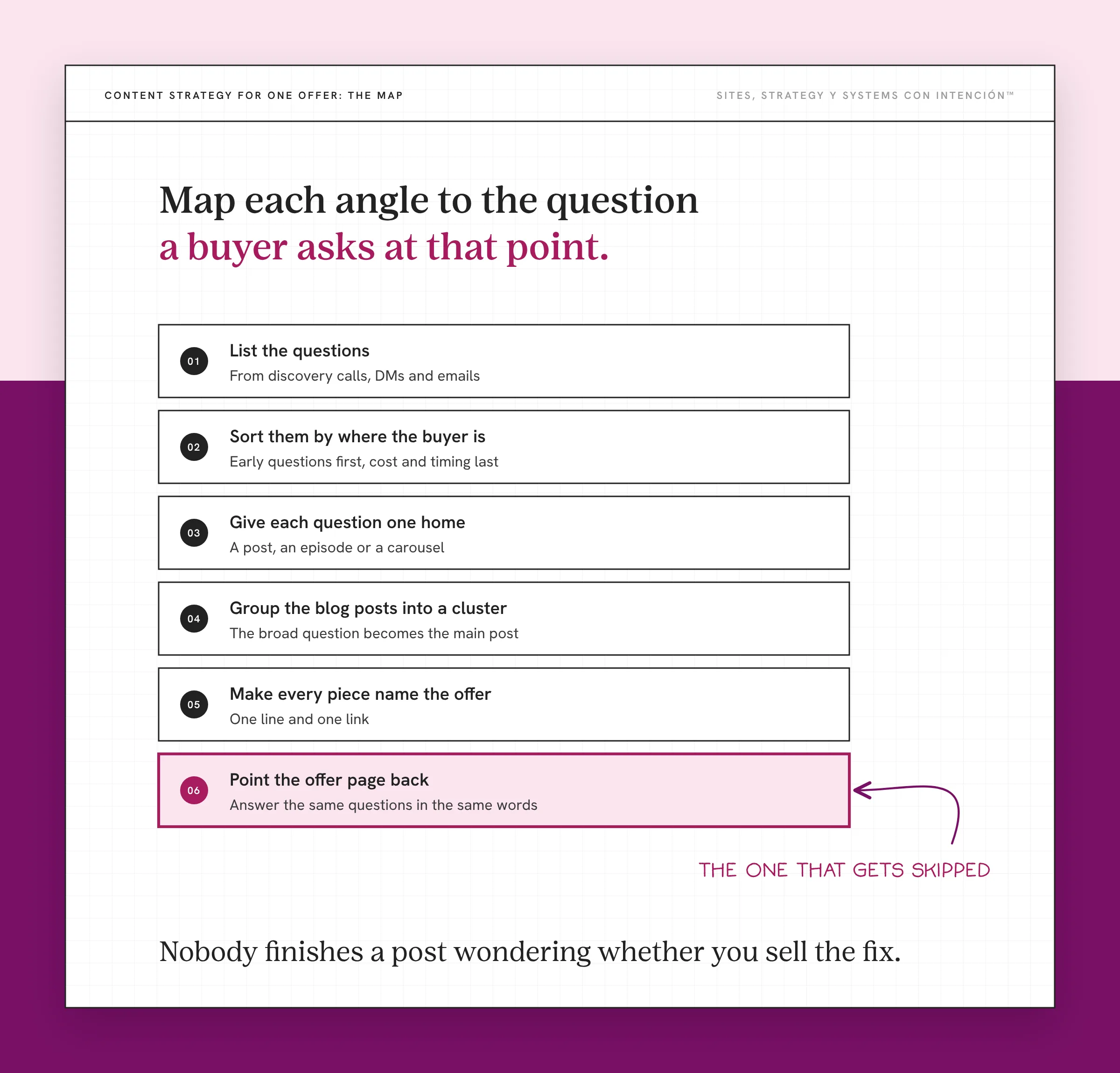
Map each angle to the question a buyer asks at that point, then decide where it lives and where it sends people.
- List the questions. Pull them from discovery calls, DMs and the emails people send before they book. The questions your buyers already ask are your topic list.
- Sort them by where the buyer is. Early questions sound like "why does this keep happening?" Later ones sound like "how long does this take?" and "what does it cost?"
- Give each question one home. A blog post for the ones people search. A podcast episode or an Instagram carousel for the ones that need a story. One question per piece, so nothing competes, which matters more than how often you post. That's the trap that keeps weekly posting from building authority.
- Group the blog posts into a cluster. The broad question about your offer becomes the main post and the smaller ones link back to it. A topic cluster is the shape this takes on your site.
- Make every piece name the offer. Pa' que nobody finishes a post wondering whether you sell the fix. One line that says what the offer is, one link to the page.
- Point the offer page back. The services page should answer the same questions your content answers, in the same words.
That last step is the one that gets skipped and it's the one that makes the whole map work.
What Happened When One Client Linked Their Content to Their Offers?
A client of mine had plenty of content. Blog posts, a podcast, a steady Instagram. The content was good and none of it connected to what they sold.
We went through it piece by piece and linked each one to the offer it was about. A post on one problem pointed to the service that fixes that problem. An episode that told a client story pointed to the offer that client had bought. Then we went back to the site and rewrote the offer pages so the copy matched the content: the same language, the same problems, the same way of explaining them.

More inquiries came in and they came in warmer. People showed up already knowing what the offer was, why it existed and that it was for them. Qué alivio for everyone on those calls. The calls stopped starting from zero, which is the whole point of content that brings people in while your site closes the sale.
Nothing new got created for that, ojo. Everything they needed had already been published. It just wasn't pointing anywhere.
How Do You Keep It From Getting Repetitive?
This is the fear that keeps a lot of founders from naming their offer more often. It's a fair one. Nobody wants to be the person who turns every caption into a pitch, ni loca.
Rotate the angle, keep the offer. Monday's post is about the cost of leaving the problem alone. Next week's is about a fix that didn't hold. The week after is a client story. The offer is in all three and none of them sounds like the others.
Vary how loudly you name it. Some pieces end with a direct invitation. Some mention the offer once, in passing, because it's the natural next step. Some just link it where it fits. A reader who's seen it ten different ways doesn't feel sold to. They feel like you know what you're talking about.
Let the formats do different jobs. A blog post can answer a searched question in depth. A podcast episode can tell the story with the details left in. A carousel can take one angle and make it scannable. Repurposing one post across formats works best when each format gets its own angle.
Write from new questions, con ganas. When it feels repetitive, it's usually because you've stopped listening for new questions. Every discovery call hands you a few. Write them down the same day.
The founders who sell one offer well say the same true thing from a different seat every week, so readers keep finding a reason to step closer. That's what a marketing framework you actually stick with is supposed to give you.
Key Takeaways
- A content strategy for one offer treats every piece of content as a different angle on the same thing you sell.
- The three mistakes: writing about everything, never naming the offer and hitting it from the same angle every time.
- Map each piece to a question buyers ask, give each question one home and make every piece name and link to the offer.
- Rewrite your offer page so it answers the same questions your content does.
- Keep it fresh by rotating the angle, varying how loudly you name the offer and letting each format do its own job.
I sell one thing. How do I write about it without repeating myself?
Bring your site, your content and whatever's bugging you. In one private session we'll map the angles around your offer and what to write first. Notes included.
Off the Clock is my newsletter for founders who'd rather build something that keeps working than keep posting into the void.
Frequently Asked Questions
How do I create a content strategy that attracts clients for one offer?
Start with the questions people ask before they buy, from calls, DMs and emails. Sort them from early to late, give each one a single piece of content and make every piece name the offer and link to it. Then update your offer page so it answers those same questions. The strategy is the map from each question to the offer.
Won't talking about one offer all the time get boring?
Only if every piece says it the same way. Rotate the angle: the problem, the cost of leaving it, the fixes that didn't work, how the work happens, proof and objections. Each angle can carry many posts. Readers tune out a pitch they've already seen. An offer that keeps showing up in a new, useful context keeps their attention.
How often should my content mention my offer?
Every piece should name it at least once and link to it where it fits. That doesn't mean every piece ends in a hard pitch. Some end with a direct invitation, some mention the offer as the natural next step and some link it in the middle. What matters is that nobody finishes reading without knowing what you sell.
Should my blog only be about my offer?
Mostly, yes, if you sell one main offer. Every post should connect to a question someone asks on the way to buying it. That still leaves room for a wide range of topics, because the problems, objections and stories around one offer run deep. Posts that don't connect at all are the ones that bring traffic and no clients.
What's the difference between content strategy and content marketing?
Content marketing is making and publishing content. Content strategy decides what that content is for: which questions it answers, who it's for, which offer it leads to and in what order it goes out. Many founders with one offer are doing plenty of content marketing with no strategy behind it, which is why the content doesn't sell.
What content formats work best for one offer?
The ones your buyers already use. Blog posts answer questions people search. Podcast episodes and videos carry stories with the detail left in. Instagram carousels make one angle easy to scan. Pick formats you can keep up with and give each one a different angle on the offer so nothing repeats.
Save This One for Later
Pin it to your own board so you can find it when you're ready to fix it.
Save to PinterestAbout the Author