You hear that your business needs better copy. Then you hear that you need a content marketing strategy. Which is what and what is which? Meanwhile, you've got a page to finish and something to send to your email list. The copywriting vs content marketing conversation has given you two labels and you're still trying to figure out what to do with either one. Qué lío.
For a service business, that confusion shows up in practical decisions. What do people need to hear from you? What belongs on a landing page? Is the newsletter supposed to sell something every time you send it? And when someone asks me "Is my blog post copywriting?" I know the two labels have already blurred.
Across 100+ sites worked on over 12+ years, the first thing I want to know before telling you which kind of help to get is what you already have. Do you even have a website? Who are you trying to reach? What do they understand about the problem already? Those answers shape both the content you create and the copy you write.
The Short Answer
Copywriting is persuasive writing that helps someone take an action. Content marketing is the strategic work of creating and sharing useful content to attract and keep an audience while supporting business goals. They work together: content can help someone understand a problem, while copywriting gives a relevant next step a clear invitation.
If You're Reading This Because It's Your Site
Reading more isn't the hard part. La Jugada is $47 and it tells you which layer this is actually sitting in.
Get it, $47What's the Difference Between Copywriting and Content Marketing?
Copywriting gives written communication a persuasive job. It helps someone understand why a service fits their situation, decide to get a resource or take the next step on a sales page. The action can be small. You don't have to be asking someone to buy something for the writing to involve persuasion.
You can see that job in landing pages, service descriptions, sales emails and the words beside a signup form. On your website, copy that helps someone decide needs to make the value clear enough that they can choose whether to continue. The American Marketing Association's content marketing resources include a copywriting bootcamp built around driving action with emotive copy and explaining technical product details in accessible ways.
Content marketing includes the decisions behind useful material, its creation and how it reaches people. You work out who needs the information, which questions matter to them, what to make and where to share it. The material can include blog content, video, infographics, social media posts or a newsletter.
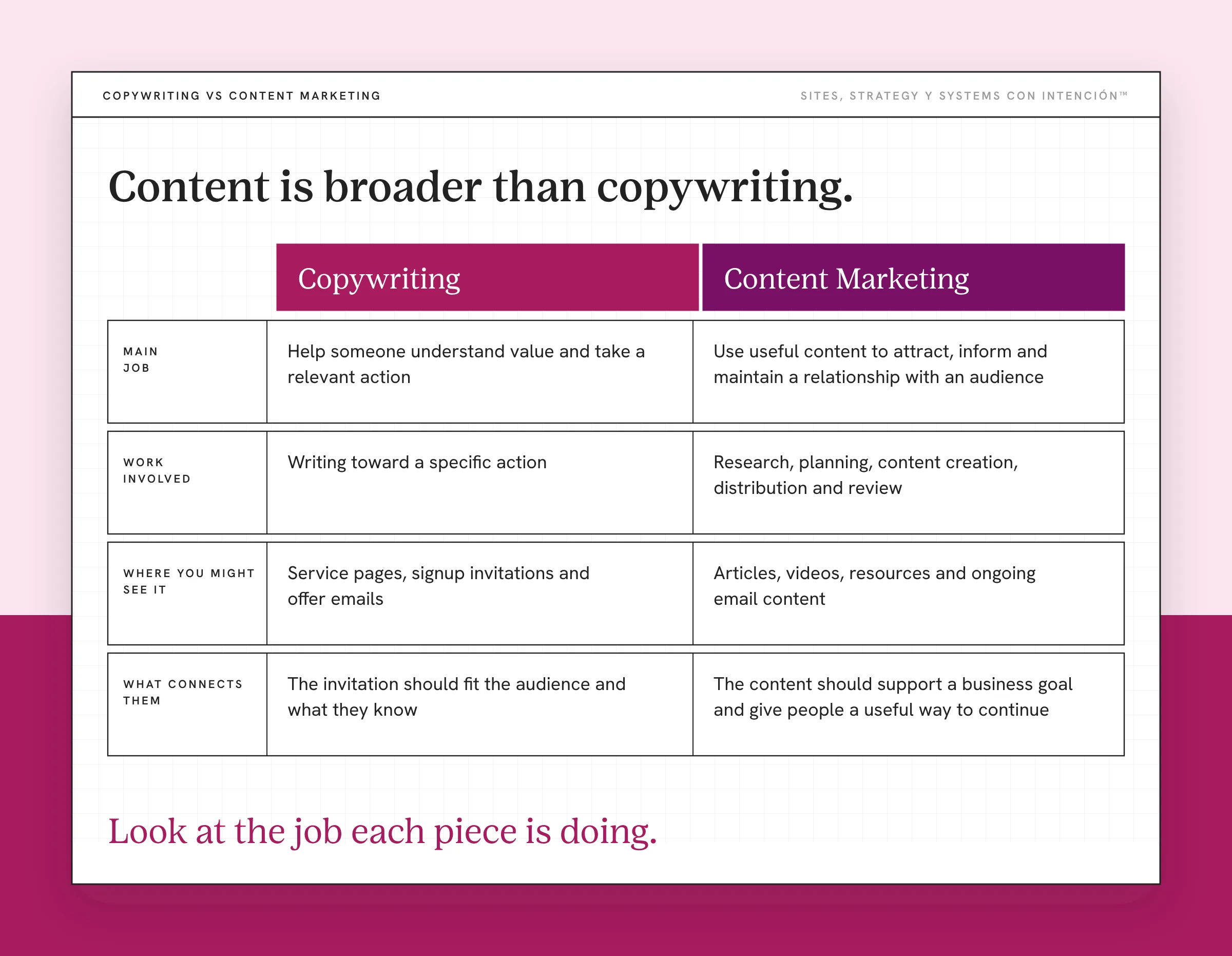
The Content Marketing Institute's definition connects creating and distributing valuable content with attracting and retaining a clearly defined audience and ultimately driving profitable customer action. There is a business purpose behind the helpful material.
That matters because content is broader than copywriting. A video explaining how you approach a recurring client problem is content. Planning that video around a question your audience needs answered and deciding how to distribute it is content marketing. Writing a clear invitation to explore your service can bring copywriting into that same piece.
Calling every written thing copywriting makes its particular job harder to see. But treating every piece of content as a sales pitch can be exhausting for the people receiving it, bendito. Sometimes they need an explanation before an invitation makes any sense.
| Copywriting | Content Marketing | |
|---|---|---|
| Main job | Help someone understand value and take a relevant action | Use useful content to attract, inform and maintain a relationship with an audience |
| Work involved | Writing toward a specific action | Research, planning, content creation, distribution and review |
| Where you might see it | Service pages, signup invitations and offer emails | Articles, videos, resources and ongoing email content |
| What connects them | The invitation should fit the audience and what they know | The content should support a business goal and give people a useful way to continue |
How Do Copywriting and Content Marketing Work Together?
Think about a Mets fan following player stories, game breakdowns and behind-the-scenes videos between games. Choosing and sharing useful material for that fan is content marketing.
The ticket page has a more immediate job. It needs to help you understand what's on offer and decide whether to go. The headline, offer description and invitation to buy are copywriting.
You might come for a player interview and end up wanting to see that team in person. Maybe you're already checking which game you can get to, con ganas. The ticket page gives that interest somewhere to go.
The two can also appear together. A useful team update might include an invitation to get the next one in your inbox. There's content serving the fan and copywriting explaining why signing up is worthwhile.
For an illustrative service-business example, say you help businesses organize their operations. You could publish an article answering a question potential clients ask about handing work over to a team.
Choosing that question, developing a useful answer and deciding where to share it are content marketing decisions. An invitation within the article to download a related handoff checklist needs copywriting: what does the checklist help with, who is it for and why would someone want it?
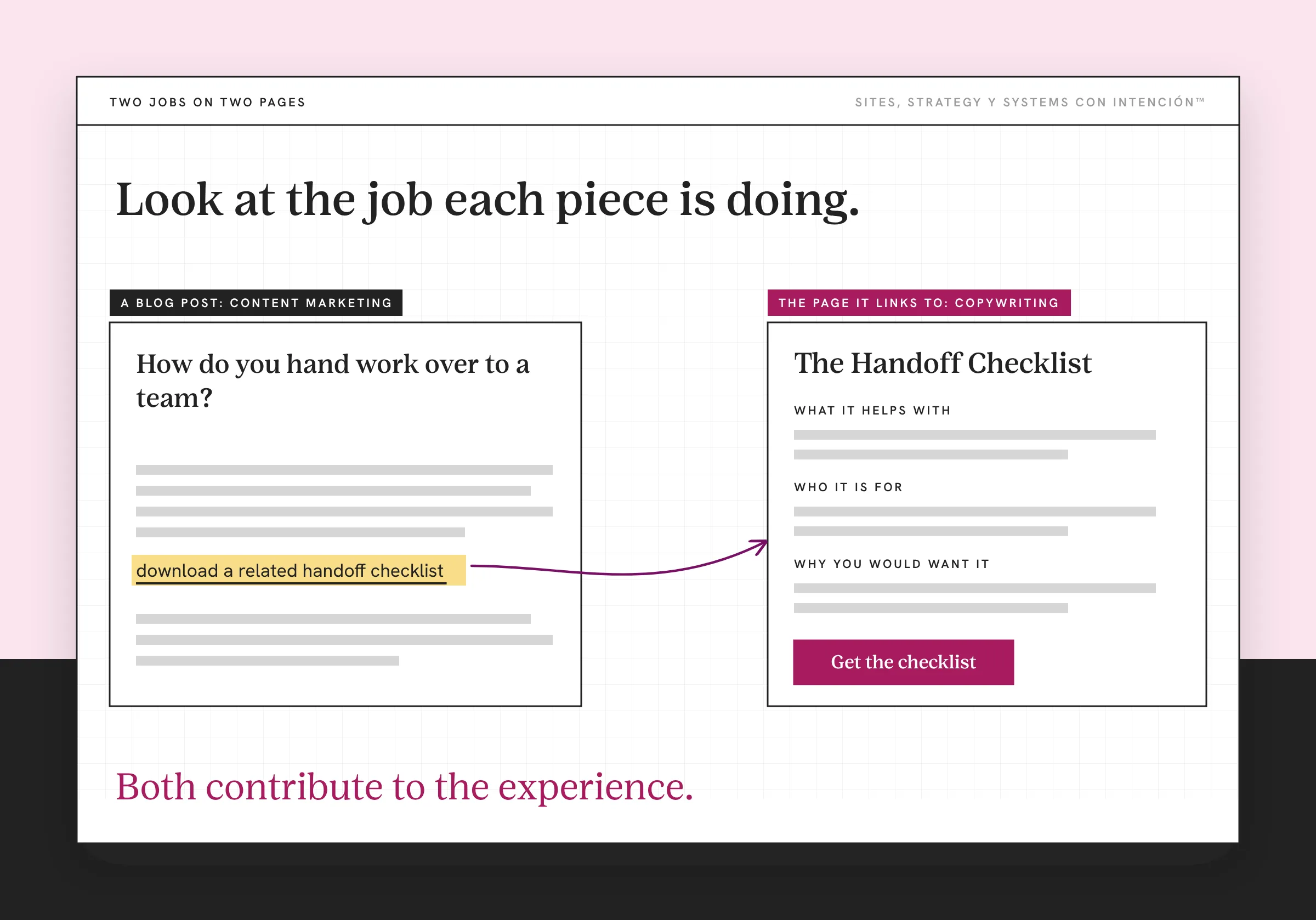
The article still needs to deliver on the question that brought someone there. The invitation still needs to be relevant to what they've read. Both contribute to the experience.
This is why I'm careful with the idea that content marketing only educates and copywriting only sells. Someone can decide to work with you because an article demonstrates how you think. A call to action can invite them to read more before they're ready to inquire.
Look at the job each piece is doing and the decision inside it. The format alone won't tell you everything.
What Needs to Be Clear Before You Start Either One?
My first question is about what exists already. A business with a website, a clear offer and an active email list has different material to work with from one that needs its first landing page.

But even a single page needs some decisions made before the writing starts. You need to know who it's for, what they're aware of and what you want that page to do.
You don't get to skip those decisions because the deliverable is short, mija. A headline has fewer words than a blog. It still needs to say something that matters to the person reading it.
I look at these inputs before deciding what to write:
- The target audience. Who needs this product or service? What are they trying to do? A useful buyer persona gives you something more specific than an industry and a job title.
- Their awareness. Are they just noticing the problem, exploring approaches or comparing providers? What can you reasonably assume they know?
- The goal. What should this piece contribute to the business? Getting someone onto an email list is a different immediate task from helping them inquire about a service.
- The surrounding conversation. Look at what competitors explain and the promises they make. Identify questions you could answer with more useful detail or a different perspective.
That last part is market research. Looking at the competition should give you context for your own choices. You still have to decide what you believe, what you can substantiate and what your audience needs from you.
It's tempting to open another competitor's site when you can't find the words. Then you've got their headline, their offer and their assumptions in your head. Ay, no. Come back to your own audience before you start sounding like a business you didn't build.
These inputs belong to both kinds of work. A good copywriter needs to understand the reader. Someone planning content needs that understanding too. The decisions that come before website copy are part of getting the writing pointed in the right direction.
How Can You Tell What Your Business Needs Next?
Start with something that's already in front of you: a page, an article idea or the next email you need to send. Name who it's for and what it should help them understand or do.
If you can't explain why that piece belongs in your marketing, work on the plan. What question does it answer? Where will the intended audience find it? How does it connect to the work you sell?
If those answers are clear, look at the writing. Does the reader understand the value? Does the invitation explain what happens next? Is it obvious who the offer is useful for?
Those questions can help you define a brief for a copywriter or content marketer. They also help if you're doing the work yourself. You can ask for a more specific result than making something sound better.
For example, a checklist signup page needs to explain what someone gets and why it's relevant. A set of articles needs a reason for those topics to exist together. Writing a stronger signup invitation and deciding what useful material to publish are connected tasks with different immediate jobs.
You may need work on both. That doesn't mean you need to rebuild everything, de verdad. Identify the decision that's missing in the piece you're reviewing and start there.
There are also other reasons a page may struggle. A broken form or a confusing route to the service needs attention alongside the writing. The order information appears on your site shapes what a visitor can understand before they reach the ask. Copy can't fix every part of the user experience on its own.
What Should You Take From This Comparison?
Knowing the difference should help you give your content and copy clearer jobs. It shouldn't leave you with two competing to-do lists. That split is where good content strategy starts.
Look at one thing you're planning to publish. Decide what the audience needs from it and how that supports your business. Then look at the words that invite them to continue. They should follow from the useful work the piece has already done.
That gives you a starting point for creating it yourself or explaining what you need to someone you're hiring. You're making decisions about the work before asking the writing to carry them.
Key Takeaways
- The copywriting vs content marketing distinction is about different, connected jobs: persuasive writing and the strategic use of useful content.
- Both depend on understanding the audience, their awareness and the business goal.
- Content can take many forms and can include copywriting within it.
- A relevant invitation to act should fit the information someone has just received.
- Clarify the purpose of an existing page or piece before deciding what kind of help to get.
Do I need better copy or more content? Where do I start?
Take La Digital Rueda first. It's free and takes about two minutes. It asks a few questions about your site, your content and your backend and shows you where the pressure is.
Frequently Asked Questions
Is copywriting vs content writing the same comparison?
They're related comparisons with different scope. Content writing describes producing written material, such as an article. A content writer may work within a broader plan that also includes video, distribution and measurement. Copywriting shapes words around an action. Content marketing is the broader strategic practice. A single piece can involve content writing and copywriting, so these are overlapping kinds of work.
Can one person do copywriting and content marketing?
Yes, one person can do both, but ask what their work includes. A copywriter might research your audience and write a landing page without planning your ongoing content. A content writer might produce articles from a supplied brief without developing the marketing strategy. Confirm who owns research, planning, writing, distribution and review. The job title alone doesn't tell you which decisions or deliverables are covered.
Does all content need a call to action?
Start with the purpose of the piece and where it appears. A useful next step might be another article, a resource or an invitation to inquire. The ask should fit what someone has just learned and what they're ready for. A CTA can help them continue without asking them to buy immediately. Avoid adding an unrelated sales invitation just because there's room at the end.
Is copywriting only for sales pages?
No. Persuasive copy can appear wherever you're helping someone decide to take an action. That can include an email signup, a resource download or an invitation inside helpful content. The action and the information needed to support it will vary. A sales page has room to explain an offer; a button needs to name the next step. Both need a clear connection to what the reader wants to do.
Which one matters more for SEO?
Neither wins. SEO and content work both need to serve the question someone's searching and the page they land on. Useful articles can answer those questions. Clear copy can help visitors understand a relevant next step. A strong headline doesn't guarantee search visibility and neither does a pile of articles. Decide what the page needs to deliver before you choose how to improve it.
About the Author